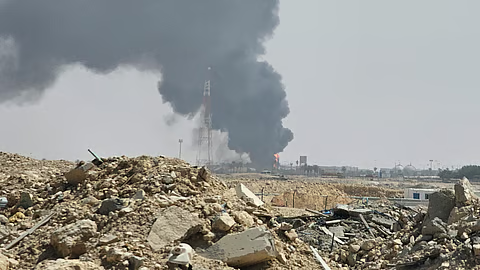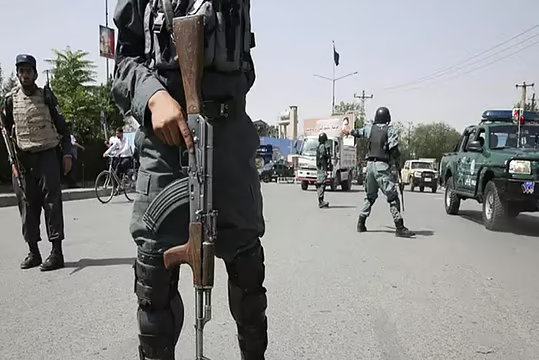
US military leaving Iraq is now official, with American and Iraqi officials confirming on Tuesday that all U.S. forces will withdraw by the end of September. The announcement brings a formal close to a 23-year presence that began with the 2003 invasion to topple Saddam Hussein and gradually narrowed into smaller operations against the Islamic State group.
A Joint Announcement at the White House
The news came directly from the top. Standing alongside Iraqi Prime Minister Ali al-Zaidi at the White House, President Donald Trump said the United States no longer sees a need for a military presence in Iraq, pointing to the country’s expanding relationships with oil companies.
Trump framed the shift as part of a broader partnership rather than a retreat. He explained that the relationship had grown into something far larger than military cooperation, adding that American forces were there to help and to protect Iraq if necessary, but that such protection no longer appeared essential.
Al-Zaidi, speaking through an interpreter, confirmed the timeline clearly. He said U.S. forces would be out of Iraq by September 30, while American companies would remain active inside the country, underscoring the pivot from military engagement to economic ties.
Reaffirming a Prior Agreement
The withdrawal isn’t a sudden reversal but the culmination of a plan already in motion. The Pentagon issued a statement reaffirming a 2024 agreement with Iraq to end the U.S. mission against IS fighters. That deal, struck during the Biden administration, had already led many American troops to depart.
For years, the United States has been steadily shifting the responsibility for fighting IS from American and coalition forces to Iraqi troops trained by the U.S. military. American forces have gradually shrunk their footprint, pulling out of certain areas and consolidating what remained.
Looking Back: How It Began
The story of the U.S. military in Iraq stretches back more than two decades. In March 2003, the United States launched a massive “shock and awe” bombing campaign that lit up the skies and devastated large parts of the country, clearing the way for American ground troops to advance on Baghdad.
The invasion rested on claims that Saddam Hussein had secretly hidden weapons of mass destruction. Those weapons were never found, a fact that would come to define much of the controversy surrounding the war.
The Rise and Fall of Troop Levels
The scale of the American commitment fluctuated dramatically over the years:
- At the peak of counterinsurgency operations in 2007, the U.S. presence swelled to more than 170,000 troops.
- The Obama administration negotiated a drawdown, and in December 2011, the final combat troops left, leaving only a small security assistance office and a Marine detachment to guard the embassy.
- In 2014, the rapid rise of the Islamic State group across Iraq and Syria prompted U.S. and partner forces to return at the Iraqi government’s invitation, helping rebuild and retrain shattered military and police units.
After IS lost control of the territory it once held, coalition military operations formally ended in 2021. Since then, the U.S. had maintained roughly 2,500 troops in Iraq for training and joint counter-IS operations with Iraqi forces. Following the 2024 agreement, many of those troops departed, leaving only a small contingent of military advisers and support personnel still in the country.
The End of an Era
The upcoming September withdrawal marks the final chapter of one of the most consequential and contentious military engagements in modern American history. What began as a full-scale invasion built on flawed intelligence has evolved into a partnership increasingly defined by commerce rather than combat. As the last U.S. forces prepare to leave, Iraq and the United States appear ready to redefine their relationship around oil, business, and diplomacy, closing a long and complicated military chapter while opening a new economic one.
Author