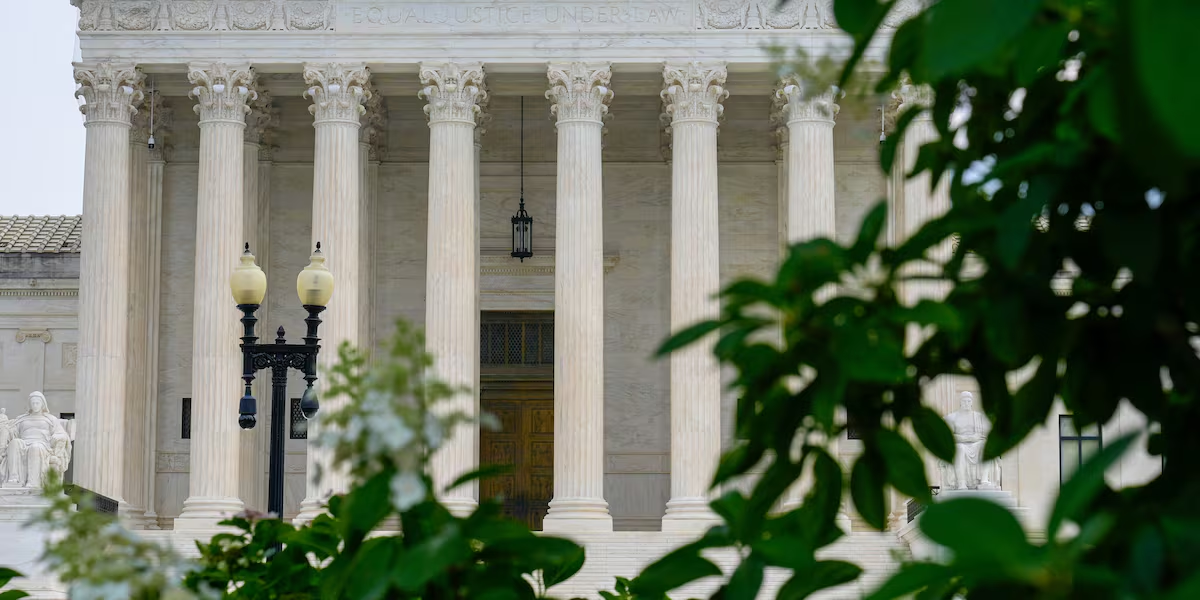
The Supreme Court mail-in voting ruling issued Monday hands the Trump administration a significant procedural win, allowing it to begin enforcing a revised set of restrictions on how mail ballots are distributed just months before voters head to the polls in November.
The justices split 6-3. Their order lifted an injunction that had frozen the policy across 23 states, all of which had gone to court to challenge it. The administration appealed that block in July, and Monday’s decision unwinds it.
What Changes Right Away
The most concrete effect is operational rather than sweeping. With the injunction gone, the U.S. Postal Service can now cross-reference the mail ballots it distributes against a citizenship roster compiled by the Department of Homeland Security.
Both the Postal Service and the Justice Department signaled they would move immediately, saying the revised mail-ballot procedures would be put into effect without delay.
Beyond the logistics, the timing carries obvious political weight. The administration has spent considerable effort arguing that heavy reliance on mail voting leaves the system open to tampering and fraud, and this ruling arrives with the midterm calendar already underway.
Inside the Executive Order
The underlying directive, titled “Preserving and protecting the integrity of American elections,” took a two-part approach. It instructed federal agencies to assemble voter-eligibility lists organized around citizenship status, then told the Postal Service to send mail-in ballots only to individuals whose names appeared on those approved lists.
The order grounds its reasoning in existing federal statutes. It points to provisions of U.S. law that already bar foreign nationals from registering or casting ballots in federal contests, and argues that states have not adequately verified citizenship on their own. It further contends that the Justice Department has not devoted sufficient attention or resources to enforcing those prohibitions in recent years.
Supporters view the measure as closing a verification gap. Critics read it very differently.
The Legal Argument That Decided the Case
Opponents framed the order as Washington reaching into territory the Constitution leaves largely to the states, since elections are administered at the state and local level. That was the core of the challenge brought by the 23 states.
The Court did not resolve that broader constitutional question. Instead, it focused on a narrower and more technical issue: whether the challenging states had legal standing to sue in the first place.
The majority concluded they did not. As the Court framed it, the provision at issue instructs the Secretary of Homeland Security to create and distribute state citizenship lists, and that instruction functions as an internal command from a president to an official who works under him. Because the directive places no obligations on the states themselves, the majority reasoned, those states cannot point to any concrete injury. Absent concrete harm, there is no standing, and without standing, the lawsuit cannot proceed.
In short, the majority treated the order as something that governs how federal agencies behave, not something that rewrites the rules states must follow.
Justices Sonia Sotomayor, Elena Kagan and Ketanji Brown Jackson dissented.
A Ruling With Deliberate Limits
One detail is easy to overlook but matters considerably. The Court was explicit that its decision addresses only the injunction that had been blocking implementation. It does not endorse the executive order as lawful, and it does not settle whether the policy will ultimately survive scrutiny.
That leaves the door open. Additional legal challenges are still possible, and the substantive questions about federal authority over election administration remain unanswered. What changed Monday is that the policy can operate while those questions work their way through the courts, rather than sitting on hold.
The Political Backdrop
The ruling lands amid an ongoing push from Trump and many allies to scale back mail voting. He recently criticized what he described as an unusually large volume of mail ballots in the 2026 Los Angeles mayoral primary involving Nithya Raman.
Speaking to Fox News, Trump argued that California has effectively moved away from in-person voting booths in favor of mail, and said he did not believe a Republican could win there without passage of the SAVE America Act, Republican-backed legislation that would tighten mail-voting rules and strengthen voter identification requirements. He went further, saying mail-in voting would have to be eliminated.
His complaint echoed a pattern that has drawn conservative attention in several recent races: results that shift after election night as later-counted mail ballots, which have skewed Democratic in many jurisdictions, are added to the totals.
It is worth noting the reporting caveat attached to that claim. No specific instance of election fraud connected to the Los Angeles mayoral race has been verified.
Why the Mail-Ballot Debate Keeps Returning
The disagreement tends to turn on a handful of recurring points:
Timing of results. Mail ballots are frequently counted after in-person votes, which can produce visible swings in the days following an election. Supporters call this normal processing; skeptics call it grounds for suspicion.
Verification methods. Signature matching, deadline rules and eligibility checks vary widely from state to state, which fuels arguments on both sides about consistency.
Federal versus state authority. Elections are administered locally, but federal law does set certain baseline requirements. Where one ends and the other begins is precisely what future litigation over this order is likely to test.
Access considerations. Advocates for mail voting emphasize turnout among rural voters, older voters, people with disabilities and those working inflexible hours.
What Happens Next
For now, the practical situation is straightforward. The Postal Service may screen ballot distribution against the DHS citizenship list, and the states that sued have lost their injunction.
The larger fight is not finished. Because the Court ruled on standing rather than substance, opponents may return with different plaintiffs, different theories of harm, or claims that arise once the policy is actually in operation and its effects can be documented.
This remains a developing story, and further updates are expected as implementation begins.
Author