





Fact Check: Viral Photo of Couple at Mecca Does Not Show Executed Bangladeshi Nationals
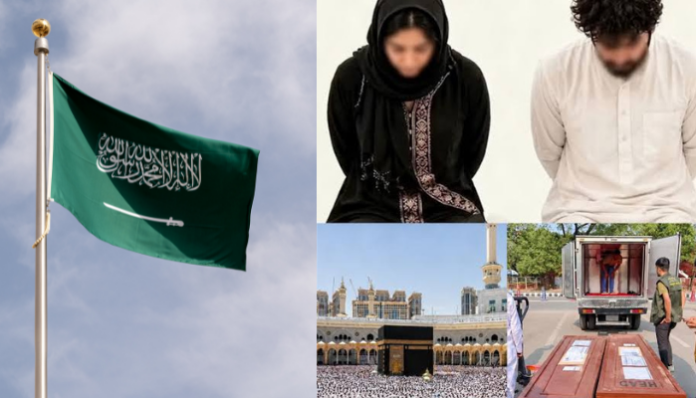
Bangladeshi couple executed Saudi Arabia is the phrase driving a storm of posts across social media this week, and most of them are built on a lie. An image of a man and woman standing together at the Masjid al-Haram in Mecca is being passed around with a dramatic caption claiming it shows a newlywed pair from Bangladesh who were put to death for an intimate gesture inside Islam’s holiest mosque.
The photo is real. The people in it, however, are not who the posts say they are. They are an Egyptian couple with no connection to the case at all.
The Claim That Went Viral
The posts, amplified by prominent accounts including Supreme Court lawyer Shashank Shekhar Jha, follow a familiar script designed to provoke outrage. They name the pair as Nazrul Islam Abdul Basir and Siri Akhtar, describe them as recently married, and assert that the husband was executed simply because he kissed his pregnant wife’s belly while inside the mosque.
Attached to this story is a tender image of a couple in the courtyard of the Grand Mosque, which gives the narrative an emotional punch that text alone could never achieve. It is exactly the kind of content that spreads fast: shocking, visual and seemingly confirmed by a photograph.
What Actually Happened
There is a kernel of truth buried under the distortion. Saudi authorities did execute two Bangladeshi nationals, one man and one woman. That much has been confirmed by multiple sources, including an official statement from the Kingdom.
Everything else in the viral posts falls apart on inspection.
The Photo Shows Someone Else Entirely
The image at the centre of the claim depicts an Egyptian couple visiting Mecca. It has nothing to do with the executed individuals, and whoever first attached it to the story either did not check or did not care. Reusing unrelated photographs to lend credibility to false narratives is one of the oldest tricks in online misinformation, and it works precisely because few people stop to ask where a picture came from.
They Were Not a Married Couple
Reporting by Bangladeshi outlet Jago News 24 adds a crucial detail. Journalists there reached the father of the executed man, who stated clearly that the woman was not his son’s wife and that the family had never known her. The “newlywed couple” framing, which forms the emotional core of the viral story, is simply untrue.
The Names Are Slightly Off
Even the identities in the posts are garbled. The Saudi Press Agency, the Kingdom’s official channel for government communication, published a release dated 14 October 2026 identifying the two as Nadhir Al Islam Abdul Basir and Siti Akhtar. The viral version renders these as Nazrul Islam Abdul Basir and Siri Akhtar, small changes that nonetheless show the information was not drawn from the primary source.
What the Official Statement Says
The SPA release confirms that the two Bangladeshi citizens were sentenced to death after being found to have committed an “indecent act” inside a mosque in the holy city. That is the full extent of the official description.
Critically, the statement does not say what the act was. There is no mention of a kiss, a pregnancy or any specific gesture. The claim that the man was punished merely for kissing his wife’s stomach appears to have been invented to make the story more shocking and to cast the punishment as grotesquely disproportionate.
A BBC report on the executions likewise confirms that the two were put to death but offers no detail about their relationship or the nature of the offence. Any post that claims to know exactly what happened inside the mosque is filling in gaps with fiction.
Why This Matters
Misinformation of this kind causes real harm on several fronts.
It misrepresents the people in the photograph, who are private individuals now wrongly identified with a criminal case.
It spreads false information about a sensitive legal and religious matter, inflaming tensions between communities and countries.
It distorts public understanding of what Saudi authorities actually said, replacing a vague official statement with a vivid but fabricated account.
The involvement of high-profile figures makes the problem worse. When a lawyer with a large following shares an unverified claim, it gains a veneer of authority that encourages ordinary users to accept it without question.
How to Spot This Kind of False Claim
A few simple habits can help readers avoid being misled by similar stories in future.
Check whether the photo has been used elsewhere. A reverse image search often reveals the true origin of a picture within seconds.
Look for the primary source. In this case, the Saudi Press Agency release was publicly available and contradicted key parts of the viral story.
Be suspicious of extreme emotional framing. Claims that seem engineered to provoke fury are frequently exaggerated or false.
Notice inconsistencies in names and details. Misspellings and altered facts are common signs that a story has been passed through many hands without verification.
The Verdict
The executions of two Bangladeshi nationals in Saudi Arabia did take place, and the Kingdom has acknowledged them. But the widely shared photo does not show those individuals, the pair were not a married couple, and no official source has described the offence as a kiss on a pregnant woman’s belly.
The viral claim mixes a real event with an unrelated image and invented details. Readers who encounter it should treat it as false and avoid sharing it further.
Author