In the frozen waters off Antarctica, a small activist vessel sailed straight into a Norwegian fishing ship this week — and depending on who you ask, it was either a deliberate attack that nearly caused an environmental disaster, or a brave act of direct intervention against an industry stripping the ocean of one of its most essential species. Both sides have video. Both sides have lawyers. And the Southern Ocean is, once again, a battleground.
What Actually Happened Out There
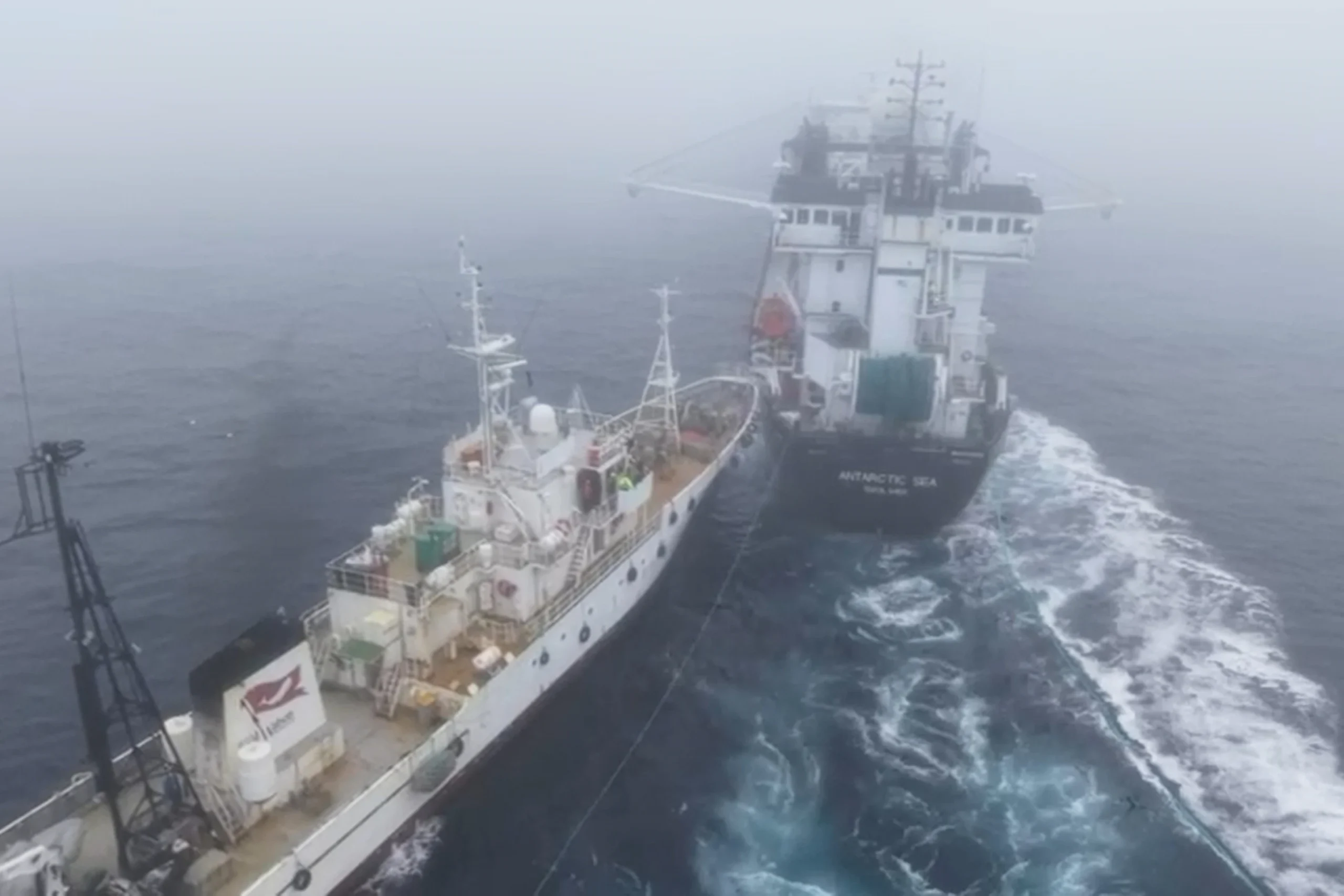
On Tuesday, the M/V Bandero — operated by the Captain Paul Watson Foundation — steamed toward the stern of the Norwegian-flagged Antarctic Sea, a krill fishing vessel owned by Aker QRILL Co., and struck its port side at a slight angle. Aker provided a two-minute video of the moment to the Associated Press, showing the Bandero slowly but deliberately closing in before impact.
Aker says the Bandero came within centimeters of rupturing a diesel tank on the Antarctic Sea. In some of the most remote and ecologically sensitive waters on the planet — home to multiple whale species, seals, seabirds, and the krill they all depend on — that near-miss could have triggered a catastrophic spill.
“Our crew were put at risk in some of the most remote waters on Earth, and only luck avoided potential environmental damage.”
— Webjørn Barstad, CEO of Aker QRILL Co.
The company said its multinational crew was shaken but physically unharmed, and confirmed it would pursue every available legal avenue. The Watson Foundation, for its part, called it an accidental collision and described its broader campaign as a five-hour direct intervention that successfully halted all krill fishing operations. The crew also deployed large metal net-shredding devices designed to disrupt the trawlers’ equipment.
The Battle Over Antarctic Krill — Why This Fight Matters So Much
This collision didn’t happen in a vacuum. It’s the latest and most dramatic flashpoint in a deepening conflict over Antarctic krill — the tiny, shrimp-like crustacean that underpins virtually everything alive in the Southern Ocean. Krill is the primary food source for whales, seals, and penguins. It also plays a significant role in absorbing carbon and buffering global warming. And it’s increasingly in demand for use in health supplements, fishmeal, and aquaculture products.
Krill fishing in Antarctica hit a record high last season, triggering an early closure of the fishery for the first time ever. Aker QRILL Co. is the world’s largest krill harvester, responsible for more than half the global catch. The Watson Foundation argues that this level of extraction is pulling food directly out of the mouths of the wildlife the Southern Ocean is supposed to protect.
“Krill are a foundational species, serving as the primary food for most marine life. Without krill, the entire food chain would collapse.”
— Captain Paul Watson Foundation statement
Who Is Paul Watson — and Why Does His Name Still Carry So Much Weight?
Watson himself was not aboard the Bandero during Tuesday’s incident. But his shadow looms over every moment of it. The Canadian-American activist founded the Sea Shepherd conservation movement in the 1970s and spent decades building a reputation for confrontational, high-seas direct action — including ramming vessels, a tactic that made him both celebrated and deeply controversial.
He was detained in Greenland for five months in 2024 on a Japanese warrant related to a 2010 incident involving an encounter with a vessel Japan described as a whaling research ship. Denmark ultimately rejected the warrant, and Interpol removed its most-wanted designation for Watson last year. Watson has long maintained the legal battles against him are politically motivated.
His influence has split the broader ocean conservation movement. Sea Shepherd Global and its 20 national affiliates have moved toward a more watchdog-oriented model — supporting law enforcement, policy engagement, and monitoring illegal fishing. Meanwhile, Watson’s newer namesake foundation, backed by affiliates in France and Brazil, continues operating in the more confrontational tradition he pioneered. The Bandero is named after a tequila brand owned by billionaire John Paul DeJoria — the Paul Mitchell co-founder and longstanding Watson supporter who helped fund the vessel.
What Happens Next — Legally and at Sea
Under international maritime law, an overtaking vessel is obligated to keep clear of any nearby ship it’s passing — a rule that will be central to any investigation into Tuesday’s collision. Legal proceedings are expected to begin at the Bandero’s next port of call. Criminal prosecution is a real possibility.
The broader fishery is governed by the Commission for the Conservation of Antarctic Marine Living Resources, an international body representing 27 nations and the European Union. How that organisation responds to escalating direct-action tactics in its managed waters will be a telling indicator of whether diplomacy or confrontation shapes the future of the Southern Ocean.
One thing is certain: with record krill catches, a near-miss diesel spill, net-shredding devices, and video footage circling the world, the fight over Antarctica’s most important species just became impossible to ignore.
Author