China gains an edge on the U.S. with every week the war in Iran continues — and a confidential U.S. intelligence assessment now spells out exactly how. According to two U.S. officials who have read the report, Beijing is methodically exploiting the conflict to widen its advantage over Washington across military, economic, and diplomatic fronts.
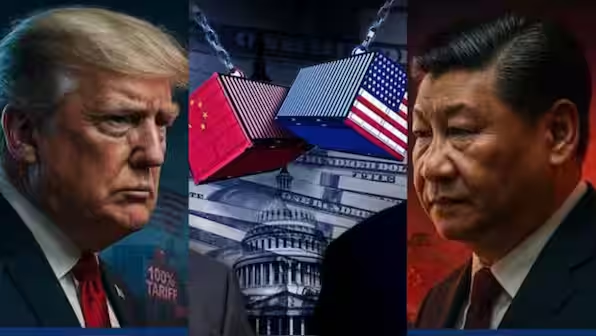
The timing could hardly be more pointed. The assessment began circulating just as President Donald Trump arrived in Beijing for a closely watched summit with Chinese President Xi Jinping.
What the Report Says
The analysis was produced this week for Gen. Dan Caine, chairman of the Joint Chiefs of Staff, by the Joint Staff’s intelligence directorate. It has reportedly stirred concern inside the Pentagon about the broader geopolitical price of Washington’s ongoing standoff with Tehran.
To frame its findings, the report uses what’s known as the “DIME” model, which evaluates China’s response through four levers of state power:
- Diplomatic — repairing and deepening ties with countries hurt by the war
- Informational — shaping global narratives around the conflict
- Military — observing how the U.S. fights and learning from it
- Economic — stepping in to meet energy and trade needs
Officials spoke about the previously unreported findings on condition of anonymity, citing the sensitivity of intelligence matters.
Selling Weapons to America’s Own Allies
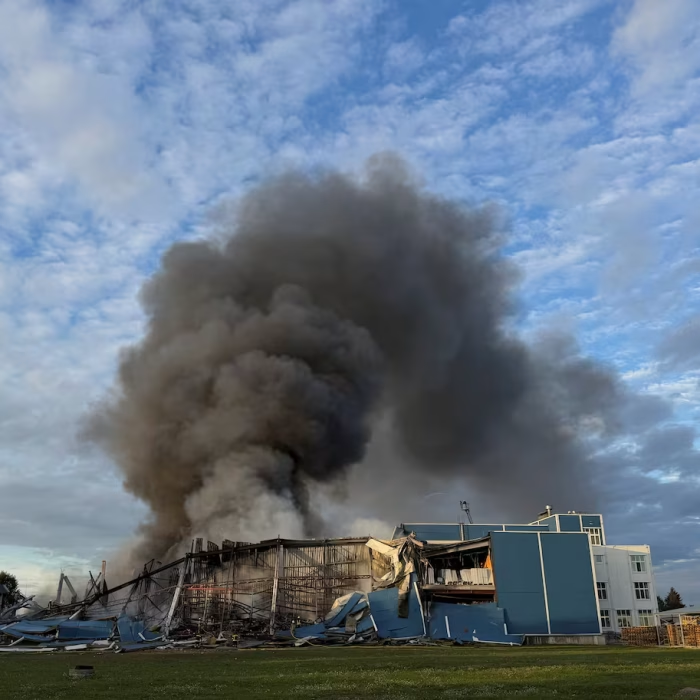
One of the report’s more striking conclusions involves arms sales. Since the U.S. and Israel launched the Iran war on Feb. 28, China has reportedly sold weapons to Persian Gulf nations — many of them U.S. allies — as they scrambled to defend their bases and oil infrastructure from Iranian missile and drone attacks.
In other words, when Washington’s partners needed help, Beijing was there to provide it.
Filling the Energy Gap
China has also positioned itself as a problem-solver on the global energy stage. After the U.S.-Israeli strikes prompted Iran to close the Strait of Hormuz — a passage that carries roughly one-fifth of the world’s oil and gas — countries around the world were left struggling to meet their energy needs.
Beijing moved quickly to help. It has reached out to Thailand, Australia, the Philippines, and others, offering short-term access to jet fuel and scarce products while pitching Chinese-made green energy technology as a longer-term fix.
Ryan Hass, a China expert at the Brookings Institution, noted that China is among the most insulated countries in the world from the energy crisis — second only to the United States — thanks to its renewable energy development and large oil reserves. That cushion lets Beijing play the role of a generous partner.
But Hass was blunt about the motive. This isn’t altruism, he said; it’s Beijing seizing a chance to drive wedges between America and its traditional partners. And with the Trump administration showing little interest in convening the kind of emergency diplomacy Washington has led in past energy crises, China has found an open lane.
Watching How America Fights
The military implications run deeper than weapons sales. The war has burned through enormous U.S. stockpiles of munitions — many of them expensive and slow to manufacture — used to defend Israel and Gulf allies and to dismantle Iran’s arsenal.
The strain has been especially visible in supplies of Patriot air defense weapons, THAAD interceptors, and Tomahawk cruise missiles. These are precisely the kinds of weapons that would be critical in any confrontation with China over Taiwan.
The conflict has handed Beijing something else valuable: a front-row seat. By watching how the U.S. conducts a real war — including the damage and destruction of American hardware and facilities across the Middle East — China can study U.S. tactics and apply those lessons to its own future planning.
Allies Are Getting Nervous
That munitions drain hasn’t gone unnoticed by U.S. partners in Asia. Taiwan, Japan, South Korea, and others are now openly worried about American military readiness and whether Washington could realistically intervene if China were to attack.
Jacob Stokes, a senior fellow at the Center for a New American Security, said the situation raises hard questions about whether the U.S. defense industrial base can restock munitions quickly enough — concerns that compound existing frustrations over slow deliveries.
There’s a political ripple effect, too. Stokes noted that the strain gives Beijing-friendly voices within Taiwan an argument to slow or block funding for the island’s military buildup — a buildup that Taiwan’s supporters consider essential for deterring China.
Winning the Narrative War
The report also highlights how China is using the conflict to claim the moral high ground. Beijing has folded popular criticism of the war into its public messaging, going so far as to label the conflict “illegal.”
This fits a long-running Chinese strategy of chipping away at the image of the U.S. as a responsible steward of the international order. As Stokes put it, the war gives China an opening to portray the United States as an aggressive, declining power that can’t stop itself from getting drawn into costly Middle East wars — while conveniently distracting from Beijing’s own human rights record and coercive behavior in Asia.
Washington Pushes Back
U.S. officials rejected the idea that the balance of power is shifting. Pentagon chief spokesman Sean Parnell said any claim that global power has tilted toward another nation is fundamentally false, and insisted the military maintains a deep, resilient arsenal and the industrial capacity to deter any adversary.
White House spokeswoman Olivia Wales said the U.S. decimated Iran’s military capabilities in 38 days and is now squeezing what remains of its economy through a highly successful naval blockade. She called the U.S. military the greatest fighting force on the globe.
Trump himself has dismissed the notion that he needs Beijing’s help to end the war, telling reporters before departing that the U.S. would win “one way or the other, peacefully or otherwise.” The Chinese Embassy in Washington did not respond to a request for comment.
The Bottom Line
The summit in Beijing — postponed from March because of the Iran war — comes at a moment when Trump’s standing at home and abroad has been weakened by public dissatisfaction with the conflict and its damage to the global economy.
Experts say the intelligence findings reinforce a growing consensus. As Jacob Stokes summed it up, the war in Iran is, on balance, massively improving China’s geopolitical position. Whether or not Washington acknowledges it, the report suggests that the longer the conflict lasts, the more ground Beijing stands to gain.
Author