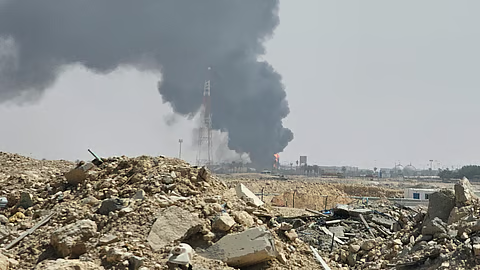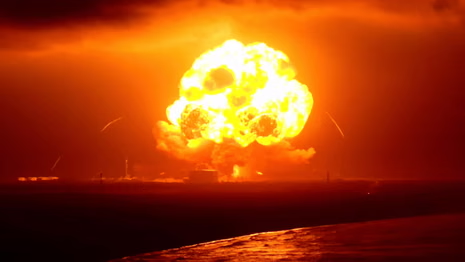
The Blue Origin rocket explosion lit up Florida’s Space Coast on Thursday night, as a New Glenn rocket erupted in a massive fireball at Cape Canaveral. The dramatic blast, visible for miles, has raised serious questions about the timeline for Jeff Bezos’ space company and its ambitions, even as officials confirmed that no one was hurt.
What Happened on the Pad
The incident unfolded at one of the most closely watched spaceports in the world. A powerful New Glenn rocket owned by Jeff Bezos’ Blue Origin exploded in a spectacular fireball Thursday, sending billowing clouds of fire, smoke and flaming debris into the night sky. CBS News
According to multiple accounts, the timing and sequence were striking. The explosion occurred around 9 p.m. EDT as engineers were counting down to a brief test firing of the New Glenn’s seven methane-fueled BE-4 first stage engines at the Cape Canaveral Space Force Station. CBS News
The test in question was a so-called hotfire, also known as a static fire. In this procedure, a rocket’s engines are ignited while the vehicle remains firmly anchored to the launch pad, allowing engineers to evaluate engine performance without an actual liftoff. Something, however, went badly wrong. As the engines appeared to begin firing, trouble erupted at the base of the towering rocket, and the vehicle was quickly engulfed in a rapidly growing fire.
Blue Origin’s Response
The company moved swiftly to acknowledge the event, even before the full scope of the damage became clear. “We experienced an anomaly during today’s hotfire test,” Blue Origin wrote in a statement, adding that all personnel had been accounted for and that updates would follow. Space.com
Founder Jeff Bezos addressed the situation directly on social media, striking a tone that mixed candor with resolve. He confirmed that everyone was safe and that the cause remained unknown, while signaling determination to push forward. “It’s too early to know the root cause but we’re already working to find it,” Bezos wrote, adding that it was a “very rough day,” but that the company would rebuild whatever needed rebuilding and get back to flying because “it’s worth it.” Spaceflight Now
No Injuries, but a Warning About Debris
The most important news for the surrounding community was reassuring. Local authorities, including the Brevard County Sheriff’s Office, reported no injuries, and officials emphasized that the public was not at risk.
That said, the aftermath has prompted a public safety advisory. Blue Origin warned in a Friday post that debris from the explosion could wash ashore on some local beaches in the coming days or weeks. Cape Canaveral Space Force Station cautioned that launch vehicle debris is potentially hazardous, noting that direct contact poses a risk to personal health and welfare. Residents who come across any such material are advised to avoid handling it. CNBC
The Mission That Was Planned
The destroyed rocket had been preparing for a significant assignment. The New Glenn had been transported to Launch Complex 36 ahead of an anticipated launch in the coming weeks. That mission was set to carry a batch of internet satellites for Amazon’s Leo network, another Bezos-led venture aimed at building a satellite-based broadband system.
Crucially, those satellites were not aboard the rocket during the hotfire test. The Amazon Leo payload had not been installed, meaning the explosion, while costly, did not destroy the valuable satellite cargo intended for orbit.
Significant Damage to the Launch Site
Early observations suggest the blast inflicted heavy damage on the launch infrastructure itself. As the smoke cleared, observers noted that the erector-gantry, the structure used to move the New Glenn from its hangar to the pad and raise it from horizontal to vertical, was no longer visible. Likewise, one of two tall lightning towers at the site appeared to be gone.
The full extent of the damage to Launch Complex 36, and what repairs will be required, will only become clear after a detailed analysis. Investigators will need to comb through telemetry data and launch pad video footage to piece together exactly what triggered the failure.
A Difficult Stretch for New Glenn
This explosion did not occur in isolation. It came at the end of a challenging period for the New Glenn program. The company had only recently announced the rocket’s return to flight following a setback during its third flight in April.
During that earlier mission, the outcome was mixed. The rocket’s first stage booster landed successfully on a seafaring barge, but the upper portion, or second stage, failed to deliver its payload, AST SpaceMobile’s BlueBird 7 satellite, to a safe orbit. That failure had prompted a Federal Aviation Administration investigation, making this latest explosion an especially unwelcome development. CNN
Regulatory and Industry Reactions
The FAA, which oversees commercial space activities, clarified the regulatory picture. The agency confirmed it was aware of the anomaly during the static fire test, but stated that the test fell outside the scope of FAA-licensed activities and that there was no impact to air traffic as a result.
The broader space community also weighed in. NASA acknowledged the incident, with NASA Administrator Jared Isaacman noting that spaceflight is unforgiving and that developing new heavy-lift launch capability is extraordinarily difficult. He pledged to support a thorough investigation and to assess any near-term mission impacts. Notably, Isaacman indicated that NASA would provide updates on any effects to the Artemis and Moon Base programs, underscoring how Blue Origin’s rocket is tied to America’s lunar ambitions.
Even rival SpaceX founder Elon Musk responded, offering a brief but knowing acknowledgment of the difficulty involved, remarking that rockets are hard.
Why This Matters
The stakes here extend well beyond a single failed test. Blue Origin views the New Glenn, a rocket standing well over 300 feet tall, as its launch workhorse, a vehicle central to its long-term vision of helping humanity establish a presence beyond Earth. The explosion therefore represents a potential setback not only for the company’s commercial goals but also for NASA’s moon plans, which rely in part on Blue Origin’s capabilities.
For perspective, major launch pad explosions of this kind are relatively rare at Cape Canaveral. The last comparable event occurred back in September 2016, when a helium tank rupture caused a SpaceX Falcon 9 rocket to explode at a nearby complex.
Looking Ahead
For now, the immediate priorities are clear: determining the root cause, assessing the damage to Launch Complex 36, and managing the debris that may reach local shorelines. Bezos has projected confidence that the company will rebuild and resume flights, but the path back will depend heavily on what the investigation reveals.
The Blue Origin rocket explosion serves as a stark reminder of the inherent risks in spaceflight, particularly when developing cutting-edge systems. As engineers begin the painstaking work of analysis, the wider industry will be watching closely to see how quickly one of the leading players in commercial space can recover from such a dramatic and very public failure.
This remains a developing story, and the details here reflect the most recent information available in the days following the explosion.
Author