




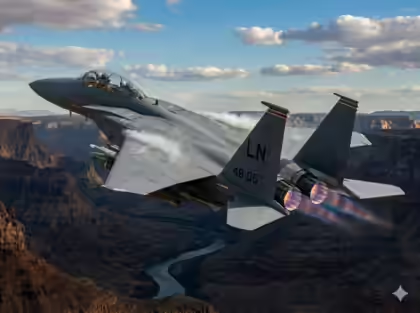
Armed with a pistol, a communication device, and a tracking beacon, a US airman whose F-15 was shot down over Iran spent more than 24 hours alone in hostile territory — hiding in a mountain crevice, scaling rugged terrain, and evading capture until one of the most complex rescue missions in recent memory could reach him. He is now safe. Here’s the full picture of what happened and what it means for the broader conflict.
How the Airman Survived — Alone in the Mountains for Over a Day
After his F-15 was shot down on Friday, the airman’s survival depended on training, equipment, and nerve. According to US officials, he used his communication device and tracking beacon to stay in contact with rescue teams while physically staying out of Iranian hands — moving through difficult mountain terrain and concealing himself in a rocky crevice as the search for him intensified on the ground.
The fact that he remained undetected for more than 24 hours in an environment where Iranian state media and local authorities were actively mobilising civilians to find him makes the personal feat all the more remarkable. He held on long enough for the cavalry to arrive.
The Rescue Operation: Commandos, Bombs, and a CIA Deception Campaign
When the extraction came, it was anything but simple. US commandos moved into the high mountains to reach the airman, with aircraft dropping bombs to clear the surrounding area before the ground team moved in. The operation involved hundreds of military and intelligence personnel — and critically, a CIA-led deception campaign designed to mislead and disorient any Iranian forces or civilians who might have been closing in on his location.
President Trump announced the successful rescue overnight on social media, ahead of a formal White House address to reporters on Monday. Israeli Prime Minister Benjamin Netanyahu swiftly praised what he called an “incredible rescue,” and Israel’s defence minister described the operation as a demonstration of close US-Israeli cooperation.
Trump’s Warning to Iran — Sharp, Profanity-Laced, and Direct
The relief of the rescue did nothing to soften the broader US posture. In a separate social media post, Trump issued a blunt, profanity-laced warning to Tehran: make a deal or reopen the Strait of Hormuz, or face severe military consequences. The Strait — the narrow waterway through which roughly one fifth of the world’s oil passes — has been a central flashpoint of the conflict, with Iran’s control over it sending global energy markets into turmoil.
Iran’s military responded with threats of its own, warning of retaliation over ongoing US-Israeli strikes on industrial infrastructure. The Islamic Revolutionary Guard Corps also claimed responsibility for striking fuel and petrochemical facilities in Bahrain, Kuwait, and the United Arab Emirates — a significant expansion of the conflict’s geographic footprint if confirmed.
Iran’s Counter-Narrative — and Why It Matters
Iranian state media moved quickly to undermine the US rescue announcement. Tasnim News Agency, which has ties to the IRGC, claimed that multiple American aircraft had been destroyed by Iranian forces and that the rescue operation had in fact failed. The competing narratives — a triumphant rescue versus a claimed Iranian victory — reflect the information war running alongside the military one, and underline why independent verification of events on the ground remains so difficult.
Diplomatic Moves on Multiple Fronts
Away from the military escalation, quiet diplomatic activity is continuing. Egypt’s foreign minister held calls with US Special Envoy Steve Witkoff, Iran’s foreign minister, and other regional counterparts in an effort to find de-escalation pathways. Separately, representatives from Oman and Iran met to discuss options for allowing ships to transit the Strait of Hormuz — a small but potentially significant signal that some parties are still looking for an off-ramp.
Whether those diplomatic threads can gain traction while the military exchanges continue to intensify is the defining question of this moment in the conflict. The rescue of the US airman is a rare piece of good news in an otherwise darkening situation — but the broader war shows no signs of reaching a conclusion.
Author