





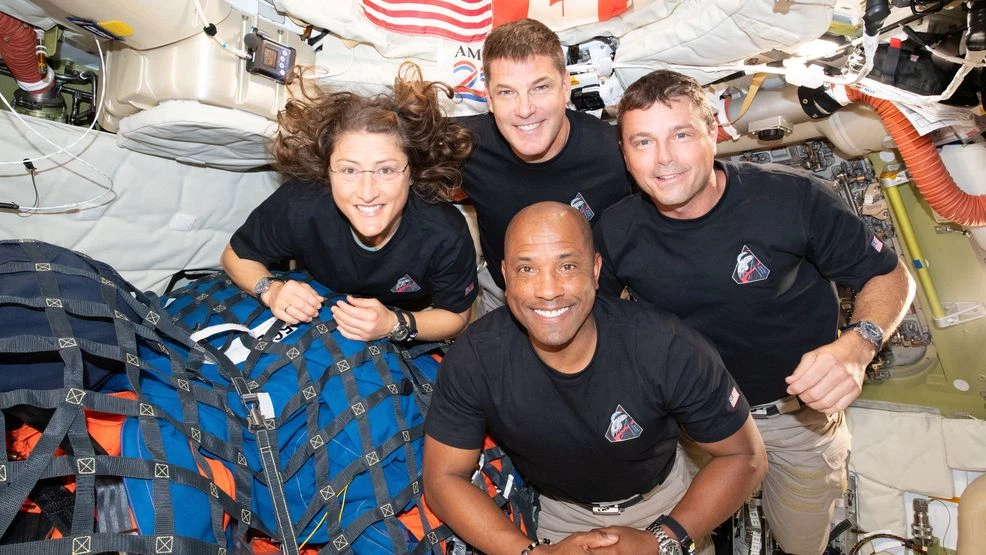
After a historic 10-day lunar flyby, the Artemis II astronauts spoke to Congress, inspired a generation, and prepared for a precise splashdown off the California coast.
There’s a certain kind of moment that stops you in your tracks — one that makes you look up and remember what human beings are actually capable of. For millions watching from Earth, the Artemis II mission has been exactly that. And as the four-person crew prepared to come home after their landmark lunar flyby, they weren’t just wrapping up a mission. They were making a case for what comes next.
“There Is Nothing This Nation Cannot Do”
On Thursday evening, with splashdown less than 24 hours away, the Artemis II crew held a press conference from aboard the spacecraft, fielding questions from members of Congress on both sides of the aisle. The mood, by all accounts, was celebratory.
Commander Reid Wiseman set the tone early. Reflecting on what the mission represented, he described the feeling of building an international team, setting sights on a sustained lunar presence, and then actually pulling it off. “There is nothing this nation cannot do when it has a vision,” he said. And then, with the kind of quiet confidence that comes from having just orbited the Moon: “We are in the golden age of space travel right now. There’s just limitless potential here.”
A Historic Crew, A Historic Moment
The record-breaking dimension of this mission was never far from the conversation. Pilot Victor Glover, who became the first Black man to travel beyond low-Earth orbit, spoke powerfully about what he hoped people took away from the mission.
“I hope that we connect back to when we went to the moon the first time,” he said, “and we take ownership of this moonshot.” His message was simple but resonant: when people come together across their differences and work toward something meaningful for everyone, there’s nothing out of reach.
Glover also spoke directly to his four children and to young people watching, encouraging them to carry this moment with them. “We want you to take this and build a vocabulary to explain the world to us,” he said — a beautiful line from a man who had just seen that world from a perspective few ever will.
The Moon Up Close: “It Rendered Us Speechless”
One of the most quietly stunning moments of the press conference came when crew members described seeing the lunar eclipse in person. Mission specialist Christina Koch said the sight simply left the crew without words. Fellow mission specialist Jeremy Hansen of the Canadian Space Agency backed her up, gently reminding those watching: “I know you saw some pictures — but it really was something.”
Some things, it turns out, don’t fully translate through a screen.
Getting Home Is No Small Task
As moving as the press conference was, the business of returning four astronauts safely to Earth is a logistical operation that leaves nothing to chance.
The Orion capsule is set to reenter Earth’s atmosphere at nearly 24,000 mph before splashing down several miles off the coast of San Diego. NASA’s associate administrator Amit Kshatriya paid tribute to the ground teams making it happen: “To every engineer, every technician that’s touched this machine — tomorrow belongs to you.”
Lead flight director Jeff Radigan laid out the precision involved, noting the team has less than a degree of margin on the reentry angle. “Let’s not beat around the bush,” he said plainly. “We have to hit that angle correctly — otherwise we’re not going to have a successful re-entry.”
The timeline for Friday’s return runs like clockwork:
- 4:33 PM PT — Orion crew module and service module separate; service module burns up in atmosphere
- 4:37 PM PT — Crew module raise burn
- 4:53 PM PT — Entry interface begins, causing a brief communications blackout
- 5:03 PM PT — Drogue parachutes deploy
- 5:07 PM PT — Splashdown
The USS John P. Murtha will be on standby for recovery operations, a process expected to take between one and one and a half hours. Recovery teams must initially keep their distance due to incoming debris, before moving in to extract the crew once the area is confirmed safe. From there, the astronauts will be flown to NASA’s Johnson Space Center in Houston for post-mission medical evaluations.
Radigan also had a word for anyone thinking of watching from the California coastline: the splashdown will happen far enough out to sea that it won’t be visible from shore — and given the exclusion zone in place, he urged people to stay well clear of the area.
What Comes Next
The Artemis II mission was always more than a flyby. It was a proof of concept — a demonstration that humanity still has the will, the technology, and the teamwork to push beyond what’s familiar. With a sustained lunar presence and eventual missions to Mars on the horizon, this crew didn’t just make history. They pointed toward it.
As Commander Wiseman put it: limitless potential. And from where they’ve been standing this past week, that phrase carries a little more weight than usual.
Author