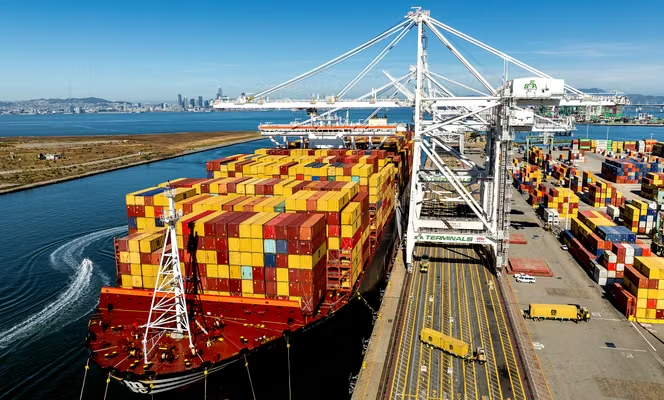
Fifty percent US tariffs on Canada are set to take effect Wednesday, and the two sides remain some distance from any agreement that would prevent it. Canadian businesses in several already-strained sectors warn the duties could trigger layoffs, while the dispute threatens to derail a much larger negotiation over the future of North American trade.
President Donald Trump reached for an unusual legal instrument last month to make this happen: Section 338 of the Tariff Act of 1930. The provision permits a president to impose punitive duties of up to 50 percent on trading partners judged to have discriminated against American goods.
It has essentially never been used this way before.
What Gets Hit
The tariffs cover a scattered list of Canadian exports rather than a single industry:
- Wine and dairy products
- Furniture and custom cabinetry
- Cement and clothing
- Fishing rods and hockey equipment
Altogether the measures touch close to $20 billion in Canadian goods. That figure represents roughly 5.2 percent of the $383 billion the United States imported from Canada in 2025, according to Census Bureau data.
Canada ranks as America’s second-largest trading partner, trailing only Mexico.
The USMCA Shield Doesn’t Apply
One feature separates these duties from most of Trump’s earlier trade actions. They would apply even to goods that qualify for preferential treatment under the U.S.-Mexico-Canada Agreement.
That agreement has protected the bulk of Canadian exports from tariff exposure, so removing the protection introduces a new category of risk for the Canadian economy.
The picture grew more uncertain last month when Trump declined to extend USMCA for another 16 years, opting instead for annual reviews. Businesses now face a trade framework that gets relitigated every twelve months — a structure that has already discouraged investment and hiring north of the border.
Negotiators Still Apart
Prime Minister Mark Carney declined Monday to discuss specifics, describing the talks as intense and delicate. He said he expects to speak directly with Trump before the deadline arrives.
Dominic LeBlanc, the minister handling U.S. trade relations, and chief negotiator Janice Charette have intensified their contacts with American counterparts. LeBlanc has met U.S. Trade Representative Jamieson Greer six times in four weeks, including a virtual session Sunday and another meeting Monday.
Despite that pace, LeBlanc told an advisory committee Friday that the two countries remain far from a draft agreement, according to a source briefed on the discussion.
Automobiles have emerged as a major obstacle. Two industry sources told Reuters that tariffs on Canadian-built vehicles have become a central point of contention.
The View From the Factory Floor
Alain Ouzilleau, who owns the custom kitchen cabinet brand Cabico Ltd, described the math bluntly. A 50 percent tariff is not something manufacturers can absorb, he said, and expecting American customers to swallow it is equally unrealistic. Certain Canadian-made products, in his assessment, could become economically noncompetitive in the U.S. market almost immediately.
Smaller firms face the sharpest exposure because so many depend on unrestricted access to American buyers.
Dan Kelly, president of the Canadian Federation of Independent Business, said the tariffs would produce enormous disruption for small companies serving U.S. clients — and equally for American purchasers who rely on Canadian suppliers. The damage runs in both directions.
Wildfire-hit wine producers and the struggling wood products sector are among those least positioned to absorb another shock.
A Dissenting Economic View
Not everyone regards the tariffs as catastrophic in aggregate terms. Joseph Steinberg, an economics professor at the University of Toronto, noted that even with these duties Canada would remain among the lowest-tariff exporters to the United States.
In macroeconomic terms, he said, the tariffs are not that significant. His concern lies elsewhere: whether this escalation stalls the broader USMCA negotiations, and what becomes of the specific sectors caught in the middle.
That distinction matters. A 5.2 percent slice of trade barely registers in national GDP figures while potentially devastating individual towns built around a single industry.
Dairy and Alcohol on the Table
Greer has pushed Canada on two issues in particular: its supply-managed dairy system and the removal of American alcohol from provincial liquor stores.
Ted McKinney, chief executive of the U.S. National Association of State Departments of Agriculture, said dairy goes well beyond a sticking point and is probably the central issue in the entire negotiation.
Ontario Premier Doug Ford, among the loudest critics of Trump’s tariffs, said last week he would restore American alcohol to shelves if Canada secures a fair deal. New tariffs taking effect Wednesday would likely make provinces less inclined to follow through.
An Uncomfortable Historical Echo
The statute Trump invoked carries considerable historical baggage. The Tariff Act of 1930 is remembered chiefly for sweeping duty increases that triggered retaliation abroad, and economic historians widely regard it as having deepened the Great Depression.
Reviving a mechanism from that law to pressure a close ally is a choice with symbolic weight — and Canadian negotiators have limited time left to make it moot.
Author
-
Lucienne Albrecht is Luxe Chronicle’s wealth and lifestyle editor, celebrated for her elegant perspective on finance, legacy, and global luxury culture. With a flair for blending sophistication with insight, she brings a distinctly feminine voice to the world of high society and wealth.