The Great American State Fair was meant to be the crown jewel of America’s 250th birthday celebration, but on Saturday it became a scene of medical emergencies, mass evacuations, and mounting chaos. Brutal heat sent nearly a dozen people to hospital, and severe storms later drove thousands from the National Mall. Even so, organisers insisted the festivities would push forward, with President Donald Trump vowing to address the crowd no matter how late the hour.
A Day That Spiralled Out of Control
What began as a proud patriotic showcase quickly unravelled under the weight of dangerous conditions. Before the storms even arrived, the punishing heat had already taken a serious toll on attendees.
Emergency responders reported a striking number of medical incidents. According to D.C. Fire and EMS, crews handled 44 patient contacts before the fair closed on Friday. Of those, 11 individuals were rushed to hospitals for a range of illnesses and injuries. Seven of them needed advanced life support, while four received basic life support.
The heat, however, was only the beginning of the day’s troubles.
Storms Force a Mass Evacuation
As severe weather approached in the evening, organisers made the difficult decision to clear the grounds. Guests, performers, and staff were all urged to leave the event and take shelter in nearby buildings.
The scale of the evacuation was staggering. Reports indicated that thousands of people, with one estimate placing the figure above 10,000, were told to abandon the National Mall. The situation grew so intense that a major museum reached full capacity while sheltering fleeing attendees.
Despite the disruption, the group behind the event announced that gates would reopen at 9:45 p.m., roughly two hours after the initial warning. They confirmed the president would speak at 11 p.m., with fireworks to follow.
Trump Refuses to Back Down
Even as crowds huddled indoors, the president remained defiant. Posting on social media while attendees waited out the weather, he embraced the storms rather than lamenting them.
He suggested that storms bring good fortune and add excitement to any occasion, insisting he would wait them out no matter how long it took. He declared he didn’t care if it stretched to two in the morning, refusing to let a little rain derail the milestone celebration.
Earlier in the afternoon, he had downplayed the heat entirely, claiming conditions weren’t as severe as forecasters predicted. He praised the incredible crowds and even commented on the troubled Reflecting Pool, blaming its damage on vandals and promising a swift repair after the holiday weekend.
A Troubled Event From the Start
The weather woes added to what had already been a rocky rollout for the ambitious celebration. Long before Saturday’s chaos, the fair had been plagued by a series of setbacks.
The list of problems leading up to the event was extensive, including:
- Numerous performers who cancelled or distanced themselves from the fair.
- Reports of thin, underwhelming crowds.
- Power outages across the grounds.
- Weather-related closures.
- A sponsor pulling out over a Confederate flag display.
- Alarming video of stage equipment collapsing near young dancers during a rehearsal or performance.
Together, these issues cast a shadow over an event billed as a historic, once-in-a-generation spectacle.
Heat Reshapes the Schedule
The extreme temperatures had already forced organisers to rework the day’s timeline. With Washington baking under readings above 100 degrees and heat index values pushing conditions toward a stifling 110 to 115 degrees, safety became the priority.
Gates for the “Salute to America 250” event were pushed back to 5 p.m., with programming set to begin at 7 p.m. The president was originally expected to speak around 10 p.m. before the fireworks display.
In a joint statement, multiple agencies, including the National Park Service, U.S. Park Police, Secret Service, and FEMA, emphasised that guest safety remained their top concern. They noted they had coordinated to adjust timing and expand cooling resources, water stations, and medical support.
Unprecedented Security Meets Sweltering Heat
This year’s celebration stood out not just for its scale but for its extraordinary security measures. It marked the first Fourth of July event in the capital to be designated a National Special Security Event, placing the Secret Service in charge and uniting federal, state, and local agencies.
The security footprint was massive. More than 4,800 National Guard members from 23 states and the District of Columbia were deployed throughout Washington. Miles of fencing surrounded portions of the National Mall, and visitors had to pass through airport-style screening just to enter.
Unfortunately, these restrictions created additional hardships in the heat. Several items were banned from the grounds, including:
- Coolers and folding chairs.
- Metal drink containers.
- Aerosol cans, including spray sunscreen.
Organisers encouraged attendees to rely on hydration stations, take breaks, and seek shade wherever possible. Yet local reports painted a troubling picture, describing pallets of bottled water sitting in the sun and seating areas offering little relief. Images from the Mall showed medical workers assisting overheated visitors and fairgoers using ice to cool themselves down.
A Nationwide Heat Crisis
The struggles in Washington were part of a much larger pattern gripping the country. The capital’s traditional Independence Day parade was cancelled outright due to the dangerous temperatures.
Astonishingly, roughly 150 million people across the nation found themselves under heat alerts as communities kicked off the yearlong countdown to America’s 250th birthday. The scope of the heat wave underscored just how widespread and serious the conditions had become.
An Ambitious Vision Under Strain
The fair itself was designed to be enormous in scope. Organised as part of the administration-backed semiquincentennial celebration, the 16-day event was scheduled to run through July 10 and promoted as a World’s Fair-scale attraction.
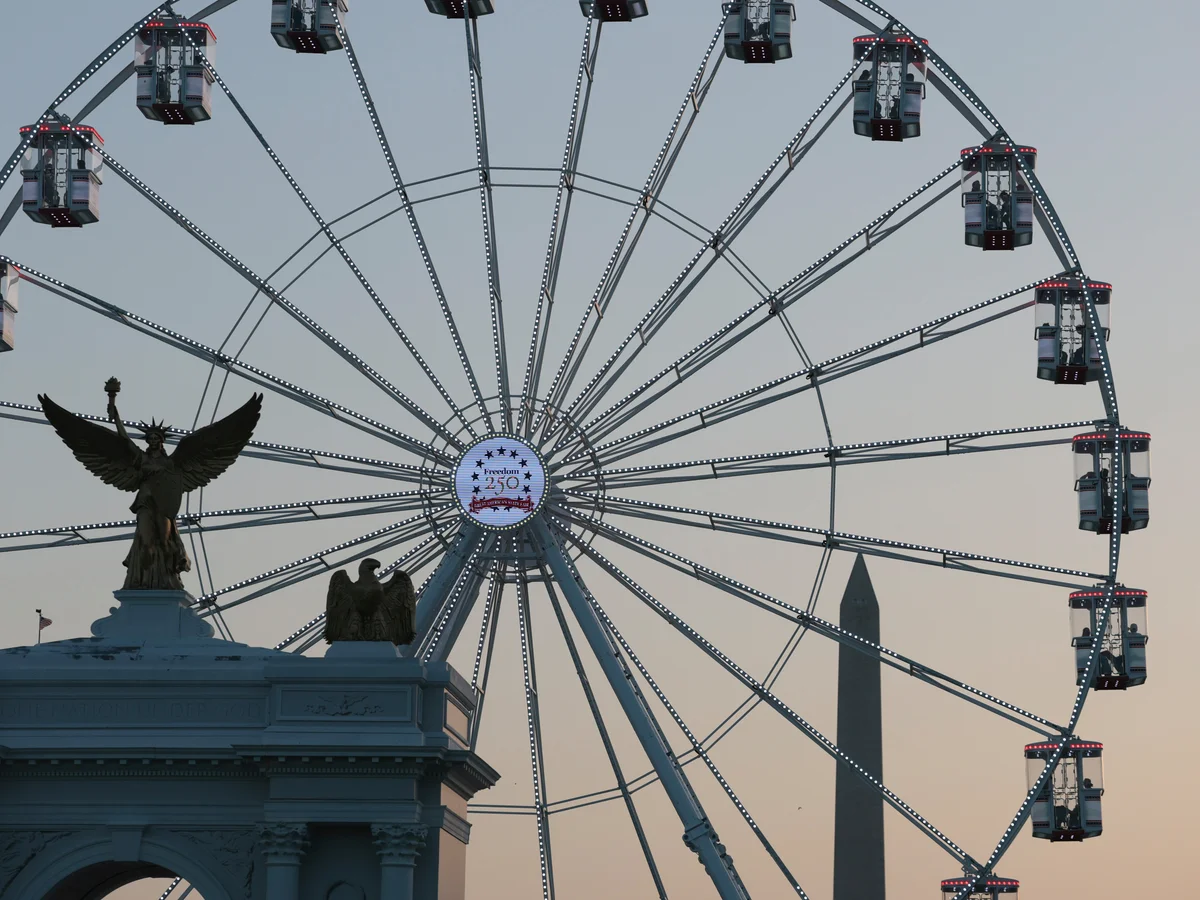
Plans included state and territory exhibits, federal agency displays, live music, military flyovers, and a Ferris wheel positioned between the U.S. Capitol and the Washington Monument. Yet the execution repeatedly fell short of the grand vision.
Several high-profile performers backed out after saying they had been led to believe the event would be nonpartisan. One of the few who defended his participation ultimately had his concert cancelled because of the weather. Meanwhile, some Democratic-led states declined to send official delegations, citing cost concerns or worries about partisanship.
Defending the Turnout
Despite the criticism, the organisers pushed back against claims of low attendance. A spokesperson stated that more than 200,000 people had visited the fair and its accompanying FIFA Fan Fest zone.
Some attendees reportedly offered positive reviews as well, praising the experience even amid the sweltering heat and sparse crowds in certain areas. For supporters, these numbers suggested the event still resonated with a significant portion of the public.
A Celebration Defined by Adversity
In the end, the Great American State Fair became a vivid symbol of ambition colliding with reality. Between hospitalisations, evacuations, cancelled acts, and relentless heat, the event faced obstacle after obstacle on one of the most significant days in the nation’s history.
Yet through it all, the determination to celebrate endured. Whether viewed as a triumph of persistence or a cautionary tale of overreach, the day left an undeniable mark on America’s 250th birthday, proving that even the grandest plans remain at the mercy of forces far beyond anyone’s control.
Author