


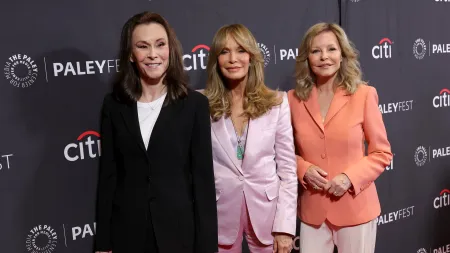
Kate Jackson, Jaclyn Smith and Cheryl Ladd reunited at PaleyFest LA to celebrate half a century of a show that, against the odds, gave women permission to be something they hadn’t seen on screen before.
Good night, Angels — and hello again
Half a century is a long time. Long enough for a show that its own network didn’t fully believe in to become one of the most culturally enduring series in television history. On Monday evening at PaleyFest LA, Kate Jackson, Jaclyn Smith and Cheryl Ladd gathered at the Dolby Theatre in Hollywood to mark Charlie’s Angels’ 50th anniversary — reflecting with warmth, laughter and remarkable candor on a show that, by all accounts, was never supposed to be this big.
The original series debuted in September 1976 and followed three women working as private detectives — beautiful, capable and, crucially, the ones doing the rescuing. That last part, it turns out, was the whole point.
“This show was different, special and unique. I thought: wow, three women chasing danger instead of being rescued from danger. It gave women permission to be independent and to break out of the mold and not be defined by men.”
— Jaclyn Smith
How it all came together — and who almost played who
Kate Jackson was there from the very start. After her time on The Rookies, she helped Aaron Spelling and Leonard Goldberg develop the concept, and was originally set to play Kelly Garrett — the role that would ultimately go to Jaclyn Smith. Jackson switched to Sabrina Duncan instead. Smith, for her part, confessed that her audition was far from her finest hour and she genuinely didn’t expect to get the part.
She also offered a wry observation about the original casting logic: the producers wanted “a blonde, a brunette and a redhead,” which, she noted with a smile, “they thought was inclusive” at the time.
The third Angel in that first season was, of course, Farrah Fawcett — whose departure after just one year genuinely stung. Both Jackson and Smith admitted they were disappointed when she left. Enter Cheryl Ladd, who had turned Spelling down three times before he finally came to her with a different pitch: what if she wasn’t replacing Farrah, but playing her character’s younger sister?
“He said, ‘If you’re Farrah’s little sister, then you’re part of the family.’ And I said, ‘I’m in.'”
— Cheryl Ladd
The little troublemaker makes her point
Ladd arrived on set wearing a shirt that read “Farrah Fawcett Minor” — a cheeky acknowledgment of the impossible position she was in. But perhaps her most memorable act of quiet rebellion came in response to Spelling’s habit of putting her character in bikinis. She went out and bought the tiniest swimsuit she could find, wore it on set, filmed the scene — and Aaron was not pleased.
The message that came back to her: “Tell the little troublemaker that she’s never going to do that again.” Ladd laughed recounting it. “And I didn’t. But I made my point. When I was wearing a swimsuit, it was something I felt comfortable in.”
The conversation also took a quieter, more personal turn when Ladd opened up about her past battle with breast cancer — something that both Jackson and Smith have also experienced. Far from dividing them, the shared ordeal brought the three women closer together.
The roles that got away
Success has its costs. Being locked into one of the biggest shows on television meant watching other extraordinary opportunities pass by — and the trio didn’t shy away from talking about those losses.
Smith was in the running to be a Bond girl in 1979’s Moonraker, but her contract and her own sense of loyalty won out. “Aaron was the first to invite me to the party, so I was honoring my contract,” she explained. She was also considered for Beetlejuice — but admitted she simply didn’t understand the script at the time. “My husband regrets that,” she added, to laughter from the audience.
The most poignant missed opportunity belonged to Jackson. Asked about turning down the role that Meryl Streep would make iconic in Kramer vs. Kramer, she gave an answer that was equal parts candid and quietly devastating: “You want the truth? They changed the schedule for the movie four times and every time they did, Aaron would look at the Charlie’s Angels schedule and say, ‘Oh gee, we had to change our schedule. Now it doesn’t work here, here and here.’ He didn’t let me do it.”
A network that almost missed its own hit
What makes the legacy of Charlie’s Angels even more remarkable is how hard the network fought against believing in it. Smith recalled that the pilot was initially aired as a two-hour TV movie — and it shot through the roof in ratings. The network’s response? Suspicion. They aired it a second night to test whether the numbers were real. Ratings climbed even higher.
And even then, they didn’t order a full season.
The three also touched on the financial side of things — noting, with a certain weariness, how little money they’ve actually seen from a franchise that spawned multiple films and generations of cultural influence. It’s a reminder that even a show that changes television doesn’t always reward the people who made it.
Fifty years on
Sitting together on that stage at the Dolby Theatre, Jackson, Smith and Ladd looked like exactly what they are: women who have weathered a great deal — personal loss, illness, professional regrets and the complicated legacy of being symbols before anyone quite had the language for it. The show they made wasn’t perfect, and they’d be the first to tell you that. But it mattered. It gave women permission, as Smith put it — and that permission has been rippling outward for fifty years.
Author