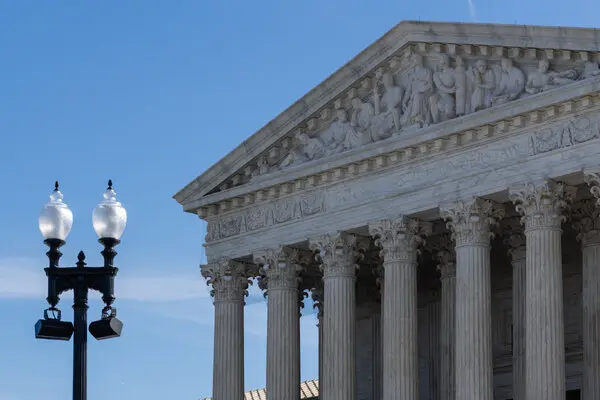
The Louisiana redistricting ruling has taken center stage in American politics after the Supreme Court decided Monday to let last week’s landmark decision take effect immediately. The move set off a heated public exchange between two justices and pushed Louisiana officials into a frantic effort to redraw their congressional map before this year’s elections.
A 6-3 Decision That Reshaped the Map
In Louisiana v. Callais, the high court ruled 6-3 that the state’s existing U.S. House map, which features two majority-Black districts currently represented by Democrats, was unconstitutional. The reaction from Louisiana officials was swift. They suspended this month’s House primaries almost immediately and began the process of drafting a new map.
The voters who originally brought the challenge then asked the justices to speed things up. Normally, the Supreme Court waits 32 days after a ruling before officially handing the case back down to lower courts. With elections looming, those voters argued there was no time to waste. They asked the district court to step in quickly so an orderly process could be put in place to fix the map.
The court agreed. In its order, the justices noted that the standard waiting period can be adjusted whenever circumstances call for it.
Jackson’s Sharp Objection
Justice Ketanji Brown Jackson, one of the three liberals on the bench, did not hold back. She labeled the decision “unwarranted and unwise” and warned that it effectively cleared the path for Louisiana to scrap its primaries and push a fresh map through at speed.
She also pointed to ongoing legal disputes surrounding the suspended primaries, calling the entire situation chaotic. According to Jackson, the court has historically tried to stay out of last-minute election-related changes, and ignoring that tradition risks making the institution look biased.
In her words, principles that once held firm now seem to bend under the weight of political power.
Alito Fires Back
Justice Samuel Alito, who authored the majority opinion in Callais, wasted no time pushing back. In a concurrence joined by Justices Clarence Thomas and Neil Gorsuch, Alito called Jackson’s accusations “baseless and insulting.”
He flipped the argument on its head, suggesting that the real appearance of partiality would come from letting an unconstitutional map remain in place by stalling on procedure. Alito described Jackson’s reasoning as “groundless and utterly irresponsible,” and questioned what principle, exactly, the court had supposedly violated.
He also argued that following Jackson’s logic would mean keeping a map the court has already declared illegal. Jackson responded in a footnote, clarifying that her real preference was for the court to step back entirely and stick to its default timeline.
Why This Fight Matters Beyond Louisiana
The clash between Jackson and Alito reflects just how much is riding on this case. The Callais ruling has implications stretching far past Louisiana’s borders. Two additional states, Tennessee and Alabama, have already kicked off last-minute redistricting efforts that could shrink the number of Democratic-held seats in Congress.
At the heart of the case is Section 2 of the Voting Rights Act of 1965. For decades, this provision has been used to challenge congressional maps that allegedly dilute the voting power of minority communities.
A New Legal Standard
Historically, southern states have often needed to create majority-minority districts to satisfy the Voting Rights Act and avoid claims of racial discrimination. The Callais decision changes that landscape considerably.
Alito’s majority opinion established a tougher test. Going forward, a map only violates the Voting Rights Act if there’s strong evidence that a state deliberately drew its districts to disadvantage minority voters because of race.
According to Alito, this new standard better matches the actual text of Section 2 and reflects how much has changed since the law was first passed. He pointed to higher Black voter turnout in recent decades and the elimination of openly discriminatory voting laws as reasons the older approach is no longer necessary.
The Liberal Dissent
Justice Elena Kagan, writing for the three dissenting liberals, painted a far different picture. She argued that the ruling effectively guts Section 2, leaving it as little more than a symbolic provision.
Kagan stressed that proving intentional racial discrimination in the map-drawing process is nearly impossible in practice. Lawmakers rarely admit to such motives, and the kind of internal evidence needed is almost never available to challengers.
In her dissent, joined by Jackson and Justice Sonia Sotomayor, Kagan said the decision rolls back a fundamental right that Congress fought to secure: equal opportunity in elections regardless of race.
Looking Ahead
What happens next will play out quickly. Louisiana must produce a new congressional map in time for the upcoming elections, and other states may follow suit with their own redistricting moves. Legal battles around the suspended primaries are still active, and the political consequences could reshape the balance of power in the U.S. House.
The Louisiana redistricting ruling has done more than alter one state’s electoral landscape. It has sparked a national conversation about race, representation, and how far the Supreme Court should go in settling matters so close to an election. With tempers flaring even among the justices themselves, the debate is far from over.
Author