




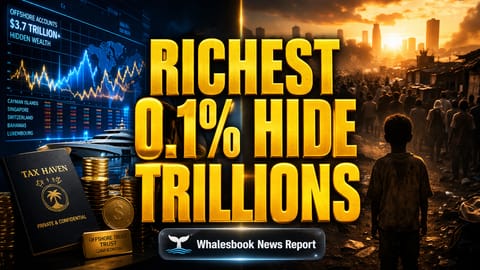
Three and a half trillion dollars. That’s Oxfam’s estimate of how much wealth the global super-rich may currently be shielding from tax authorities — stashed away in offshore accounts, hidden behind legal structures, and quietly sitting outside the reach of the rules the rest of us live by. The charity is calling on governments around the world to close the loopholes and make the ultra-wealthy pay their share.
The Scale of the Problem Is Staggering
In a new report timed to mark the 10th anniversary of the Panama Papers — the landmark investigation that blew open the world of offshore tax havens — Oxfam estimates that total offshore wealth reached $13.25 trillion in 2023. That’s a significant jump from previous years, and the portion hidden from tax authorities, while falling since new international reporting rules came into force in 2016, still amounts to roughly $3.55 trillion — more than 3% of global GDP.
The picture gets starker when you look at who owns it. Drawing on work by economist Gabriel Zucman and the EU Tax Observatory, Oxfam estimates that around 80% of this hidden wealth — over $2.84 trillion — belongs to the richest 0.1% of households. Put another way: the untaxed assets of that tiny elite are roughly equivalent to the total wealth of the poorest half of the entire global population.
“This Is About Power and Impunity” — Oxfam’s Sharp Message to Governments
Oxfam’s lead on tax, Christian Hallum, didn’t mince words when speaking about the findings.
“This isn’t just about clever accounting — it’s about power and impunity. When millionaires and billionaires stash trillions of dollars in offshore tax havens, they place themselves above the obligations that bind the rest of society.”
— Christian Hallum, Oxfam Tax Lead
Oxfam is pushing for a global progressive wealth tax, including through ongoing negotiations at the United Nations on a framework for international tax cooperation. The charity is also calling for developing nations in the global south to be brought into the Common Reporting Standard — the information-sharing system between jurisdictions that has already helped reduce offshore secrecy significantly since 2016.
What’s Already Happening in the UK — and Why Oxfam Says It’s Not Enough
In Britain, Chancellor Rachel Reeves has already taken some steps toward taxing wealth more aggressively. She raised the rate of capital gains tax, introduced a council tax surcharge on properties worth over £2 million, and scrapped the “non-dom” regime that allowed certain foreign-born residents to sidestep UK tax obligations entirely. She also extended reforms started under her Conservative predecessor Jeremy Hunt.
But Oxfam wants her to go further — and so does the Green Party. Green leader Zack Polanski has said a wealth tax would be a “day one priority” for his party in government. His proposal: a 1% annual levy on assets over £10 million, rising to 2% on assets above £100 million, including property. The Greens claim the policy would raise around £15 billion a year.
Not Everyone Agrees on the Best Approach
The Institute for Fiscal Studies, one of the UK’s most respected economic think tanks, has pushed back on the wealth tax idea — not because it opposes taxing wealth, but because it argues that reforming existing taxes like council tax and capital gains would be more effective and easier to implement than a brand new annual levy.
Meanwhile, the House of Commons Public Accounts Committee has raised an embarrassing point: HMRC doesn’t even know how many billionaires are currently living in the UK. It’s hard to tax a group you can’t fully count.
The Bottom Line: The Rules Are Changing — But Slowly
The progress made since 2016 — when automatic information sharing between countries was introduced — has genuinely reduced the amount of wealth hidden offshore. That’s real progress. But $3.55 trillion still flying under the radar is a number too large to shrug off, especially at a time when governments worldwide are under pressure to fund public services, tackle inequality, and rebuild after years of economic strain.
Oxfam’s message is simple: the era of consequence-free offshore wealth needs to end. Whether governments have the political will to make that happen is another question entirely.
Author