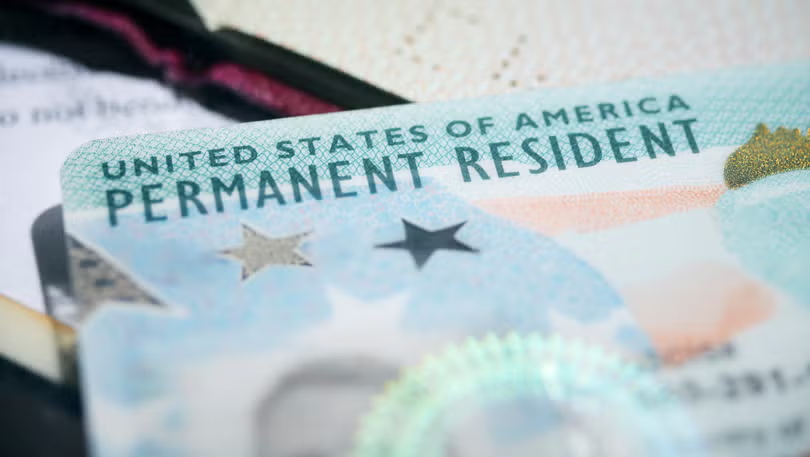
The Trump administration’s latest denaturalization effort targets 17 naturalized U.S. citizens convicted of crimes, marking an unusual move in American immigration law. The Department of Justice announced Monday that it would seek to strip citizenship from these individuals, all of whom were found guilty in various federal courts.
Who the DOJ Is Targeting
According to the DOJ statement, the 17 people came from a range of countries, including Cuba, Haiti, Somalia, China, India, and elsewhere. Their convictions span offenses such as healthcare fraud, wire fraud, and conspiracy to manipulate stock prices.
The department’s core accusation is that these individuals concealed their criminal activity during the naturalization process, effectively obtaining citizenship under false pretenses.
Acting Attorney General Todd Blanche framed the effort as a matter of protecting the integrity of citizenship. He described gaining U.S. citizenship as a privilege and said the department maintains a zero-tolerance policy toward abuse of the process. He added that the DOJ continues working with interagency partners to ensure citizenship goes only to those who genuinely deserve it.
How Denaturalization Works
Denaturalization is a rare step in the United States and carries specific legal limits:
- It can only be carried out through federal court.
- It applies solely to citizens who obtained their nationality through the naturalization process.
That distinction matters, because it leaves people who acquired citizenship by birth on entirely different legal footing.
The Broader Push on Birthright Citizenship
The administration isn’t stopping at naturalized citizens. It has also set its sights on birthright citizenship, which is protected by the U.S. Constitution and granted to anyone born under the legal jurisdiction of the federal government.
Early in his presidency, Trump signed an executive order seeking to deny birthright citizenship to children born to undocumented parents. The administration is additionally targeting “birth tourism,” the practice of foreigners traveling to U.S. soil specifically to give birth to a child who would automatically become a citizen.
The stakes here are significant. The U.S. Supreme Court is expected to rule, possibly by the end of this month, on Trump’s executive order aimed at ending automatic birthright citizenship.
A Setback on the H-1B Visa Fee
While the administration presses forward on citizenship, it is meeting resistance elsewhere in immigration policy. On Monday, a federal judge struck down a $100,000 fee the administration had imposed on H-1B visas for highly skilled foreign workers. Officials had defended the fee by arguing that the H-1B program was being used to displace American workers.
A coalition of 20 Democratic attorneys general challenged the measure in court. U.S. District Judge Leo Sorokin of Massachusetts, an Obama appointee, ruled against it, concluding that the $100,000 charge functioned as a tax rather than a fee. Because taxes require congressional authorization, he found, the administration could not impose it on its own. In his ruling, Sorokin wrote that the substance and application of the payment revealed it to be a tax, no matter what label was attached to it.
Taken together, these developments paint a picture of an administration pushing aggressively on multiple immigration fronts at once, some efforts advancing through executive action while others run into the limits set by the courts.
Author