Two Petitions, One Verdict: Trump and the Justice Department Take the Carroll Case to the Supreme Court
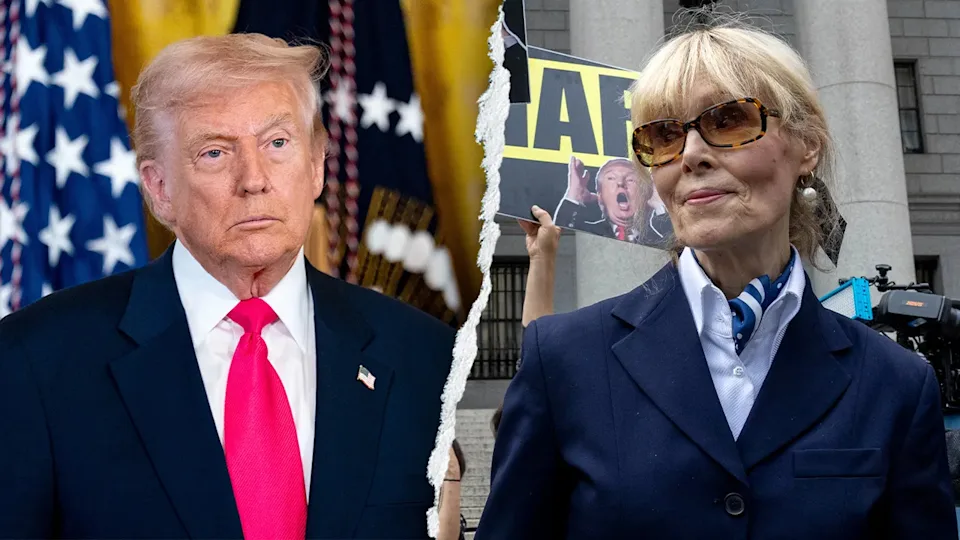
The E. Jean Carroll defamation verdict is heading to the Supreme Court for a second time, and this round arrives with an unusual feature: the president is not appealing alone. The Justice Department has filed alongside him, asking the justices to let the federal government step into the case in his place.
If that request succeeds, the practical effect would be to end Carroll’s claim entirely.
Two Different Arguments
The filings advance separate theories aimed at the same outcome.
Trump’s personal attorneys argue presidential immunity. Their position is that the statements at issue were made in 2019, while he held office, in response to press questions about accusations touching on his fitness to serve. Because such accusations are matters of public concern, they contend, a president’s response to them is inherently official conduct — and they are asking the Court to say so directly.
They also accuse the Second Circuit of dodging. According to the petition, the appeals court engaged in procedural maneuvering rather than deciding whether immunity applied at all, a result they describe as demanding review in what they call an unprecedented case. They characterize the award as grossly excessive and note, accurately, that no court in American history has previously imposed damages liability on a president for conduct while in office.
The Justice Department takes a narrower route. Rather than asking the Court to expand immunity doctrine, it invokes the Westfall Act, a 1988 statute that shields individual federal employees from tort suits arising out of their official duties by substituting the United States as the defendant.
Federal attorneys wrote that without intervention, a sitting president faces close to a hundred million dollars in personal liability for conduct they say fell within the scope of his federal office — and that this fact alone warrants the Court’s attention. They also argued that the previous administration’s decision to abandon the defense of a former president should not have prevented the current administration from renewing it.
The department is now led by Todd Blanche, who previously served as Trump’s criminal defense attorney.
Why Substitution Would End the Case
Ordinarily, Westfall substitution shifts liability from an employee to the government, leaving taxpayers responsible. Here the mechanics work differently.
Defamation claims cannot generally be brought against the United States, because the Federal Tort Claims Act preserves sovereign immunity for that category of suit. So substituting the government as defendant would not transfer the $83.3 million bill to the Treasury — it would extinguish the claim.
That is why the DOJ petition, despite being framed as the more modest of the two, may be the more consequential.
What the Appeals Court Said
The Second Circuit upheld the judgment. A three-judge panel concluded that Trump had not identified grounds for revisiting its earlier holding on presidential immunity, that the district court had not erred in the challenged rulings, and that the jury’s damages were fair and reasonable.
On the substitution question, the court’s objection was largely about timing. Judge Denny Chin wrote that no other defendant would be permitted to seek substitution of the United States fifteen months after trial and entry of judgment.
That timing point is the crux of the disagreement. Trump’s side reads the ruling as a procedural sidestep of a substantial constitutional question. The panel treated it as an ordinary application of rules that apply to everyone.
Notably, the appeals court split over the decision and agreed to postpone payment until the Supreme Court has its say.
The Two Verdicts, Kept Straight
The litigation has produced two separate judgments, and they are easy to conflate.
The first, in 2023, resulted in a $5 million award after a jury concluded that Trump had sexually abused Carroll and defamed her in remarks made after his first term ended. That judgment has been paid. The Supreme Court declined to hear his appeal of it in June, and he is now asking the justices to reconsider that refusal.
The second, in January 2024, produced the $83.3 million award. It concerns statements from 2019, during his presidency, in which he denied knowing Carroll, said she was not his type, and asserted she had fabricated the account to sell books.
Carroll, a longtime advice columnist and former television host, testified before two New York juries that Trump assaulted her in a dressing room at Bergdorf Goodman in the spring of 1996. She first described the encounter publicly in a 2019 memoir. Trump has consistently denied any wrongdoing, and in his earlier petition emphasized the absence of eyewitnesses, video, or a police report.
Her attorneys have declined to comment on the current filing.
The Precedent Being Invoked
Trump’s petition leans on the Supreme Court’s 2024 ruling granting broad immunity from criminal prosecution for official acts taken in office — the decision that effectively ended the special counsel’s election-related case.
Whether that reasoning extends to civil liability is an open question, and it is essentially what the Court is being asked to resolve. There is older precedent pointing toward broad civil immunity for official acts, and other precedent making clear that a president is not immune from suits over unofficial conduct.
The dispute, then, is definitional. Is a president answering a reporter’s question about a personal accusation from decades before he took office performing his job, or speaking as a private individual who happens to occupy the office?
Reasonable lawyers land on both sides of that line, which is part of why the case is genuinely difficult rather than merely contentious.
Timing
The Court is out for the summer, so the petitions will not be considered until the fall. If the justices agree to hear the case, a decision would most likely arrive by June of next year.
Until then, the $83.3 million remains unpaid and the judgment remains on the books.
For Carroll, now in her eighties, the delay is itself a cost. For Trump, the stakes extend past the money to whether a president can be held financially accountable in court for what he says from the White House podium — a question no American court has previously had to answer.
Author
-
Lucienne Albrecht is Luxe Chronicle’s wealth and lifestyle editor, celebrated for her elegant perspective on finance, legacy, and global luxury culture. With a flair for blending sophistication with insight, she brings a distinctly feminine voice to the world of high society and wealth.