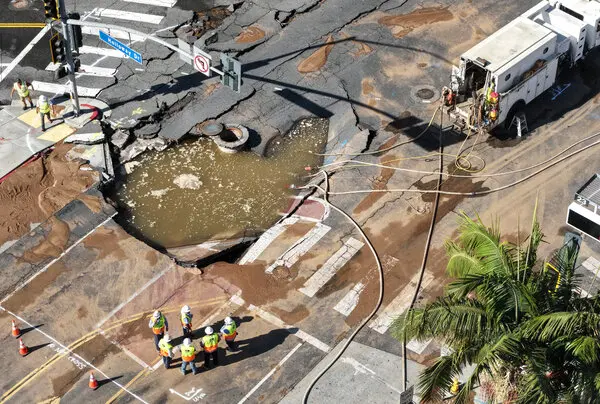
A Century-Old Pipe Bursts: How a 1916 Water Line Turned Sunset Strip Into a River
Los Angeles woke up to a startling scene early Thursday when a century-old water line gave way, unleashing thousands of gallons of water that surged down the Sunset Strip and into surrounding neighborhoods. The rupture became the latest, and perhaps most dramatic, reminder that the city’s aging water infrastructure is straining under the weight of its own history.
Streets became rivers, garages became pools, and a giant sinkhole opened in the middle of one of L.A.’s most famous boulevards. But the real story runs deeper than a single burst pipe.
A Pipe From Another Era
The line that failed wasn’t just old — it was 110 years old. Installed in 1916, the riveted steel pipe was part of the Sunset Trunk Line, one of the major arteries that carries water from reservoirs and tanks to the smaller distribution mains threading across Los Angeles.
The timing is almost cruel. According to the utility, this very section had been scheduled for replacement in 2031, meaning it ruptured years before crews were set to retire it.
The scale of the challenge behind that single failure is staggering. The city sits atop roughly 547 miles of trunk line, and as far back as 2019, the Los Angeles Department of Water and Power reported that about 29% of the city’s pipes had passed 80 years in age — inching toward the 100-year lifespan most such pipes are built to last.
Why the System Keeps Breaking Down
The core problem is as much financial as it is physical. Utilities have been fighting an uphill battle to keep the system running, hamstrung by limited funds for any sweeping overhaul of the aging network.
David Feldman, a professor emeritus of urban planning and public policy at UC Irvine, explained the slow decay in plain terms. Over time, he noted, rust and corrosion inevitably set in. He pointed out that the city operates an enormous grid of pipes and simply cannot replace every one, both because the cost would be prohibitive and because the disruption would be overwhelming.
The danger, Feldman said, lies in the weak spots. When corrosion eats away at a section of pipe, a sudden surge of pressure can be enough to trigger a leak — exactly the kind of failure that played out on Sunset Strip.
Adding to the frustration, a 2019 report from the city’s Office of Public Accountability found that the utility had struggled to advance its planned trunk line replacement projects, largely because of contracting delays.
A Familiar Nightmare
For Los Angeles officials, aging infrastructure is a recurring headache rather than a fresh surprise. The city has watched this scenario unfold before.
- In 2009, a string of major breaks drew public outrage, including one incident where a sinkhole partially swallowed a fire truck.
- In 2014, a ruptured trunk line on Sunset Boulevard in Westwood sent millions of gallons of water flooding across the UCLA campus, damaging several buildings and causing millions of dollars in losses.
The Hollywood Hills, where Thursday’s rupture occurred, has long stood out as a trouble spot. A Times data analysis conducted after the 2014 flood found that nearly half of L.A.’s water pipes had been graded “C” or lower for their condition. Experts noted at the time that pipes in the hills run at higher-than-normal pressure, which makes leaks more likely. That same analysis flagged several lines near the recent break that were over 80 years old and had already logged previous leaks.
Standing before the fresh sinkhole at a morning news conference, L.A. Mayor Karen Bass acknowledged the underlying issue directly, calling it one of the challenges that comes with infrastructure this old.
The Morning It All Broke Loose
The chaos began just before 4 a.m., when the LADWP received word that the 110-year-old trunk line had ruptured in West Hollywood. Water came pouring down Holloway Drive, swamping businesses and flooding the underground parking garages of nearby apartments. Crews managed to shut off the leak after a few hours, but not before a massive sinkhole had opened up in the middle of Sunset Boulevard.
By the time residents woke, their streets had transformed into rushing rivers. Utility crews, Los Angeles County sheriff’s deputies, and firefighters converged on the area. A bus depot at Santa Monica and San Vicente boulevards had turned into a shallow lake, and video from the scene captured a person being swept down a street by the roaring water before regaining their footing.
Businesses Left Counting the Cost
For local business owners, the flood arrived without warning and left plenty of damage behind.
Tadeh Ghazalian, a co-owner of Dialog Cafe on Holloway Drive, began fielding phone calls around 5 a.m. about the broken line. Water surged down the street and into his restaurant, and also wrecked several cars parked nearby.
“It was like a waterfall,” he recalled.
Ghazalian, whose family has held a stake in the restaurant for 18 years, said he had no idea how long repairs would take or when he might reopen. His priority, he explained, was doing everything safely, especially with crews working to navigate sinkholes where water had pulled sand out from beneath the sidewalk.
What the City Is Doing About It
Officials insist they aren’t standing still. Anselmo Collins, DWP’s chief operating officer and senior assistant general manager, acknowledged the aging pipes but emphasized that the utility runs a water infrastructure program that installs and replaces roughly 45 miles of pipe each year.
Los Angeles has about 7,400 miles of pipes in total, counting both distribution lines and trunk lines. Collins described the replacement effort as aggressive, noting the utility keeps crews dedicated solely to trunk lines along with more than 30 additional crews swapping out distribution pipes citywide each year. Even so, he admitted, weak spots can lurk unseen until a leak suddenly exposes them.
The numbers reveal how slow the process really is. In the 2024-25 fiscal year, the city installed 5,266 feet of trunk line pipe, aiming to replace just over 6,000 feet the following year — a modest pace against hundreds of miles of aging infrastructure. The utility says it prioritizes replacements based on leak history, soil conditions, and pipe age.
Amid the reassurances, Collins stressed one key point: despite the break, all water provided to DWP customers remains safe to drink.
Planning for the Future
The rupture arrives just as the city takes steps to get ahead of its infrastructure woes. In May, Mayor Bass announced a Capital Infrastructure Program — a first for Los Angeles — designed to guide long-term decisions on essential systems like sidewalks, curb ramps, and roads. Her office noted that the absence of such a plan had long left projects underfunded and city facilities poorly maintained.
Voters will get a say too. In November, they’ll decide whether to approve a charter amendment that would let the city establish a five-year capital infrastructure program, potentially giving L.A. a more structured way to tackle its aging systems.
The Ripple Effects
The immediate fallout spread well beyond the flooded blocks. L.A. Metro warned commuters to brace for significant delays across more than a dozen lines because of the flooding, and several major streets were shut down throughout the day.
Key closures included stretches of eastbound Sunset Boulevard, Holloway Drive, and Santa Monica Boulevard, along with sections of Larrabee Street, Palm Avenue, and Hancock Avenue running between Sunset and Santa Monica boulevards.
As for repairs, the timeline remains uncertain. Collins explained that once everything is shut down, crews will pump the water out of the hole, assess the damage, and only then determine how long the fix will take.
The Bigger Picture
Thursday’s flood is more than a one-day disruption. It’s a vivid symptom of a slow-moving crisis facing not just Los Angeles but many older American cities, where infrastructure built generations ago is quietly reaching the end of its life.
The tension is clear. The pipes are aging faster than they can affordably be replaced, and every year the utility swaps out only a fraction of what’s growing old. Until funding, planning, and pace catch up with the sheer scale of the problem, a century-old pipe bursting beneath a famous boulevard may be less an anomaly than a preview of what’s to come.
Author