The Chongqing landslide that struck Friday morning killed at least eight people and left 34 unaccounted for, burying more than 10 residential buildings and forcing over 1,100 people from their homes.
It happened at around 9:08 a.m. in Pengshui County, on the outer edge of the Chongqing municipality in southwestern China, when an enormous volume of rock and soil swept down a slope onto a residential area.
The Scale of the Collapse
The numbers give a sense of the force involved.
Wang Chuanjun, who heads Planning and Natural Resources in Pengshui County, said the landslide carried roughly 18,000 cubic meters of rock and debris — about 636,000 cubic feet.
A single boulder within that mass measured around 3,000 cubic meters, or approximately 106,000 cubic feet. That’s one rock with the volume of a small apartment building.
Ten people were pulled from the debris, including two with serious injuries, according to Pengshui County Mayor Ren Xujiang.
A Warning That Came Just Too Late
One detail changes how this event should be understood.
Residents said local officials and community organisers had begun an evacuation after small rocks started falling and unusual sounds were heard coming from the hills.
The landslide occurred during that evacuation, according to local newspaper Chongqing Daily.
The warning signs were noticed. People acted on them. The mountain simply moved faster than the evacuation could finish.
Without those early signs and the response they triggered, the casualty figures would almost certainly be far higher than they are.
The Rescue Operation
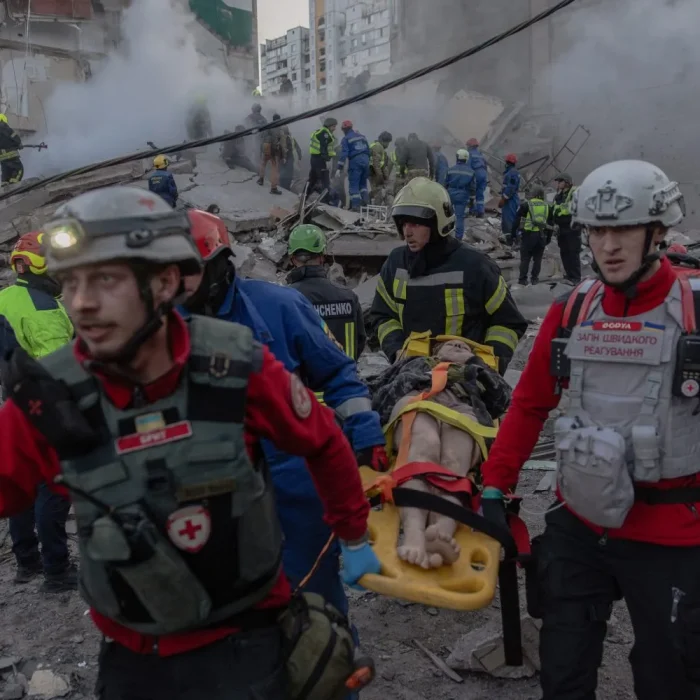
More than 800 rescuers worked at the site, according to a local government statement.
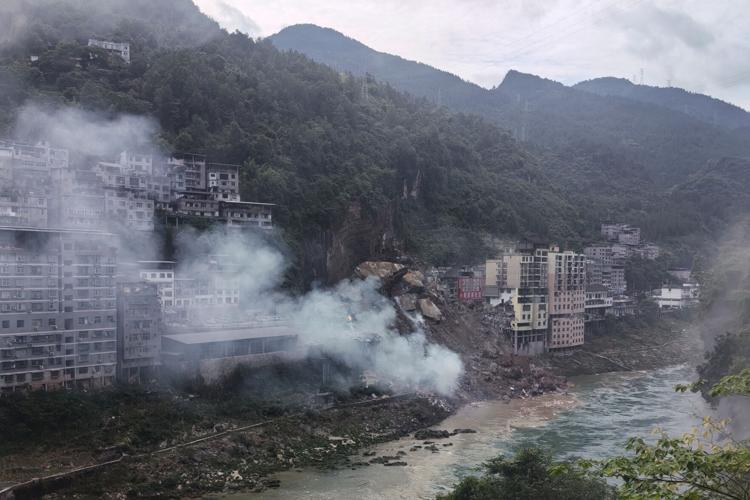
Images from state broadcaster CCTV showed part of a mountainside collapsed onto the residential area, with several buildings standing immediately adjacent to the slide path and crews searching through debris.
Social media footage showed rescuers in orange gear operating excavators to dig through rubble. At one point, a team pulled a survivor from the wreckage.
Drones were deployed to survey the affected sites, according to Xinhua — a practical choice given how dangerous it is to send people onto unstable ground.
The Danger Hasn’t Passed
CCTV reported that rescue efforts were being hampered by unstable terrain and the threat of a second landslide.
That risk is not theoretical. Wang warned that further collapse remains possible under extreme weather, including both heavy rainfall and prolonged periods of clear, hot weather.
Expert field inspections found scattered unstable rock masses still sitting at the top of the steep cliff and along its sides.
Both weather extremes create hazard through different mechanisms. Rain adds weight and lubricates failure surfaces. Extended heat causes thermal expansion and contraction that fractures rock over time.
Utilities Cut as a Precaution
Water, electricity, and gas supplies were shut off within a one-kilometer radius of the landslide — about 0.6 miles — to prevent additional disruptions.
Severed gas lines and live electrical infrastructure in a debris field create secondary risks that can be more dangerous to rescuers than the collapse itself.
The National Response
President Xi Jinping directed authorities to determine the cause of the disaster, according to state media.
More than 13,000 disaster relief items were sent to Chongqing, including tents, folding beds, and family emergency kits — supplies aimed at the 1,100-plus people now displaced.
The Geography Behind the Risk
The landslide occurred near a section of the Wujiang River, in terrain that helps explain why this happened.
The area is karst mountain country — limestone landscape shaped by water dissolving rock over long periods, producing steep cliffs, caves, and internal voids. Small towns and agricultural terraces are scattered throughout.
Karst terrain is inherently unstable in ways that aren’t always visible from the surface. Water moves through rock rather than simply over it, gradually weakening structures that appear solid.
Combine that with steep slopes, heavy rainfall, and residential buildings constructed close to cliff faces, and the conditions for exactly this kind of event are present.
Pengshui County sits in the southeastern part of Chongqing, bordering Hubei and Guizhou provinces.
What the Damage Looked Like
Photographs showed large rock slabs that had slid past buildings and down into a waterway below.
Two structures — one roughly five stories, another about 15 — were damaged but remained standing. That they survived at all, positioned that close to the slide path, suggests the debris flow was channelled rather than spread evenly across the area.
What Comes Next
The immediate priority is the 34 people still missing, though the passage of time and the volume of material involved make that search increasingly difficult.
Beyond that, the investigation Xi ordered will likely examine two questions: what triggered the collapse, and how residential buildings came to be sited directly beneath an unstable cliff face.
The second question tends to matter more for preventing the next one. Karst mountain regions across southwestern China contain many communities in comparable positions, and the warning signs residents noticed Friday morning — falling rocks, unusual sounds from the hillside — are the same signs that could save lives elsewhere.
Author