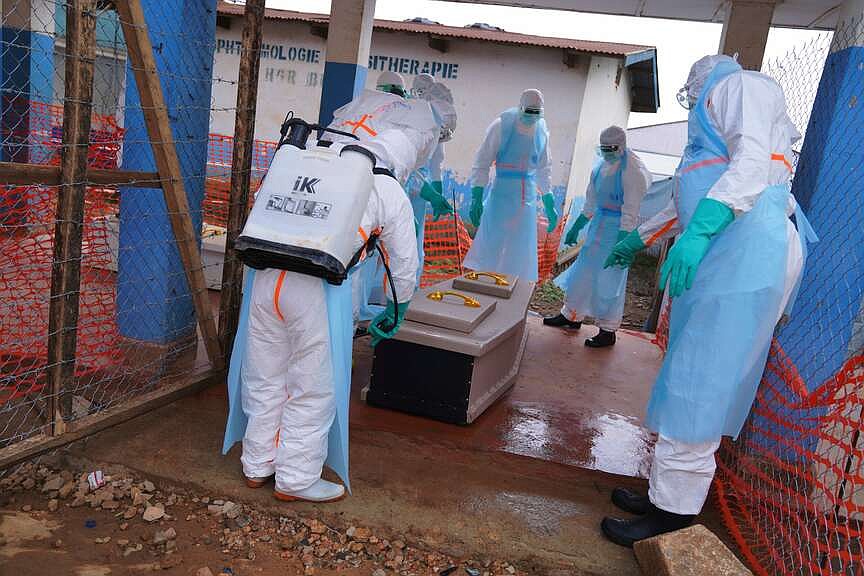
The Ebola outbreak DR Congo declared on May 15 has now killed more than 1,000 people, according to official figures released Thursday. Health workers have documented 2,536 cases and 1,033 deaths in roughly two months.
The more alarming number is not the total. It is the rate.
The Speed Problem
Congo’s 2018–2019 outbreak required ten months to reach 2,000 confirmed cases. The current epidemic covered that distance in two.
That comparison, drawn from World Health Organization figures, makes this the fastest-spreading Ebola outbreak ever recorded. Every response system built around historical transmission speeds is now operating against something that moves five times faster.
Trish Newport, an emergency program manager with Doctors Without Borders, described the core problem plainly: the response cannot continue with the same limited resources while the epidemic keeps outpacing it.
Why Ituri Is the Hardest Possible Place
The epicenter sits in a province that would challenge any public health response even under ideal circumstances. Ituri has none.
Armed conflict has persisted there for more than three decades. More than 900,000 people live in displacement camps — dense settlements where isolation is nearly impossible and where any infectious disease finds ideal conditions.
The regional economy compounds the difficulty. Artisanal gold mining draws large numbers of informal workers who move frequently between sites and across regions. Mobile populations are precisely what an outbreak needs to expand its geographic footprint.
Add a health system already degraded before the epidemic began, and the response starts from behind.
The Money Isn’t There
The funding gap is not marginal. It is most of the budget.
In mid-July, the WHO reported that its joint response plan with the Africa Centers for Disease Control — budgeted at $518 million — faced a shortfall exceeding $400 million.
That means roughly a fifth of the required resources have materialized.
The consequences reach all the way down to individual workers. Health staff in Ituri went on strike briefly this month, walking away from Ebola wards and in some cases burning tires outside health centers, protesting unpaid wages and dangerous working conditions.
Asking people to treat one of the deadliest known pathogens without paying them is not a sustainable model.
Beds That Don’t Exist
Doctors Without Borders and other responding organizations have warned that treatment centers are running at capacity.
The downstream effect is the one that should worry everyone.
When no bed is available, patients wait at home. A person with Ebola waiting at home is surrounded by family members providing care without protective equipment. Each such wait is a transmission event in progress.
Capacity shortages in an Ebola response do not simply delay treatment. They actively accelerate spread.
Contact Tracing Falling Apart
Amadou Bocoum, Congo director for CARE International, told NPR the situation is worsening daily, citing three specific failures:
- Contact tracing systems unable to keep pace
- Funding well below requirements
- Rapid geographic expansion beyond the original zone
Contact tracing is the backbone of any Ebola response. Identify everyone an infected person encountered, monitor them, isolate them at first symptom. When that system fails, the outbreak stops being trackable and becomes something you can only count after the fact.
The Kisangani Warning
The most consequential development in recent weeks is geographic.
The government confirmed this month that Ebola has reached Tshopo and Haut-Uele provinces. Tshopo carries particular risk.
Four deaths have been recorded in Kisangani, the provincial capital — a trading center of more than one million people with direct transport links to Kinshasa, the national capital.
That connection is the scenario responders have been working to prevent. Ebola in a rural district is a containable emergency. Ebola established in a major urban center connected to the capital is a different order of crisis entirely.
Four deaths is a small number. It is also how urban outbreaks begin.
Government Response
Prime Minister Judith Suminwa traveled to the eastern hotspots Thursday to assess conditions directly, accompanied by officials from the United States and the United Nations.
Ministerial visits do not stop transmission. But they signal political attention, and political attention is often what unlocks funding — which is the binding constraint here.
What Would Actually Help
The needs identified by responders are concrete rather than abstract:
- Closing the $400 million funding gap
- Paying health workers reliably so wards remain staffed
- Expanding treatment capacity so patients stop waiting at home
- Rebuilding contact tracing at the scale the spread now requires
- Containing the Kisangani cluster before urban transmission establishes
None of that is technically mysterious. Ebola response is a well-understood discipline. The obstacle is resources, not knowledge.
The Assessment Nobody Wants to Hear
Bocoum’s conclusion was direct: without a substantial increase in funding, controlling the situation is unlikely.
That is not despair. It is arithmetic.
An epidemic doubling faster than any previous outbreak, in a conflict zone, among displaced and mobile populations, with a fifth of the necessary funding, is not going to resolve on its own trajectory.
More than 1,000 people have died. The rate suggests that number will look small before this is over — unless something changes in the next several weeks.
The window for that change is narrowing. It has not closed.
Author
-
Lucienne Albrecht is Luxe Chronicle’s wealth and lifestyle editor, celebrated for her elegant perspective on finance, legacy, and global luxury culture. With a flair for blending sophistication with insight, she brings a distinctly feminine voice to the world of high society and wealth.