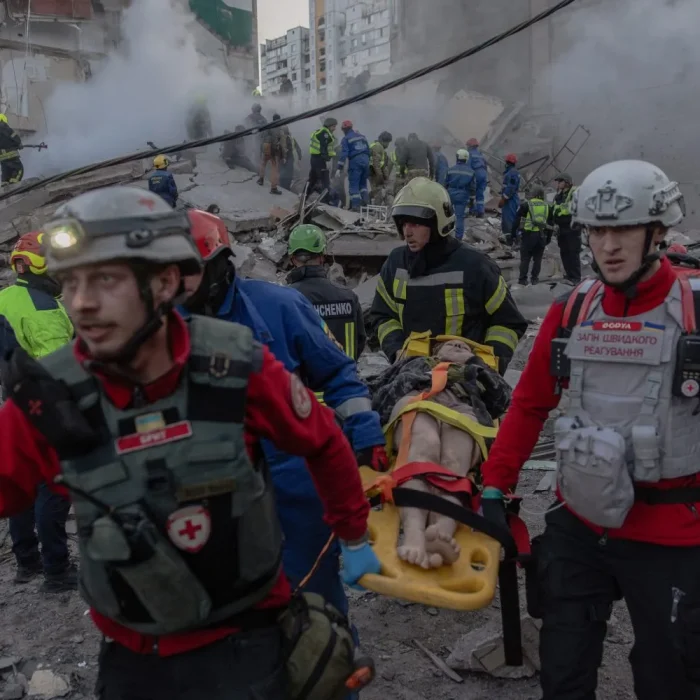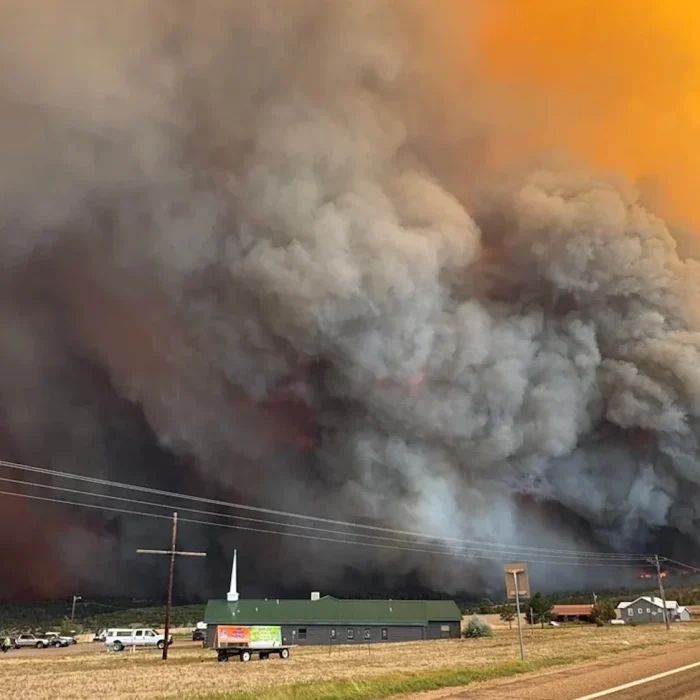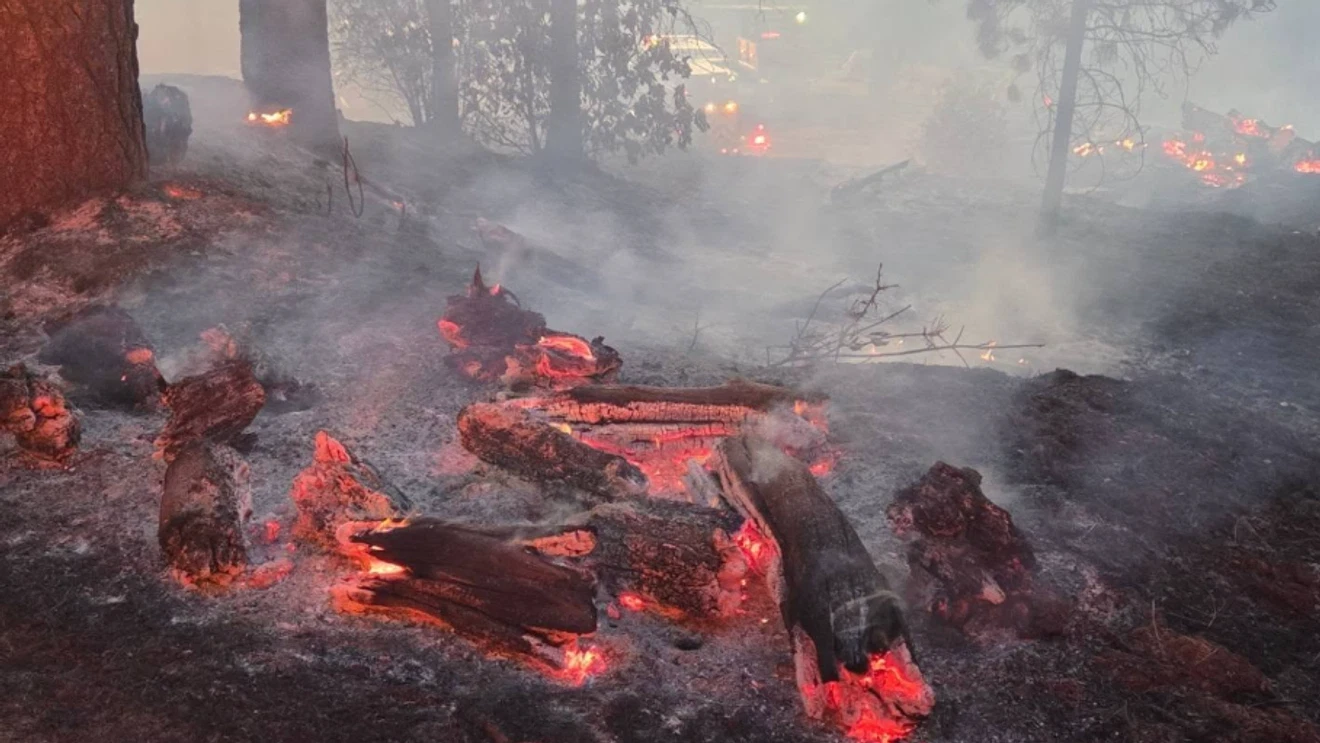
A Dove Fire Sonora evacuation unfolded rapidly on Sunday afternoon as flames tore through the Sierra Nevada foothills southwest of downtown, forcing families out of their homes and shutting major roads in a city that serves as one of the main gateways to Yosemite National Park.
The blaze was reported shortly before 3 p.m. and expanded quickly, reaching 223 acres by 7:30 p.m., according to Cal Fire. Containment stood at just 1% late Sunday night.
Progress, but Barely
There was one encouraging development as the evening wore on. The fire’s rate of spread eased from dangerous to moderate, and crews reported it was staying inside the control lines they had cut to slow it.
In a 6 p.m. update, the Cal Fire Tuolumne-Calaveras Unit said resources were making good progress — measured language that acknowledged the fight was far from over.
Two firefighters were hurt during the response and taken for medical evaluation, according to Cal Fire public information officer Emily Kilgore. The agency was still assessing whether any buildings had been damaged, and the cause of the fire had not been determined.
A Heavy Response
Cal Fire called in additional air and ground support as the fire ran through the mid-afternoon hours.
More than 225 personnel were assigned to the incident, supported by multiple air tankers, helicopters, 22 engines and four bulldozers. That level of commitment early in an incident usually reflects one thing: proximity to homes.
Downtown Sonora heard sirens through the afternoon, and a substantial smoke column rose over the area. The plume drifted far enough to be visible near Lake Tahoe.
Who Had to Leave
The Tuolumne County Sheriff’s Office issued mandatory evacuation orders covering Dove Lane, McKibbon Drive, Golden Dove Lane, Crooked Lane, Southgate Road, Stockton Road and Silver Pine Lane. Orders also applied to the stretch from Washington Street to Lowe’s, the north side of Mono Way, the area from the silos on Washington Street to Hospital Road, and Beretta Street between Washington and Lyons Road.
By late afternoon, evacuation warnings had reached into downtown itself, covering South Washington Street to Berretta Street, Martha Lane, Outlook Drive, South Stewart Street, South Shepherd Street, South Beretta Street, and Washington Street from Highway 108 to the Red Church on Shell Street.
Cal Fire described the situation as an immediate threat to life and told residents in the affected zones to leave now.
The sheriff’s office went further, urging anyone who felt unsafe to go without waiting for an official order, and asking the public to stay clear of the area so emergency crews could work.
That instruction — leave before you are told — matters more than it might sound. Evacuation orders lag behind fire behavior by design, since officials need confirmed information before acting. Residents watching flames or heavy smoke from their own property often have better real-time information than a dispatcher several miles away.
Roads Shut Down
Closures made movement around Sonora difficult through the evening.
Highway 108 was blocked between Fifth Avenue and Mono Way. Mono Way was closed from Greenley into downtown. Washington Street was shut from Highway 108 to Bradford. Stockton, Lyons, Morning Star and Forest roads were closed at several intersections.
All evacuation orders and warnings remained active as of 7:30 p.m.
Where People Could Go
Officials opened the Tuolumne County Resilience Center at 18241 Bay Ave. in Tuolumne, roughly ten miles east of Sonora, as an evacuation site.
The Tuolumne County Transit Center was also opened as a cooling center and clean-air location for unhoused residents — a detail worth noting, since people without shelter face compounded risk during a fire, exposed both to smoke and to heat with nowhere to retreat.
In Jamestown, a temporary animal evacuation shelter was established at Animal Control, 10040 Victoria Way, alongside a large-animal evacuation center at the Posse Grounds, 19130 Rawhide Road.
That second facility reflects the reality of foothill communities where horses and livestock are common. Large animals cannot be loaded quickly, which is why residents with stock are usually advised to move them at the warning stage rather than waiting for a mandatory order.
The Weather Working Against Crews
Conditions on Sunday afternoon were tailor-made for rapid fire growth. Temperatures sat in the low 90s near the fire, with wind gusting between 15 and 20 mph.
Forecasters expected the gusty winds to persist until sunset, with temperatures holding in the 80s to low 90s.
Overnight brought relief. Temperatures were projected to fall into the 60s with light winds and relative humidity climbing to around 50% — the window crews rely on to strengthen containment lines while fire behavior calms.
Monday looked less forgiving. Temperatures were forecast to return to the low 90s, with gusts of 10 to 20 mph and minimum relative humidity dropping to roughly 15%. That combination of heat, wind and extremely dry air is what fire managers watch most closely, because it can undo overnight gains within hours.
Why This Location Is Difficult
Sonora sits in the Sierra Nevada foothills, terrain characterized by steep slopes, dense brush and homes scattered through the wildland interface rather than clustered in defensible blocks.
Fire moves faster uphill, and foothill vegetation this late in July is thoroughly cured. Access roads are often narrow and winding, which slows both engine deployment and civilian evacuation — a single stalled vehicle can back up an entire escape route.
The city’s role as a Yosemite gateway adds another layer. Summer brings substantial visitor traffic to the area, meaning some people caught in closures are unfamiliar with local roads and have no alternate route in mind.
Staying Informed
Fire conditions in this kind of terrain change hour by hour, and evacuation boundaries can expand with little warning.
Residents should rely on the Tuolumne County Sheriff’s Office and Cal Fire for current orders rather than social media, where outdated maps circulate widely. Anyone in a warning zone should have vehicles loaded, documents and medications gathered, and a departure route chosen before conditions force the decision
Author