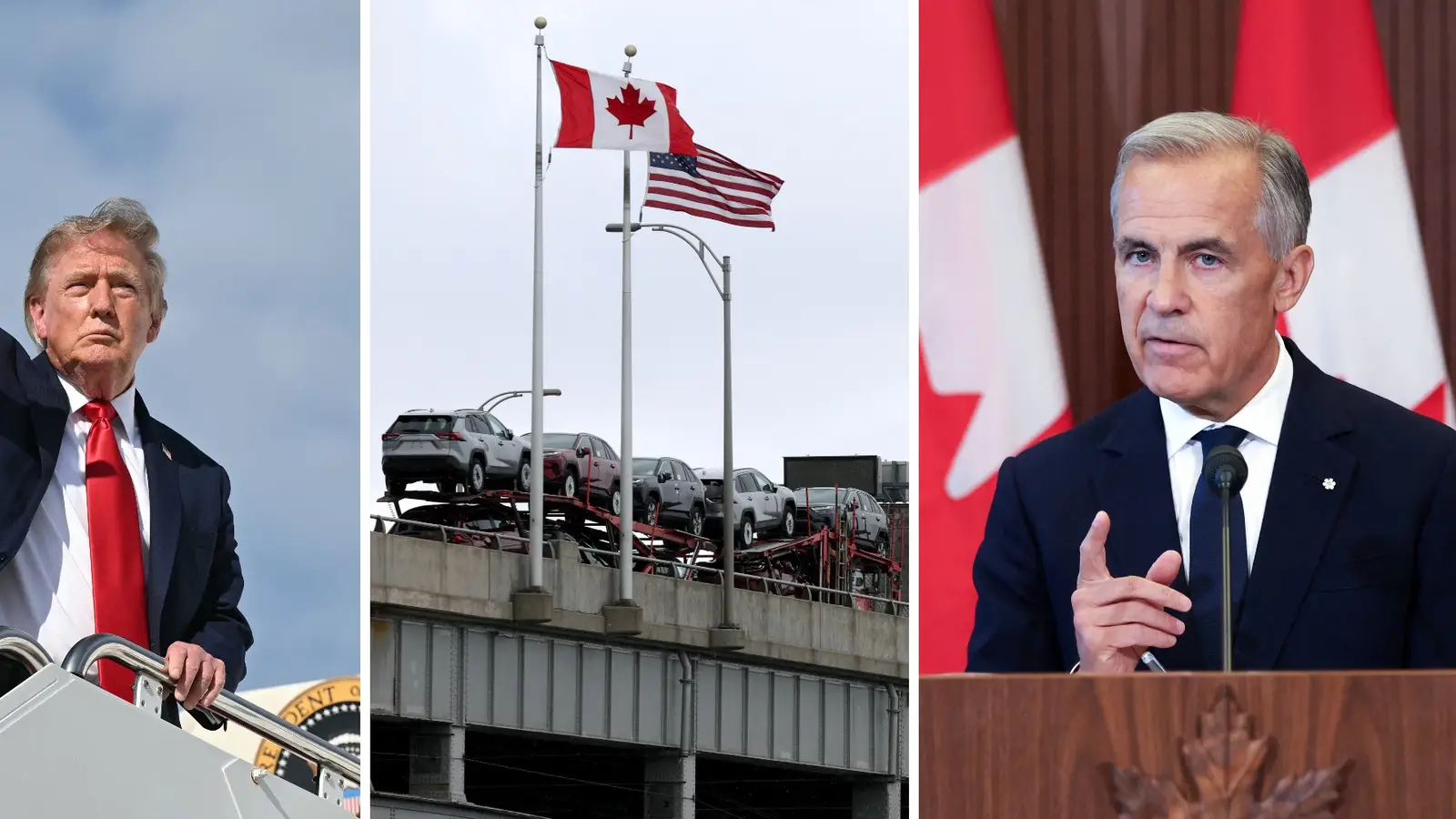
The US Canada trade war has moved past tariffs and into outright bans. The White House confirmed on Tuesday that Washington will block imports of certain Canadian dairy products, most alcoholic beverages, and some motorcycles, a decision taking effect on September 29.
The announcement did not arrive in a vacuum. Hours earlier, Canada’s promised retaliatory tariffs kicked in on $20 billion worth of American imports, itself a response to earlier moves by President Donald Trump after negotiations between the two governments fell apart last month.
What the Ban Actually Covers
The prohibited list is oddly specific, which is what happens when trade fights become personal.
Various Canadian wines and spirits are barred, a direct answer to several Canadian provinces pulling American alcohol from their shelves. Also covered are certain motorcycles and mopeds, dairy products including whey, and several categories of molasses.
Trump went further than product bans. He moved to lock Canadian goods out of large, long-term US government contracts, instructing the General Services Administration to treat Canadian products as ineligible until Canada permits what he described as full and fair reciprocity for American goods.
How a Long Friendship Fell Apart
The two countries have argued about trade for decades. Canada’s protected dairy sector and its subsidies for softwood lumber producers have been perennial irritants. But the arguments happened between allies.
That framework has collapsed quickly under Trump. On August 22, the US imposed 50 percent tariffs on roughly 5 percent of Canadian imports, accusing Canada of unfair treatment of American dairy, alcohol and auto industries.
Layered on top are Trump’s repeated comments about making Canada the 51st state, remarks that have generated more genuine anger in Canada than any tariff schedule. Prime Minister Mark Carney won power in a come-from-behind victory last year largely on a promise to stand up to exactly this.
Carney’s Answer: Stop Depending on Them
Carney has not framed his response primarily as retaliation. He has framed it as independence.
The strategy, he said, is about making sure no country can hold Canada hostage and that Canadians can live the way they choose. He acknowledged short-term economic pain but argued it would accelerate Canadian investment, infrastructure spending and trade diversification.
His assessment of the old arrangement was candid. It was easy business, he said, but it left Canada leaning far too heavily on a single economic partner. That era, in his words, is finished.
The numbers show how large the task is. More than 70 percent of Canadian exports still head to the United States. Carney says exports to other markets are climbing quickly and could double within a decade.
Looking Toward Europe
Canada is quietly exploring a much deeper relationship with the European Union, according to a Canadian official familiar with the discussions who spoke anonymously because they were not authorised to comment publicly.
The possibilities under consideration stop short of membership but could include expanding existing agreements, negotiating an entirely new treaty, or building other cooperative structures. Ottawa is already consulting provinces, territories and labour organisations about what a closer EU relationship might look like, though no particular model has been selected.
The timing is conspicuous. Carney travels to Strasbourg next week, where he will attend European Commission President Ursula von der Leyen’s State of the European Union address on September 16 and speak to the European Parliament the day after.
Why Canada Retaliated
Carney defended the counter-tariffs on straightforward grounds: Canada could not allow American goods to enter duty-free while Canadian firms absorbed US tariffs.
He insisted Ottawa was not trying to escalate, but said protecting Canadian workers required a response.
His deeper complaint concerns what Washington actually asked for during the failed talks. The cumulative American demands, he said, revealed a desire to make Canada more reliant on the United States rather than less. In too many areas, he argued, the Americans wanted dependency rather than genuine partnership.
According to Carney, Washington sought limits on French-language and cultural protections, influence over Canada’s future trade agreements, and terms that would have weakened the auto, steel and forestry sectors.
The Scale of Canada’s Response
Canada’s tariffs hit hundreds of American products at rates of 15, 25 or 50 percent. The affected goods include steel, aluminium, cheese, appliances, clothing, cosmetics and farm equipment.
The package covers roughly $20 billion in American exports, about 6 percent of the $333.6 billion the US sold to Canada last year.
Since talks collapsed on August 21, the Trump administration has added tariffs and issued a stream of threats and public characterisations of Canada as weak and dependent.
Public Anger Has Its Own Momentum
Government policy is only part of the picture. Canadians have cut travel to the United States sharply and organised boycotts of American products, responses Carney has praised as evidence of national resolve.
British Columbia Premier David Eby captured the mood with a plan to install new signs at US border crossings. They will read: Welcome to British Columbia, Canada. Strong, proud and will NEVER be the 51st state. Sorry!
Canadian kindness is a real strength, Eby said, but nobody should ever mistake it for weakness.
Nobody Wants to Look Eager
Officially, both governments say the door remains open. Canada-US Trade Minister Dominic LeBlanc said Ottawa was reviewing the newest American measures and that he stays in contact with US Trade Representative Jamieson Greer, adding Canada is prepared to engage whenever Washington is.
A senior Trump administration official, speaking on a White House conference call late Tuesday, said trade representatives from both countries have had constructive conversations and would talk again shortly to explore whether a path forward exists.
The politics work against speed. Former US trade official Wendy Cutler noted that Carney’s approval rating now exceeds 70 percent, giving him little incentive to rush back to the table. Neither side, she said, wants to appear anxious to reengage for fear of looking weak.
A Canadian official put it more bluntly earlier Tuesday, saying Ottawa would not change course whether Trump responded with nothing at all or with what the official called a nuclear response. The plan stays the same: build more domestically, sell more elsewhere.
What Is Really Being Tested
The outcome matters well beyond North America. This has become a live experiment in whether a smaller American ally can absorb sustained economic pressure from Washington without folding.
Every other country watching the exchange is drawing conclusions about its own exposure. That is why a dispute over cheese, whisky and motorcycles is being read, correctly, as something considerably larger.
Author