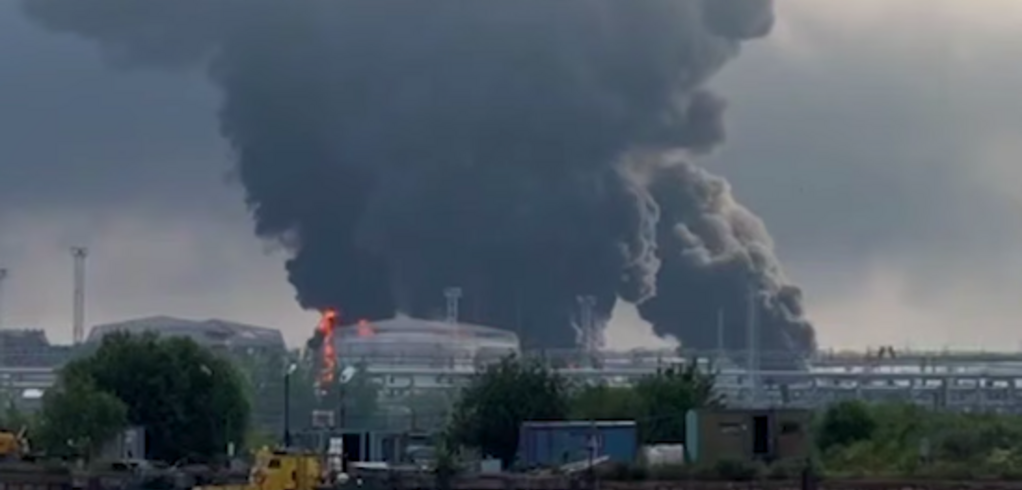
Ukraine strikes Russian oil terminals near St. Petersburg marked a striking escalation in Kyiv’s ongoing campaign to cripple Moscow’s war economy. In a daring long-range operation, Ukrainian drones reached deep into Russian territory on Saturday, targeting key energy infrastructure along the Baltic Sea. The attack represents the latest chapter in Ukraine’s determined effort to choke off the revenue streams that fuel Russia’s military machine, signalling that no target is too distant to reach.
A Bold Reach Deep Into Russian Territory
The strikes hit Russian oil facilities located near St. Petersburg, the country’s second-largest city. According to the region’s governor, the metropolis endured what he described as a large-scale drone assault, though he confirmed that no casualties resulted from the attack.
What makes this operation particularly significant is the sheer distance involved. Ukraine managed to strike targets hundreds of kilometres from its own borders, demonstrating a growing capability to project force far beyond the front lines.
This wasn’t a random act of aggression but a calculated move designed to send a clear message. By reaching such a heavily defended and economically vital area, Ukraine underscored the expanding scope of its long-range ambitions.
Zelenskyy Confirms the Strategic Purpose
Ukrainian President Volodymyr Zelenskyy wasted no time in claiming responsibility for the attacks. He explained that the operation was specifically aimed at disrupting the flow of energy revenue that sustains Russia’s war effort.
According to his statement, Ukrainian forces targeted port oil infrastructure that generates crucial income for Moscow. He also revealed that the strikes reached Kronstadt, a significant military site situated more than 850 kilometres from Ukraine’s state border.
The dual focus on both economic and military targets highlights Ukraine’s strategy. Rather than simply inflicting damage, Kyiv appears intent on systematically weakening the financial and logistical foundations that keep Russia’s invasion going.
A Widening Wave of Attacks
Saturday’s strikes were far from an isolated incident. They formed part of a much broader wave of drone operations sweeping across various parts of Russia.
This latest assault came just weeks after Ukraine had previously targeted St. Petersburg during a high-profile economic conference, an event where the Russian president himself was delivering a speech. That timing was widely seen as a deliberate embarrassment aimed at the heart of Russian prestige.
The scope of Saturday’s operation extended well beyond a single location. Several notable developments emerged from the coordinated attacks, including:
- Drones striking the port of Vysotsk, positioned roughly 170 kilometres northwest of St. Petersburg on the Gulf of Finland.
- The targeted facility being a major hub that handles oil, grain, coal, and liquefied natural gas.
- Authorities reporting that 72 drones were shot down over the surrounding Leningrad region.
The Russian Defence Ministry claimed an even larger scale of interception, stating that 389 Ukrainian combat drones had been brought down across the entire country overnight. Whether or not these figures are precise, they point to an operation of considerable size and ambition.
Ripple Effects Across the Region
The consequences of the drone campaign reached beyond Russia’s borders. Neighbouring Finland found itself forced to respond to the heightened tensions in the area.
According to Finnish public broadcasting, the country imposed temporary restrictions on both aviation and maritime activity in the eastern Gulf of Finland. These precautionary measures reflected the very real spillover risks that such large-scale drone attacks can create for nearby nations.
This development illustrates how the conflict continues to send shockwaves throughout the wider region, affecting even those countries not directly involved in the fighting.
Competing Claims Over Kostiantynivka
While Ukraine celebrated its long-range successes, a separate and contentious battle unfolded on the ground in eastern Ukraine. Russia announced that its forces had seized control of the city of Kostiantynivka, a strategically important target in the Donetsk region.
The Russian president hailed the reported capture as a major strategic achievement. He emphasised the city’s importance, describing it as a vital transport link and a significant industrial centre within the Donbas.
Russia’s top military commander framed the advance as part of a larger campaign to bring the entire Donetsk region under Moscow’s control. For the Kremlin, such claims serve both military and propaganda purposes.
Ukraine Pushes Back Firmly
Ukrainian leadership flatly rejected Russia’s version of events. Zelenskyy dismissed the claim outright, insisting that Ukrainian forces still held the city firmly in their grip.
He characterised the Russian announcement as yet another fabrication, calling it an attempt to manufacture a favourable news story. In a pointed remark, he suggested that if Russia truly controlled Kostiantynivka, then perhaps the Russian president would have no objection to meeting him there to negotiate an end to the war.
Ukraine’s military leadership reinforced this position. The General Staff confirmed that the city remained under Kyiv’s control, stating that units of the Eastern Grouping continued to carry out defensive operations both within the town and along its approaches.
Two Fronts, One Determined Strategy
Taken together, these events reveal the multifaceted nature of Ukraine’s approach to the ongoing conflict. On one hand, Kyiv is reaching deep into Russian territory to strike economic and military targets that sustain the war. On the other, it continues to fiercely defend contested ground on the battlefield.
The oil terminal strikes near St. Petersburg represent more than isolated military successes. They form part of a deliberate, expanding strategy aimed at eroding Russia’s ability to finance and wage its invasion over the long term.
By targeting the very infrastructure that generates Russian wealth, Ukraine hopes to shift the balance of the conflict in its favour, applying pressure that extends far beyond the immediate front lines.
A Conflict That Continues to Evolve
As the war grinds on, both sides remain locked in a fierce struggle for advantage, whether through dramatic long-range strikes or hard-fought ground battles. The contrasting claims over Kostiantynivka demonstrate just how contested and information-driven this conflict has become, with each side eager to shape the narrative.
Ukraine’s willingness to strike targets hundreds of kilometres inside Russia signals a bold new phase in its resistance. Rather than remaining on the defensive, Kyiv is actively taking the fight to Russia’s economic heartland, determined to make the cost of war increasingly difficult for Moscow to bear.
For now, the situation remains fluid and unpredictable. What is clear, however, is that Ukraine intends to keep pressing its campaign against Russia’s war economy, using every tool at its disposal to weaken its far larger adversary and inch closer to a resolution on its own terms.
Author