The Missouri redistricting fight turned into a legal traffic jam on Tuesday, when two courts issued conflicting signals within minutes of each other and left the state’s November ballot in genuine doubt. With Election Day less than two months out, lawyers on both sides spent the day sprinting between courthouses, and nobody could say with confidence which congressional map Missourians will actually vote under.
That uncertainty is not a technicality. The map at the center of the dispute would hand Republicans a realistic shot at picking up one more House seat, a margin that matters enormously in a chamber where the majority is measured in a handful of votes.
Two Courts, Two Directions, One Afternoon
The day began with a setback for Missouri Republicans. The US Supreme Court turned away their emergency request to use the newer, GOP-friendly map for the general election. The order came from Justice Brett Kavanaugh, who handles emergency filings from that part of the Midwest. He offered no explanation, recorded no dissents, and did not send the matter to his eight colleagues, a choice that typically signals a justice does not consider the appeal weighty enough to warrant full review.
Then, only minutes later, the picture flipped. US District Judge Stephen Clark, a Trump appointee, issued a temporary order in a separate lawsuit directing the state to move forward with that very same map.
Clark’s reasoning centered on timing rather than the merits of the map itself. Swapping maps between a primary and a general election, he wrote, would upend the fairness and order of Missouri’s elections, throwing the legitimacy of already-nominated candidates into question and effectively second-guessing the ballots cast in August. Voter confusion, in his view, would be unavoidable.
The plaintiffs in Clark’s courtroom, led by Republican Rep. Bob Onder, argued that a midstream switch raised an equal protection concern. The judge found that argument strong enough to justify temporary relief.
Groups opposing the map moved almost immediately, filing appeals and a string of emergency motions aimed at freezing Clark’s order before it can take effect.
A Deadline That Won’t Wait
The clock made everything worse. Missouri was scheduled to finalize its November ballots on Tuesday evening, which is why every filing carried an emergency label.
Attorney General Catherine Hanaway, a Republican, said the state was prepared to follow the district court’s ruling. She repeated the state’s core argument: changing a congressional map after a primary has already been run is not logistically workable and treats voters unfairly.
Opponents saw Kavanaugh’s earlier denial as the meaningful outcome. Richard von Glahn, who leads People Not Politicians Missouri, framed it as a straightforward win for the law and pointed to what he described as clear rulings from the state constitution and the Missouri Supreme Court.
How Missouri Got Here
The disputed map was enacted last year, drawn under pressure from President Donald Trump as part of a broader and highly unusual mid-decade redistricting push that has since spread through both Republican and Democratic states. It produced a 7-1 Republican configuration and was already used once, in Missouri’s August primary.
Its main target was the 5th Congressional District, held by Democratic Rep. Emanuel Cleaver. The redraw carved up the district’s Kansas City core and extended its boundaries into rural, Republican-leaning territory, a change designed to make the seat far harder for a Democrat to hold.
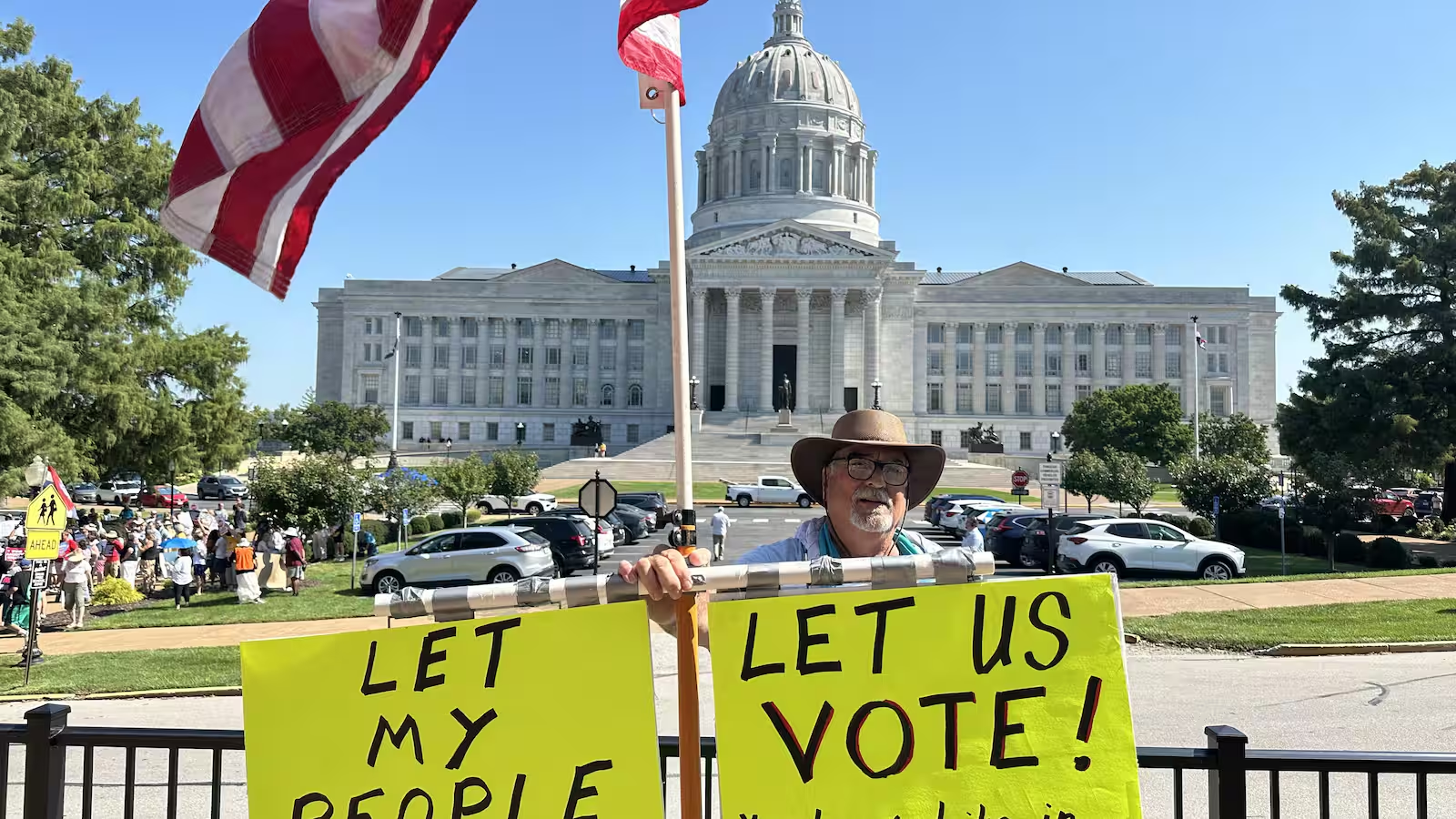
Opponents fought back through Missouri’s referendum process, gathering more than 300,000 signatures to put the map before voters. State officials sat on the petition and waited until August 4, the final permissible day, which also happened to be primary day, to reject it. Their position was that the constitutional right of citizens to vote on legislation does not extend to redistricting measures.
Last week, the Missouri Supreme Court disagreed, ruling that officials had improperly dismissed the petition. That decision is what sent state Republicans racing to Washington, where they warned of a federal election administration disaster and unprecedented chaos. The referendum organizers had a blunt response: any emergency here was manufactured by the state’s own delay.
What’s Riding on the Outcome
The stakes extend well past Missouri’s borders. Republicans have gained ground through redistricting in multiple states this cycle. If Missouri’s map ends up blocked for this election, the party’s net gain across the country would settle at nine House seats. If the map survives, that number climbs, and so does the GOP’s cushion in a closely divided chamber.
More Election Cases Are Coming
Tuesday’s order was only the opening act. The Supreme Court is expected to work through a cluster of fast-moving election disputes in the days ahead.
The most consequential involves the Trump administration’s effort to change how mail ballots reach voters, a case with implications reaching far beyond any single state. Separately, and also on Tuesday, the administration asked the justices to revive a contested citizenship records system it wants to use for broad reviews of state voter rolls.
The Court’s Growing Footprint on the Midterms
None of this is happening in isolation. The current 6-3 conservative majority has already reshaped the terrain for this year’s elections. A landmark ruling earlier this year stripped away a significant portion of the Voting Rights Act, which triggered fresh redistricting across several Southern states controlled by Republicans.
The justices have also been willing to let contested maps stand on both sides of the aisle. They permitted Texas to use a Republican-drawn map backed by Trump, and they allowed California to move ahead with a map favoring Democrats.
For Missouri voters, the practical question is much narrower and far more immediate: which district will they be voting in this November? As of now, that answer still depends on which court speaks last.
Author