The US Iran tanker strikes have pushed an already brutal six-month war into dangerous new territory. American forces hit five Iranian oil tankers on Tuesday, some in the Gulf of Oman and one close to Kharg Island, after Washington accused Tehran of firing ballistic missiles at a US warship on two separate occasions within 48 hours.
Iran did not wait long to answer. Missiles flew toward American troops based at Al Azraq in Jordan, and the Islamic Revolutionary Guard Corps claimed hits on multiple US vessels and a string of commercial tankers across the region.
Markets reacted the way they always do when the Gulf catches fire. Crude climbed to $99.49 a barrel in Wednesday’s early trading.
What CENTCOM Says Happened
According to a late Tuesday statement from US Central Command, the IRGC attempted to strike a US warship twice over two days. The ship maneuvered clear of both attempts, and CENTCOM stressed that no American personnel were injured.
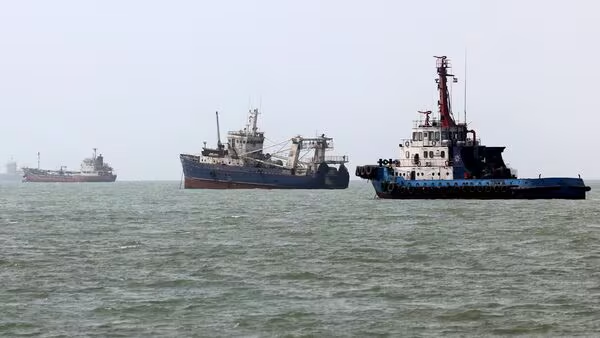
The retaliation was aimed squarely at Iran’s oil lifeline. CENTCOM named the destroyed carriers as the M/T Kaviz, M/T Charminar, M/T Horizon 1 and M/T Riesco, all struck in the Gulf of Oman, plus the M/T Derya near Kharg Island.
The command said crews were ordered off the ships before the strikes, and that the vessels were left inoperable. Video released afterward showed the Riesco going down in the Gulf of Oman.
Kharg Island matters more than its size suggests. Before the war, roughly 90 percent of Iranian oil exports moved through that terminal.
Tehran’s Version and Its Response
Iran’s state broadcaster IRIB confirmed the attack near Kharg Island, reporting that the crew was evacuated. It also described a second tanker being hit near the southern port of Jask. The IRGC later put the total at five vessels.
Iran’s retaliation, as the Guard described it, involved fierce missile fire directed at the Al Azraq base in Jordan, with claims that hangars housing US fighter aircraft were wrecked.
The IRGC went further, asserting ballistic missile strikes on the American destroyers DDG-119 and DDG-53 and saying both suffered significant damage. A later statement referenced naval operations against two American vessels and eight tankers, causing what it called great damage. Whether those two vessels were the same destroyers named earlier was never clarified.
The United States offered no immediate response to any of these claims.
Jordan Intercepts Most of the Incoming Fire
Jordan’s Armed Forces gave a more measured accounting. Air defences engaged 20 ballistic missiles and shot down 18 of them. The remaining two came down in unpopulated areas.
No casualties were reported. Specialist teams were deployed to secure the sites where debris and shrapnel landed.
Warnings That Came Before the Strikes
None of this arrived without notice. Before the tanker attacks, the IRGC issued a warning about imminent operations against oil tankers near the borders of Bahrain and Kuwait, instructing all crews to evacuate immediately.
Separately, Ali Abdollahi, chief of staff of Iran’s Armed Forces, had said plainly that Tehran would hit US military installations throughout the region if Iranian tankers were attacked. Tuesday appears to have been that promise being kept.
A Pattern Taking Shape
This was not the first round. On September 5, US forces struck three Iranian tankers, sinking one. Iran said it hit three commercial ships and three US-linked vessels the same day.
Mohsen Rezaei, one of Iran’s most senior security figures, has since said Tehran intends to declare a restricted maritime zone beyond the Strait of Hormuz. Any vessel entering it, he warned, would be added to Iran’s sanctions list.
The broader context is a Gulf that has become close to unnavigable. Tehran has closed the Strait of Hormuz. Washington is running a naval blockade against Iranian ports. Together those two moves have squeezed one of the world’s most important energy corridors from both ends.
Tehran Calls the Attacks a War Crime
Iran’s Ministry of Foreign Affairs condemned the strikes on its commercial shipping as a breach of the United Nations charter and labelled them a war crime.
The ministry framed the operations as part of a continuing campaign of military aggression paired with economic warfare, and said the United States and its partners would bear full responsibility for whatever follows.
Washington Signals No Retreat
Secretary of State Marco Rubio, speaking to reporters during a visit to Colombia, made the American position sound almost transactional. Iran keeps trying to hit US naval ships, he said, and every attempt will cost Tehran tankers.
Al Jazeera’s Mike Hanna, reporting from Washington, described the tanker strikes as a clear escalation in a war now half a year old. The US, he noted, is reaching for new categories of targets in response to what the administration says are Iranian attacks.
Hanna added that it remains unclear whether the tanker campaign reflects a deliberate strategy or simply the targets available at the moment. What is not in doubt, he said, is the economic damage. Destroying Iran’s export fleet aligns neatly with Washington’s declared aim of strangling the Iranian economy.
The Drone Dispute
One smaller episode captured how contested the narrative has become. The IRGC announced on Tuesday that it had seized an unmanned American submarine near the entrance to the Strait of Hormuz, describing the operation as a complex intelligence and operational achievement.
The US military told a different story. The underwater drone, it said, had malfunctioned while surveying regional waters. It described the vehicle as defective, insisting it gathered no sensitive information and carried no classified sonar or radar equipment.
Where Things Stand
Six months in, the conflict has settled into a grim rhythm of strike and counterstrike, with commercial shipping absorbing much of the punishment. With Hormuz closed, a blockade in force, and oil hovering near triple digits, the pressure is now global rather than regional, and neither side is showing any sign of stepping back.
Author