Rajnath Singh Urges SCO to Dismantle Terror Ecosystem and Build Connectivity on Sovereignty
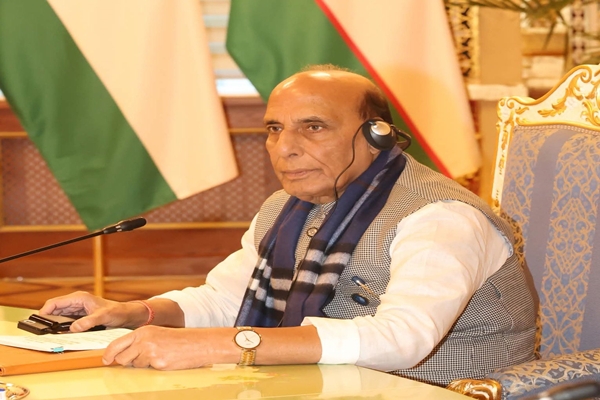
Rajnath Singh SCO remarks in Dushanbe have set out a clear Indian position on two issues that have long divided the grouping: how regional connectivity should be built, and how terrorism should be confronted. Addressing the 25th Meeting of the Council of Heads of Government of the Shanghai Cooperation Organisation in the Tajik capital, the Defence Minister pressed member states to turn shared principles into practical outcomes.
His speech blended an economic agenda focused on trade, technology and inclusion with a firm message on security, delivered to an audience that includes countries India has sharp differences with.
Connectivity Must Respect Sovereignty
Singh opened his remarks by acknowledging that connectivity is central to shared prosperity across the SCO region. But he attached an important condition. Infrastructure and trade corridors, he argued, must be built through consultation and with full respect for the sovereignty and territorial integrity of every country involved.
Projects that ignore these principles, he warned, will not endure. The comment was widely read as a reference to connectivity initiatives that pass through disputed territory, a long-standing Indian concern.
In contrast, Singh pointed to two initiatives India actively supports:
The International North-South Transport Corridor, a multimodal route linking India with Russia and Europe via Iran and Central Asia.
Chabahar Port in Iran, which India has developed as a gateway for trade with Afghanistan and the landlocked Central Asian republics.
Both, he said, can play a significant role in connecting Central Asia to wider markets while respecting the interests of all parties.
A Development Agenda Centred on People
Much of the address focused on the economic promise of the SCO. Singh argued that the organisation’s real measure of success lies in whether it creates opportunities for young people, entrepreneurs, farmers and small enterprises.
He drew on India’s own experience to illustrate how technology and innovation can accelerate growth and solve practical problems. Three examples featured prominently.
Digital Public Infrastructure. India’s digital platforms have reshaped how public services reach citizens and have brought millions of people into the formal financial system.
Start-up ecosystem. The country has built one of the largest start-up communities in the world, generating jobs and new solutions across sectors.
Women-led development. Singh emphasised that India’s approach rests on the conviction that women are not merely beneficiaries of development but central to shaping its direction.
The message to fellow members was that these models are replicable and that India is willing to share them.
No Justification, No Double Standards on Terrorism
The most pointed section of the speech dealt with security. Singh called for collective action to dismantle what he described as the entire ecosystem of terrorism, not just individual attackers or groups.
He laid out three principles that India regards as non-negotiable:
There can be no justification for terrorism under any circumstances.
There can be no double standards in how it is addressed.
There can be no room for those who finance, support or shelter terrorists.
The language echoed India’s consistent position at multilateral forums, where New Delhi has repeatedly argued that some states distinguish between “good” and “bad” terrorists depending on their targets. Delivered at an SCO meeting attended by Pakistan and China, the remarks carried obvious weight.
Keeping the SCO True to Its Principles
Singh also addressed the functioning of the organisation itself. He underlined India’s belief that economic cooperation within the SCO should be inclusive and deliver benefits to every member rather than a select few.
For the grouping to remain relevant, he said, it must stay efficient and hold firmly to the principles on which it was founded: sovereign equality among members, decision-making by consensus, and mutual respect. These values, in his view, are what distinguish the SCO from arrangements dominated by a single power.
Responding to a Turbulent Global Economy
Turning to the broader environment, Singh described a world economy under strain from several directions at once:
Geopolitical tensions that spill over into trade.
Disruptions to global supply chains.
Mounting concerns about energy and food security.
A widening technological divide between nations.
He urged the SCO to move beyond statements of intent and translate consensus into concrete steps. Three priorities stood out in his remarks: strengthening supply chains so they can withstand shocks, easing trade and investment flows among members, and using technology as a driver of development.
Backing the 2026-2030 Trade Plan
In a concrete expression of that approach, Singh reaffirmed India’s support for adopting an Action Plan for the SCO’s Multilateral Trade and Economic Cooperation Programme covering the period from 2026 to 2030. The plan is intended to provide a structured roadmap for economic collaboration over the next five years.
Why the Speech Matters
India’s engagement with the SCO has always involved a balancing act. The grouping offers a valuable platform for reaching Central Asia and maintaining dialogue with Russia and China, yet it also includes Pakistan, with which India’s relationship remains deeply strained.
Singh’s address reflected that balance. On economics, he offered cooperation, shared expertise and support for collective plans. On security and connectivity, he drew firm lines that leave no doubt where India stands.
Whether the SCO can reconcile those positions into unified action remains to be seen. But the Defence Minister’s message in Dushanbe made clear that India intends to remain an active participant while refusing to soften its core principles.
Author