Taylor Swift Trademark Voice Filing Signals New Era of AI Defense
The Taylor Swift trademark voice filing has officially put one of the world’s biggest pop stars at the forefront of an entirely new legal frontier. On April 24, the singer filed a fresh batch of trademark applications specifically designed to protect her voice and image from the rapidly growing dangers posed by artificial intelligence.
This isn’t just another routine business move. It’s a bold experiment in legal strategy that could reshape how celebrities defend their identities in an age when anyone with the right software can clone a voice or generate a fake image of a famous person in seconds.
A Closer Look at the Filings
Two of Swift’s filings fall under what’s known as a “sound mark,” a relatively rare category of trademark protection. Specifically, she’s seeking exclusive rights over two short voice phrases. The first is the recognizable greeting, “Hey, it’s Taylor Swift.” The second is the slightly shorter version, “Hey, it’s Taylor.”
These spoken phrases may sound simple, but their selection is deliberate. They’re voice-based hooks instantly identifiable as Swift’s, and protecting them could give her legal team a powerful tool against AI-generated content that uses her voice in ways she hasn’t approved.
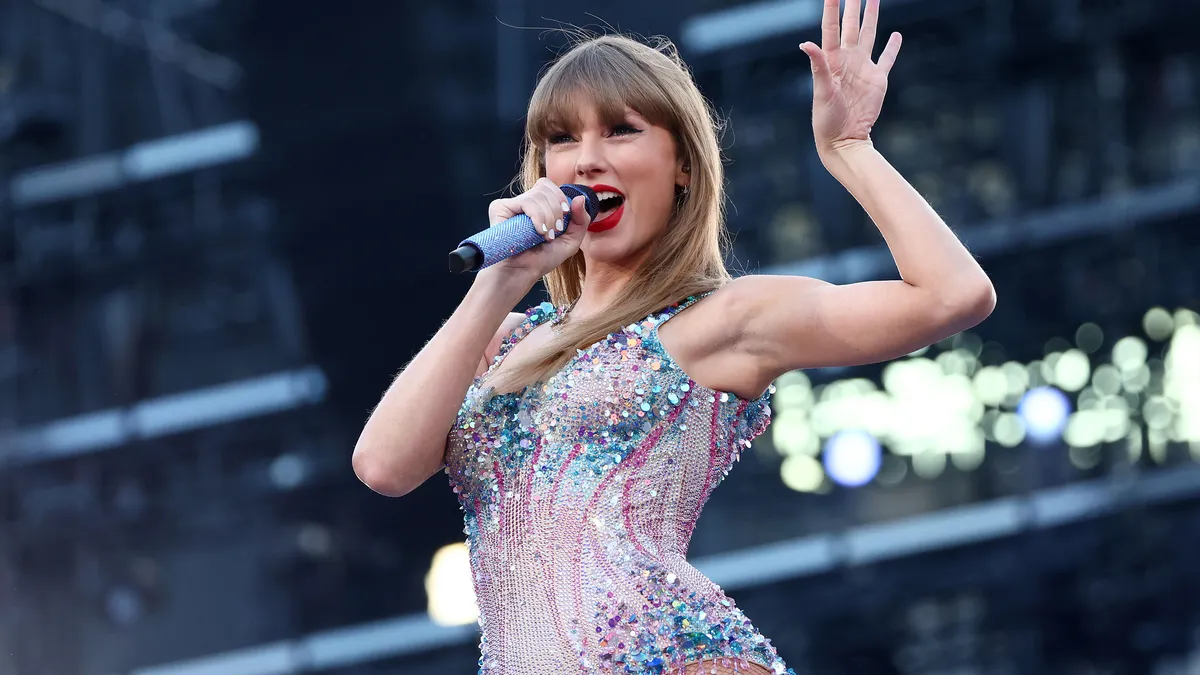
A separate filing focuses on a striking visual element: Swift holding a pink guitar with a black strap, dressed in a multicolored bodysuit accented with silver and matching boots. This particular look is heavily associated with her recent stage performances and has become a signature element of her current era.
Why AI Has Made This Necessary
The timing of these filings is no accident. AI-generated content has become an enormous problem for the entertainment industry over the past couple of years. Musicians, actors, and other public figures are finding their voices and images used in unauthorized videos, songs, and digital content circulating across the internet.
Existing “Right of Publicity” laws offer some protection against the unauthorized use of a famous person’s likeness, but those laws weren’t designed with modern AI capabilities in mind. Trademark law, while traditionally used for different purposes, may help fill the gaps that current legislation leaves wide open.
Swift Isn’t Alone in This Fight
Taylor Swift isn’t the first celebrity to take this approach. Actor Matthew McConaughey recently filed similar trademarks aimed at protecting his own voice and image. In an interview with The Wall Street Journal, McConaughey explained that he wanted to ensure any future use of his likeness or voice would require his explicit approval, emphasizing how essential consent and attribution have become in an AI-driven world.
These filings together represent something larger than just two celebrity protection efforts. They suggest the beginning of a coordinated industry-wide response to AI’s growing reach into personal identity.
Sound Trademarks: An Established But Rare Tool
The concept of registering a sound as a trademark isn’t new, though it remains uncommon. Some of the most famous examples include Netflix’s distinctive “tu-dum” sound that plays before its content, and NBC’s iconic three-note chimes that have signaled the network for decades.
What makes Swift’s case different is the attempt to register a celebrity’s spoken voice itself. This is a relatively untested use of trademark law, and there’s no clear precedent for how courts will respond when these protections are challenged.
Why Trademarks May Beat Copyright in the AI Era
Historically, recording artists have relied primarily on copyright law to protect their music. Copyright works well when someone is reproducing an existing recording, but it falls short in the AI age, where users can generate entirely new content that mimics an artist’s voice without copying any existing material.
Trademark law operates on a different and arguably broader principle. While copyright requires substantial similarity to the original work, trademark law allows owners to challenge anything that is “confusingly similar” to their registered mark. That’s a much wider net, and one that fits the AI threat landscape far better.
By registering specific phrases tied to her voice, Swift could potentially go after not just exact reproductions but also imitations and approximations. If a lawsuit were ever filed over an AI-generated audio clip using her voice, her team could argue that any use creating similar vocal impressions violates her trademark rights.
The Image Filing Works the Same Way
The visual trademark serves a similar function. By protecting a distinctive image down to specific clothing items, accessories, and pose, Swift’s team gains additional grounds for pursuing claims against manipulated or AI-generated visuals that evoke her likeness.
This means that if someone creates an AI image of “a singer in a multicolored bodysuit holding a pink guitar,” the resemblance might be enough to trigger a federal trademark violation, even if the AI never explicitly tries to recreate Swift’s face.
A New Playbook for Celebrities
What we’re witnessing through Swift’s and McConaughey’s filings is essentially a new strategy for how celebrities can fight back against AI misuse. Historically, artists haven’t used trademark law this way. Songs have been the domain of copyright, and likenesses have been governed by Right of Publicity laws.
AI has fundamentally broken that traditional model. Now anyone can produce a convincing version of an artist’s voice, make it say anything, attach it to anything, and distribute it globally within minutes. The truly alarming part is that the result doesn’t even need to be a perfect copy to cause real reputational and financial harm.
That’s exactly where trademark protection becomes valuable. Trademarks don’t just stop identical uses; they block anything that’s confusingly similar to the registered mark. In the world of AI-generated deepfakes and voice clones, that broader scope of protection is genuinely powerful.
What Happens If Swift Sues
If Swift’s team eventually pursues legal action against an AI platform or content creator, the trademark filings would give her legal arguments significant additional weight. Trademark claims also enhance the ability to obtain emergency injunctive relief, meaning courts could order content to be removed quickly while a case is being decided. They also typically allow for greater damages to be recovered, particularly against the AI platforms themselves.
This combination of speed and financial leverage could prove extremely valuable when fighting fast-moving AI-generated content that can spread across the internet within hours of being created.
Untested Legal Theories
Despite the strength of the underlying theories, it remains to be seen whether these filings will work as intended once tested in court. A federal court will need to evaluate a real case to stress-test the legal arguments behind these trademarks before anyone can say with certainty how effective they’ll be.
That said, the reasoning behind Swift’s approach is sound. Trademark law has always been adaptable, and registering distinctive phrases and images tied to a celebrity’s identity makes sense as a defensive measure when traditional protections fall short.
A Defining Legal Battle May Be Coming
The next major chapter in this story is likely to be a high-profile lawsuit. When Swift or her legal team eventually decides to test these trademarks in court, the case will draw enormous attention from the entertainment industry, technology companies, and legal scholars alike.
The ruling in such a case could shape how trademark law applies to AI-generated content for years to come, setting precedents that affect everyone from chart-topping musicians to YouTube influencers.
The Bigger Picture
The Taylor Swift trademark voice strategy represents more than just one star protecting her brand. It signals an evolving understanding of how identity, technology, and law intersect in the modern era. As AI continues to grow more powerful, the legal frameworks built decades ago must adapt or risk becoming obsolete.
For now, Swift has positioned herself at the cutting edge of celebrity legal strategy. Whether or not the filings succeed in court, they’ve already accomplished something significant by drawing attention to just how vulnerable artists have become in the age of AI.
The Bottom Line
The Taylor Swift trademark voice and image filings are bold, creative, and potentially groundbreaking. They reflect a new reality where celebrities must aggressively defend not just their music and films, but the very sound of their voices and the way they look on stage.
If the strategy works, it could become a blueprint for countless other artists facing similar threats. If it fails, it will at least have started a conversation that the law has been slow to engage with. Either way, Swift has once again proven that she’s not afraid to lead the charge into uncharted territory.
Author