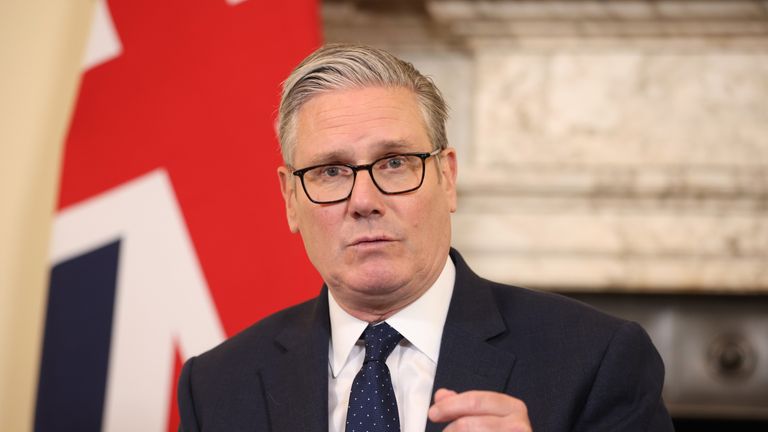
Attacks on British Jews have moved to the very top of the UK’s national agenda, with Prime Minister Sir Keir Starmer warning that the rising tide of antisemitism is no longer just a concern for one community, but a challenge for the entire country. As he opens new Downing Street talks aimed at building what he calls a “whole of society” response, the prime minister is making clear that the time for words alone is over.
A National Response Begins
Sir Keir is set to bring together senior figures from across public life to confront the growing threat to Jewish communities in Britain. The talks are being convened in the wake of the recent knife attack in Golders Green, north London, where two Jewish men were stabbed in a violent rampage through the streets.
The prime minister’s message ahead of the meetings is firm. He will tell those gathered that attacks on British Jews represent a deep and dangerous crisis, one that puts the country’s values to the test. According to Starmer, those values are not automatic. They must be defended and reinforced through action, every single day.
Who Will Be at the Table
The Downing Street meetings are designed to draw in voices from a wide range of sectors. Among those expected to take part are leaders from:
- Business and industry
- Civil society organizations
- Healthcare
- Culture and the arts
- Higher education
- Policing and security
Each group will be asked to consider how their sector can take faster, sharper action against antisemitism. The aim is not just to acknowledge the problem but to build a coordinated push that touches every part of public life.
The Golders Green Attack
The catalyst for these urgent discussions is the brutal stabbing in Golders Green that shocked the country. Two Jewish men, Shloime Rand, aged 34, and Norman Shine, aged 76, were attacked during a knife rampage through the streets of the predominantly Jewish neighborhood.
The incident left the community shaken and reignited fears about safety in everyday public spaces. Synagogues, Jewish schools, and community centers across the UK have since stepped up security as residents grow increasingly worried about whether they remain safe in the country they call home.
Starmer has been clear that the Golders Green attack was not a one-off event. He describes it as part of a broader pattern of rising antisemitism that has left Jewish communities frightened, angry, and uncertain about their place in modern Britain.
A Crisis That Touches Everyone
In his planned remarks, Starmer is set to deliver a powerful message. He will say that while these horrifying attacks target British Jews directly, the crisis they represent affects every citizen. The prime minister is expected to stress that protecting Jewish communities is a shared responsibility and that no part of society can sit on the sidelines.
He plans to make a clear distinction between simply expressing solidarity and actively defending it. According to Starmer, standing with Jewish communities cannot just be a statement. It has to be reflected through everyday choices, words, and actions across every workplace, school, and institution in the country.
The Iran War Adds a New Layer of Threat
The talks come at a particularly tense moment for the UK. Beyond the immediate domestic concerns, the prime minister will also address the security implications of the ongoing Iran war during a ministerial meeting of the Middle East Response Committee. This crisis team was created to respond to fast-moving developments in the Middle East and their impact on the UK.
One of the key concerns is that the conflict has heightened the threat level facing Jewish communities at home. Officials worry that international tensions could fuel further extremism, harassment, and even targeted attacks on UK soil. As a result, security agencies are being asked to remain vigilant while community leaders work to reassure those who feel exposed.
Building a Unified Strategy
The roundtable discussions Starmer will open are intended to push for action that moves beyond traditional government responses. By involving leaders across multiple sectors, the prime minister is signaling that combating antisemitism cannot rely solely on the police or politicians.
Possible areas of focus during the discussions include:
- Strengthening hate crime reporting and response systems
- Improving education on antisemitism in schools and universities
- Supporting workplaces in handling discrimination and abuse
- Coordinating between law enforcement and community organizations
- Enhancing the protection of Jewish institutions like synagogues and schools
Why the Moment Feels Different
Antisemitism is not a new problem in the UK, but the current climate has pushed it to the forefront in a way many have not seen for decades. Online hate has surged. Public protests have at times spilled into intimidation. International conflicts have driven divisions deeper. For Jewish families, the question is no longer abstract. It is about whether their children can wear a school uniform, walk to a synagogue, or visit a community center without fear.
Starmer’s framing of the issue as a national test rather than a community-specific problem reflects this shift. He is asking the country to view the safety of British Jews as a measure of who Britain is as a society.
Calls to Action
The prime minister will also urge attendees to commit to clear, concrete steps within their own sectors. He wants to see progress unfold quickly rather than over years. The message is direct: the time for slow consultations and delayed reports has passed. What is needed now is movement, accountability, and visible change.
For the government, this means pairing public statements with real policies. For businesses, it means addressing antisemitism in the workplace. For universities, it means protecting Jewish students. For media and culture, it means ensuring that discourse does not slide into dangerous territory.
A Defining Test
The Downing Street talks mark a significant moment for Britain. Whether they lead to lasting change will depend on what comes after the meetings end. Action plans will need to be drawn up, monitored, and enforced. Communities will be watching closely to see whether the words spoken this week translate into a safer reality.
For now, one message is clear. Attacks on British Jews are not just a matter for the Jewish community alone. They strike at the heart of what the country claims to stand for. As Starmer prepares to lead this national conversation, the challenge before him is to turn shared concern into shared responsibility and ensure that the values Britain prides itself on are upheld not just in speeches, but in everyday life.
Author