Caspian Sea Trade Route Becomes a Quiet but Powerful Lifeline for Iran
The Caspian Sea trade route, long ignored by global headlines, has suddenly become one of the most strategically important waterways in the world. As Iran absorbs heavy U.S. military pressure and Russia continues to navigate sweeping Western sanctions, the two countries have leaned on this overlooked sea to move goods, weapons components, and economic essentials. What was once considered a backwater of geopolitical interest is now a crucial artery quietly reshaping the balance of power across the region.
An Unexpected Strike Highlights the Caspian’s Importance
The world got a rare glimpse of the Caspian’s growing strategic role when Israeli fighter jets struck Iran’s naval command center at the port of Bandar Anzali in March. Massive flashes and rolling clouds of black smoke filled the sky as Israel destroyed several Iranian naval vessels in what its military called one of the most significant strikes during operations against Iran.
The remarkable detail was that this attack did not happen along the Persian Gulf, where the world’s eyes typically focus. It took place far to the north, on the Caspian Sea. The targeting of Bandar Anzali underscored just how essential the Caspian has become as a corridor connecting Russia and Iran.
Why the Caspian Is Hard to Watch
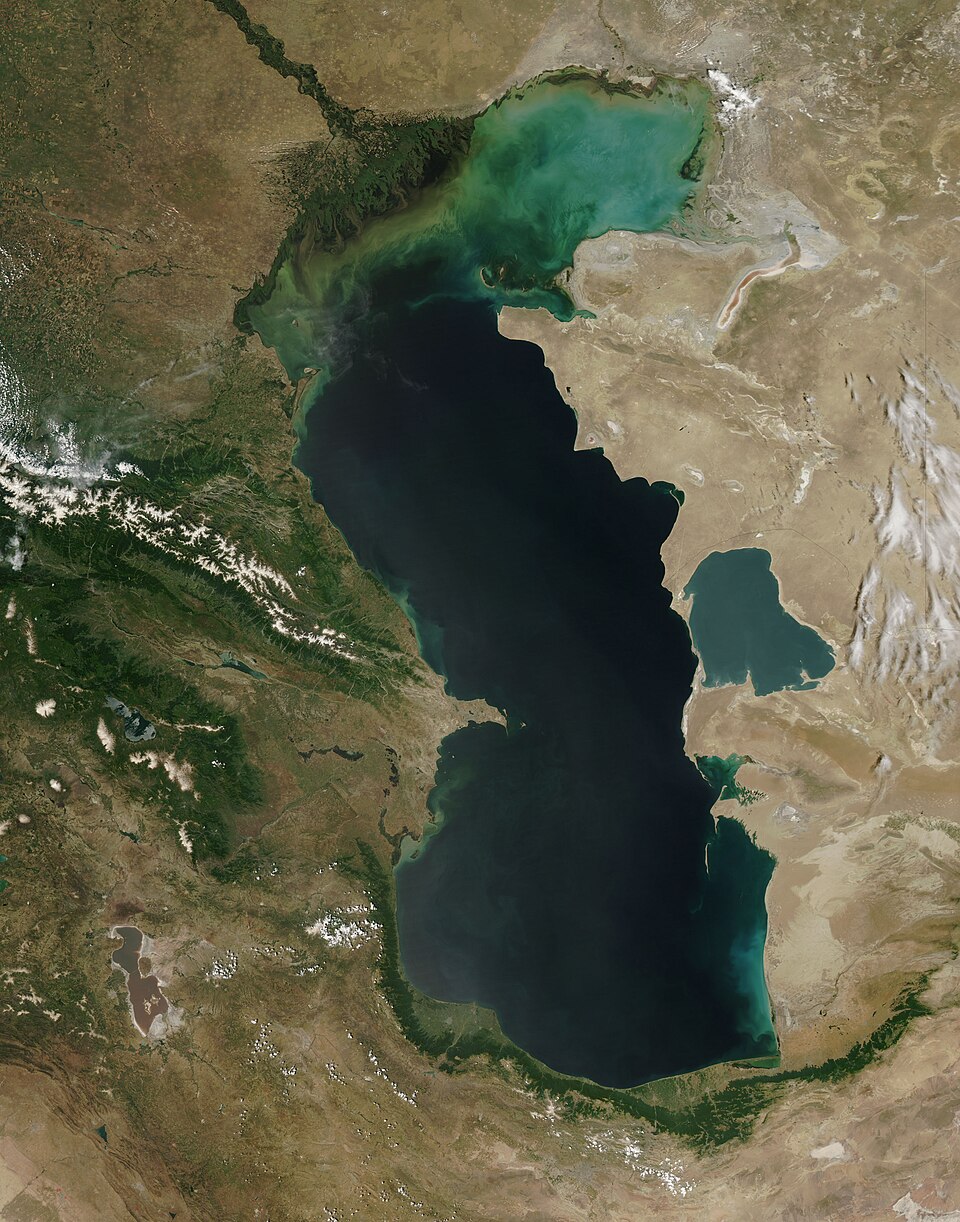
The Caspian is the largest lake on the planet, larger even than Japan, yet much of the trade flowing through it remains shrouded in opacity. Vessels routinely switch off their satellite transponders, making it difficult for outside observers to track movements. Unlike the Persian Gulf, the United States cannot intercept ships in the Caspian, since access is limited to its five bordering countries.
According to Nicole Grajewski, a professor at Sciences Po in Paris specializing in Iran and Russia, this combination of factors makes the Caspian an ideal environment for sanctions evasion and military transfers. The lack of foreign oversight has allowed Russia and Iran to move goods that would face heavy scrutiny anywhere else.
Trade Flows in Both Directions
Public trade between Russia and Iran has long included commodities such as wheat. Behind the scenes, however, weapons systems and military components have also moved in significant volumes. U.S. officials say Russia has been sending drone components to Iran across the Caspian, helping Tehran rebuild its drone arsenal after losing roughly 60 percent of it during recent confrontations.
The trade has not been one-sided. Iran spent years shipping its own drones to Russia for use in Ukraine. That demand decreased after July 2023, when Russia began producing its own version of the Shahed drone, made in Tatarstan under license from Iran. Even with Russia’s domestic production, both sides continue exchanging supplies, technology, and refinements.
The Sinking of a Sanctioned Vessel
Last August, the Ukrainian military said it had struck and sunk a Russian vessel at the port of Olya, located in the northwest corner of the Caspian. Ukraine described the port as a hub for Iranian military supplies feeding Moscow’s war machine. Russia confirmed only that the vessel was damaged.
The U.S. Treasury had already sanctioned the vessel and its owner, MG-Flot, in September 2024, accusing them of transporting short-range Iranian ballistic missiles to Russia. The incident illustrated how deeply the Caspian had been woven into the Russia-Iran defense partnership.
A Long-Standing Strategic Vision
Russia and Iran have long imagined the Caspian as a centerpiece of a major economic corridor connecting the Baltic Sea to the Indian Ocean. The proposed route, stretching about 7,200 kilometers through western Russia and the Caspian basin, would allow both nations to bypass Western trade routes entirely.
Although the project remains mostly aspirational, it includes ambitious plans for new ports, an upgraded shipping fleet, and a fresh rail line. Experts caution that ongoing wars and economic strains may delay these efforts, especially since shallow areas of the Caspian limit navigation. Still, the vision underscores why both countries continue to invest in the region.
A Diplomatic Balancing Act for Putin
For Russian President Vladimir Putin, Caspian trade comes with delicate political tradeoffs. With fewer Middle Eastern allies remaining, Putin wants to support Iran. But overt military assistance risks straining Russia’s energy ties with Arab partners and complicating relations with U.S. President Donald Trump.
This careful balance has shaped how Russia engages with Iran. Public trade flows continue openly, but military support remains discreet, hidden in the gaps where international monitoring is weakest.
A Geopolitical Blind Spot for the United States
The Caspian has long been a region the U.S. struggles to address. Luke Coffey, a senior fellow at the Hudson Institute, described it as a geopolitical black hole. American policymakers have historically treated it as if it barely exists.
The challenge is also bureaucratic. The Caspian’s bordering countries fall across different U.S. military and diplomatic regions. European Command oversees Russia and Azerbaijan, while Central Command covers Iran, Turkmenistan, and Kazakhstan. The State Department divides responsibility for the same five countries among three bureaus. The result is a fragmented approach that allows the Caspian’s strategic importance to slip through the cracks.
Russia and Iran Lean on Each Other
The Caspian’s role expanded sharply after Russia’s full-scale invasion of Ukraine in 2022. Russia repeatedly used Caspian-based ships to launch missiles at targets in Ukraine, similar to operations it had carried out in Syria. Analysts also noted a sharp rise in dark ship traffic, with vessels switching off their tracking signals to avoid detection.
Iran played a major role early in the war by supplying Russia with ammunition through the Caspian. Eventually, Iran began shipping its Shahed drones across the same waterway, fueling Moscow’s war effort and reinforcing the partnership between the two countries.
A Lifeline for Food and Goods
Beyond military aid, the Caspian has become essential for everyday trade. With the U.S. Navy blockading the Strait of Hormuz, Iran has been forced to find alternative routes for vital imports. Iranian officials have spoken openly about expanding capacity at the country’s four Caspian ports, which now operate around the clock to bring in wheat, corn, animal feed, sunflower oil, and other essentials.
Russia, too, has redirected key exports through the Caspian. Around two million tons of Russian wheat that previously moved through the Black Sea is now being routed through the Caspian, partly because Ukrainian attacks have made the Black Sea routes far riskier. Vitaly Chernov of PortNews Media Group highlighted how instability in the Middle East has made Caspian routes much more attractive for trade.
Cargo Volume Could Double This Year
The shift is large enough that some industry insiders predict a dramatic increase in Caspian cargo. Alexander Sharov, head of RusIranExpo, estimated that cargo tonnage across the Caspian could double in 2026. Although Western sanctions still make some major companies cautious, the Hormuz crisis is pushing more businesses to embrace Caspian routes despite the risks.
This shift represents a significant rebalancing of regional trade. As Western enforcement intensifies elsewhere, the Caspian has emerged as one of the few corridors offering relative discretion and continuity.
A Treaty That Strengthens the Partnership
In January 2025, Russia and Iran signed a sweeping cooperation treaty designed to deepen ties across multiple sectors. European officials have observed continued sharing of technology and battlefield tactics between the two countries, suggesting the treaty has accelerated practical cooperation rather than serving as a symbolic gesture.
While the exact volume of military goods Russia has sent to Iran remains unclear, experts agree the partnership is growing more sophisticated and integrated.
Why Israel Targeted Bandar Anzali
Anna Borshchevskaya, an expert on Russia’s Middle East policy at the Washington Institute, explained that Israel struck Bandar Anzali precisely because of the Caspian’s hidden importance. The trade route may be small in volume compared to the Strait of Hormuz, but its strategic value is enormous. Disrupting it forces Iran to scramble for new options, weakening its broader resilience.
The strike served as both a tactical blow and a symbolic message that the Caspian’s role in the conflict could no longer be ignored.
A Rising Strategic Theater
The Caspian Sea trade route has emerged as one of the most consequential, yet least understood, theaters of modern geopolitics. Far from the headlines and the more visible flashpoints, it has quietly become the backbone of an alternative global system supported by Russia and Iran.
As long as sanctions intensify and traditional trade routes remain volatile, the Caspian’s importance will continue to grow. The waterway that the world once overlooked may become one of the defining strategic spaces of the coming decade.
Author