US Pacific drug boat strikes have once again drawn global attention after the American military reported destroying yet another vessel it accused of smuggling narcotics. The latest attack, carried out Friday in the eastern Pacific Ocean, left three men dead and lifted the overall death toll from this ongoing campaign to more than 200 people.
Another Strike, Another Boat Destroyed
The newest operation marks the third such attack in a single week, underscoring just how aggressive the military’s offensive against suspected smuggling vessels has become. US Southern Command confirmed the strike, repeating the same framing it has used throughout the months-long campaign: that the targeted boat was tied to narcotics trafficking and run by an organization labeled as terrorist.
As with previous announcements, no supporting proof was offered to back up those claims. The absence of evidence has become a recurring theme, and critics argue it is precisely this lack of transparency that makes the entire effort so contentious.
According to Southern Command, the operation was ordered by General Francis L. Donovan, the senior American commander overseeing Latin America. Interestingly, the same day the strike was announced, Donovan reportedly held discussions with Cuban military officials near the US Navy installation at Guantánamo Bay, adding a diplomatic layer to an already complex situation.
A Notable Shift in the Released Footage
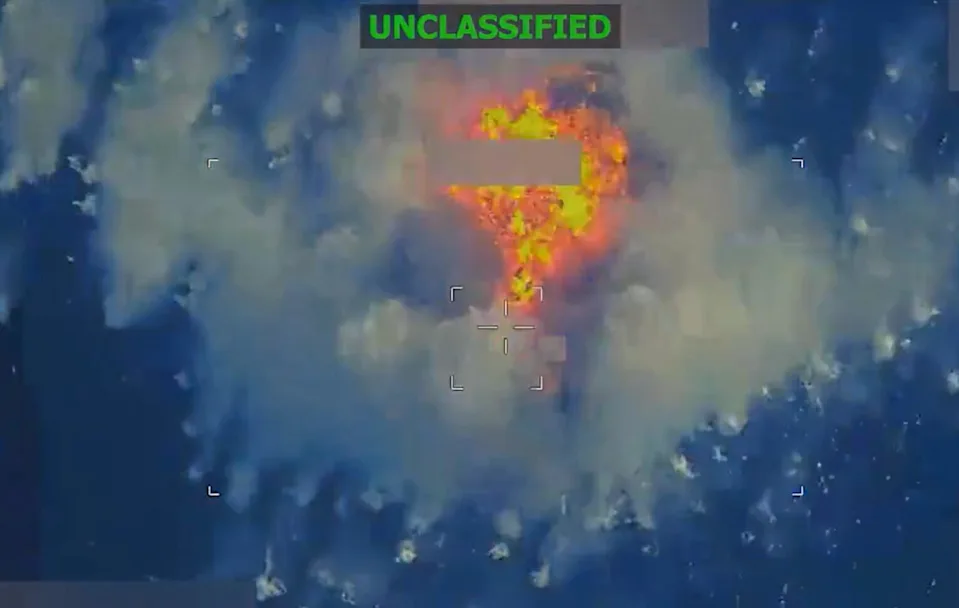
The military has consistently paired its public statements with video evidence of these attacks. This time, however, something looked different. For what appears to be the first time, the released footage was shown in full color rather than the grainy black-and-white imagery used in earlier clips.
The video captures a small boat drifting on open water moments before it is struck. In an instant, the vessel erupts into a massive fireball. The recording then shifts to what seems to be the burning craft, surrounded by scattered packages or debris bobbing across the surface of the ocean.
While the change in video quality may seem minor, it reflects the growing public visibility of these operations and the military’s apparent willingness to broadcast them.
How the Death Toll Reached 202
The figures tell a sobering story. With this latest strike, the cumulative death toll from the campaign now stands at 202 people. The operations trace back to early September, and the pace has only intensified since then. The two attacks announced earlier this same week contributed directly to the rising count.
The Trump administration has framed the entire effort as part of an armed conflict with Latin American drug cartels. Officials maintain that these criminal networks are responsible for funneling dangerous narcotics into communities across the United States, and that striking their boats is a legitimate act of defense.
Yet the central problem remains unchanged: no conclusive evidence has been presented to prove that the targeted vessels were actually transporting drugs. This gap between accusation and proof sits at the heart of the controversy.
Mounting Questions Over Legality
The campaign has sparked intense debate among legal scholars, human rights organizations, and policy experts both inside the United States and around the world. The core question is whether these strikes can be justified under domestic or international law.
Several prominent groups have made their positions clear:
- Human Rights Watch and Amnesty International have both characterized the attacks as unlawful extrajudicial killings, arguing that the military is essentially executing people without any judicial process.
- The American Civil Liberties Union (ACLU) has gone further, describing the government’s justifications as unsubstantiated and rooted in fear-mongering rather than verified intelligence.
These criticisms strike at a fundamental tension. Even if some of the targeted boats were carrying illegal cargo, opponents argue, that alone would not grant the military authority to destroy them and kill everyone aboard without trial, evidence, or oversight.
Why This Debate Matters
At first glance, a campaign aimed at stopping drug smuggling might sound like a straightforward security measure. But the reality is far more complicated. When a government claims the power to launch lethal strikes based on allegations it refuses to substantiate, it raises difficult questions about accountability and the rule of law.
If the targets truly are traffickers, why not present the evidence? And if mistakes are being made, how would anyone ever know? Without independent verification, there is no way to confirm whether the people killed were criminals, ordinary fishermen, or something in between.
This uncertainty is exactly what worries human rights advocates. Once a precedent is set that allows deadly force based purely on official assertions, it becomes far harder to draw a clear line around when such force is acceptable.
Looking Ahead
As the death toll continues to climb, the pressure on the administration to explain its actions is likely to grow. The combination of mounting casualties, repeated strikes, and a steady refusal to share supporting evidence has created a situation that few observers expect to fade quietly.
For now, the US Pacific drug boat strikes remain a flashpoint, sitting at the intersection of national security, international law, and human rights. Whether the campaign continues at its current pace, faces legal challenges, or eventually demands greater transparency may shape not only the future of this particular operation but also how similar military actions are judged in the years to come.
What is clear is that with each new strike, the debate grows louder, and the demand for answers becomes harder to ignore.
Author