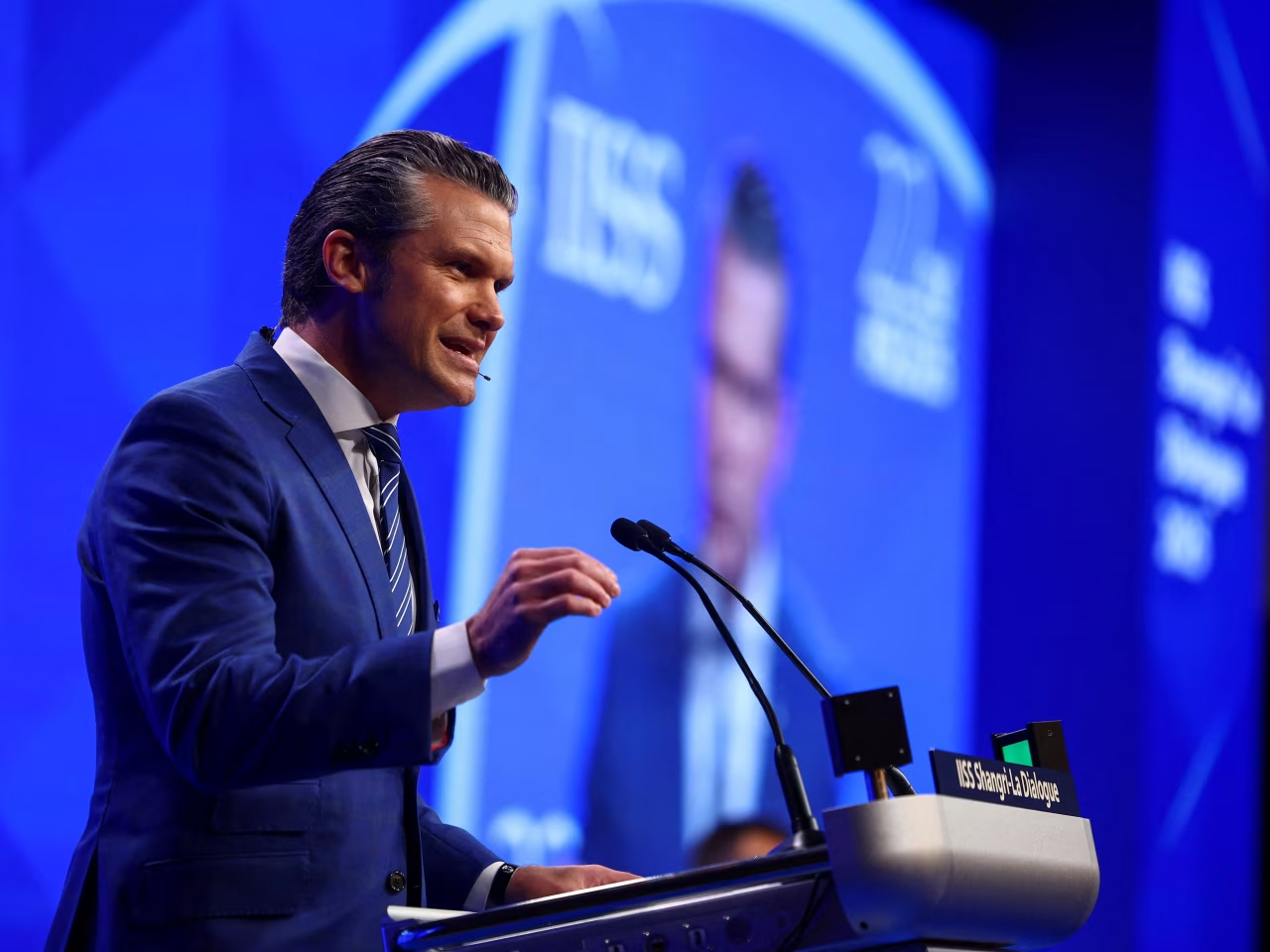
The Hegseth Taiwan speech delivered in Singapore has sparked intense scrutiny, not for what the defense secretary said, but for what he pointedly left unspoken. Addressing Asian officials at one of the region’s premier security gatherings, Pete Hegseth carried a message strikingly similar to the one he has been pressing on European allies, while quietly sidestepping the single most volatile issue in the Indo-Pacific.
A Notable Silence on Taiwan
In a major policy address at the Shangri-La Dialogue, Hegseth made no reference whatsoever to Taiwan, an omission that stands out sharply for a sitting U.S. defense secretary. The self-governing island, which China claims as part of its own territory, has long been a fixture in remarks delivered at this forum. Its absence this time spoke volumes.
Instead of confronting the issue head-on, Hegseth called for a relationship between Washington and Beijing built on fairness and reciprocity. He framed the broader goal as one of “drama-free” ties, a phrase that captured the more transactional tone running throughout his speech.
Rewarding Big Spenders
A central theme of the address echoed Hegseth’s approach toward Europe. Nations willing to invest heavily in their own defense, he suggested, would be rewarded with faster access to American weapons sales. It was a clear incentive structure, tying military cooperation directly to financial commitment.
Yet the most revealing aspects of the speech were the things he chose not to mention. There was no commentary on China’s increasingly assertive moves in the South China Sea, no warning about Beijing’s military buildup, and no reference to the artificial islands China has constructed in disputed waters or its expanding nuclear arsenal. For a region where these concerns dominate strategic conversations, the silence marked a dramatic break from years of precedent.
“Changing the Playbook”
Hegseth framed this shift as deliberate. He declared that the United States was rewriting its approach, arguing that the age of what he called performative outrage had come to an end. In his telling, Washington had spent too long issuing loud diplomatic protests that projected virtue but failed to project real capability.
This represents a striking reversal from his own previous stance. Just a year earlier, in his June 2025 address to the same conference, Hegseth had repeatedly referred to Beijing as “Communist China” and warned explicitly that an invasion of Taiwan would bring devastating consequences for the Indo-Pacific and the wider world.
This time, the language was conspicuously different. He avoided the “communist” label entirely and skipped the Pentagon’s usual grievances about Chinese military expansion. Rather than singling out any one nation, he argued that no “hegemon” should dominate the region, pointedly including both China and the United States in that category.
Breaking With Precedent
The decision to leave Taiwan out of the conversation is particularly significant when viewed against history. The three most recent Pentagon chiefs to attend the summit, going all the way back to James Mattis during Trump’s first administration, each took care to reference Taiwan in their remarks.
The United States does not formally recognize the democratic island. Instead, it has long practiced a policy known as strategic ambiguity, deliberately keeping China uncertain about whether America would step in to defend Taiwan in the event of an attack. Hegseth’s silence threatens to muddy that careful posture.
The shift is part of a broader pattern. Over the past year, the Trump administration’s criticism of Beijing has grown noticeably quieter. The most recent National Security Strategy stripped China of its status as America’s top threat, while the National Defense Strategy, shaped by Hegseth’s senior advisers, emphasized diplomacy with Beijing and made no explicit mention of Taiwan at all.
Allies Grow Uneasy
While Hegseth praised the defense buildups underway in Japan, South Korea, and the Philippines, his promises raised pointed questions. Chief among them was whether the pledge to fast-track arms sales for big spenders could be taken seriously, given that the administration had recently paused a $14 billion weapons sale to Taiwan.
Japanese Defense Minister Shinjiro Koizumi voiced this concern directly, expressing worry that some countries might begin to doubt the strength of America’s commitment to the region.
Hegseth declined to explain the reasoning behind the pause. When pressed during an audience question, he said only that any future decision regarding Taiwan arms sales would rest entirely with President Trump.
Why Words Still Matter
Former officials pushed back on the idea that rhetoric is unimportant, especially when Taiwan is involved. Chris Estep, a former U.S. defense official, offered a memorable critique. He noted that the classic strategy of speaking softly while carrying a big stick still requires actually speaking at some point. In the case of Taiwan, he argued, saying the right things is merely a starting point. Real deterrence demands concrete action, not just careful language.
Adding to the intrigue, Trump said he had spoken at length with Chinese leader Xi Jinping during a May visit about U.S. weapons sales to Taiwan. That admission appeared to contradict a longstanding American policy, dating back to the Reagan era, under which Washington did not consult Beijing on arms transfers to Taipei.
A Region Treading Carefully
Throughout the Singapore summit, allies have been notably cautious about openly criticizing China, particularly at a moment when American influence in the region seems uncertain.
Vietnamese President To Lam captured this delicate mood in his keynote address. Reflecting on the shifting balance of global power, he remarked that any adjustment to international rules cannot be accomplished through coercion, imposition, threats of force, or the creation of accomplished facts on the ground.
His words, though subtle, underscored the anxiety rippling through the region. As the Hegseth Taiwan speech demonstrates, the United States appears to be recalibrating its posture toward China, and America’s partners are watching closely to determine what that recalibration will ultimately mean for their own security.
Author