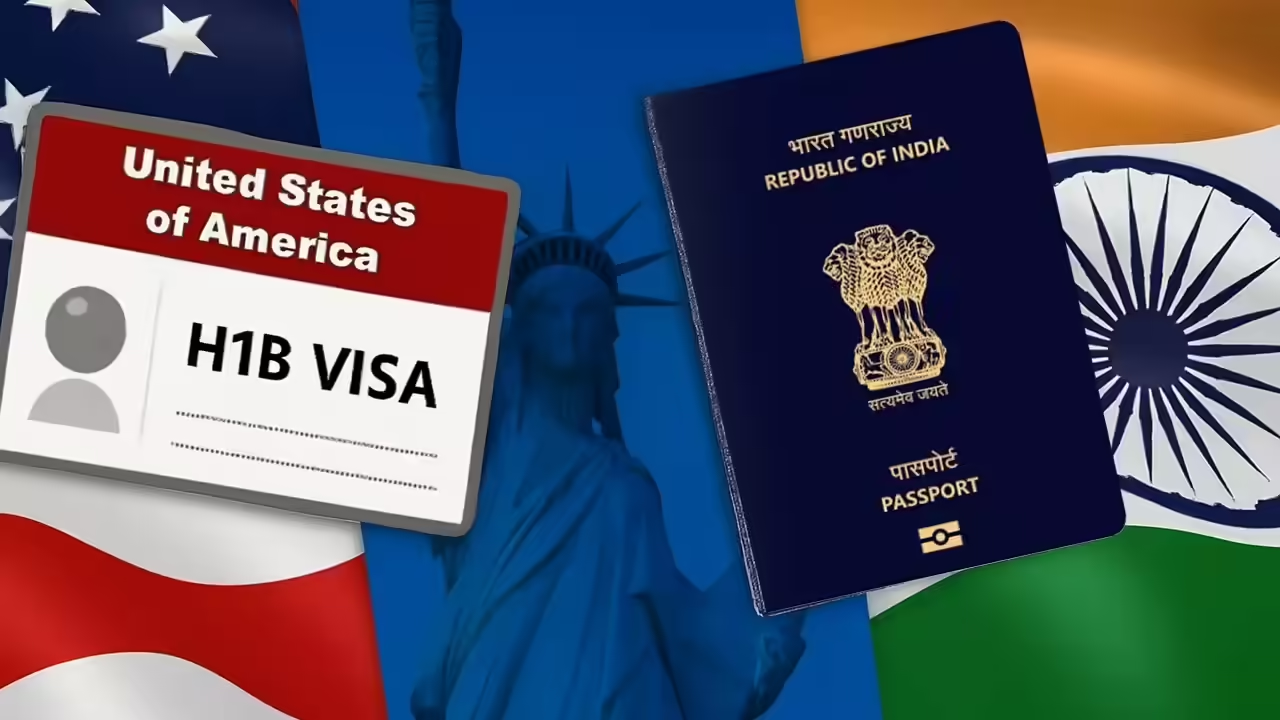
H-1B visa fee uncertainty has thrown many American businesses into a difficult holding pattern, unsure whether they can keep hiring the skilled foreign workers they’ve long depended on. After a dramatic fee hike, a federal court ruling, and a pending government appeal, employers are left trying to plan around rules that keep shifting beneath them.
A Career Built on the H-1B
For Kishore Khandavalli, the stakes are deeply personal. He launched his own career in the United States on an H-1B skilled foreign worker visa, describing himself as one of the first to come through the program.
Today, he runs a software consulting company in Dallas, where nearly half of his 380 employees hold H-1B visas. To Khandavalli, that reliance isn’t about overlooking American workers; it reflects a genuine shortage of available talent in his field.
He points to a persistent skills gap between the workers available in the market and the specialized abilities the industry actually needs, a gap he says is only widening as new technologies emerge. In his view, there simply isn’t enough domestic talent to fill every role.
The $100,000 Shock
That dependence is exactly why a major policy change rattled him. In September 2025, the Trump administration announced it was raising the H-1B visa fee dramatically, from roughly $215 to a staggering $100,000.
The administration framed the increase as a way to address program integrity, arguing that the H-1B system had been exploited to replace American workers with lower-paid labor rather than supplement them. For employers like Khandavalli, however, the math was alarming.
By his own estimate, the new fee would have cost him about $1 million a year. Since the policy took effect, he stopped hiring new foreign workers altogether, unwilling to absorb that kind of expense.
The Court Steps In
The fee didn’t go unchallenged for long. On June 8, U.S. District Judge Leo Sorokin, based in Boston, invalidated the $100,000 policy in response to a lawsuit brought by 20 states.
In his 42-page decision, Sorokin concluded that the payment was, in effect, a tax no matter what label was attached to it. He wrote that the substance and application of the $100,000 payment revealed it to be a tax, and that no statutory powers authorized the administration to impose such a charge on H-1B petitions.
The judge, an Obama appointee, reasoned that only Congress holds the authority to levy such a tax in the immigration sphere. He drew a direct parallel to a Supreme Court decision earlier in the year that struck down certain Trump tariffs on the grounds that the president lacked the power to impose them unilaterally.
Reaction was swift. New York Attorney General Letitia James, whose state was among the 20 that sued, emphasized that H-1B holders serve communities every day as doctors, teachers, and other skilled professionals, framing the ruling as the end of an unlawful attempt to dismantle a critical program.
The Ripple Effect Reaches India
The consequences of the policy stretch far beyond Texas. Much of Khandavalli’s business relies on workers from India, which according to Pew Research Center figures from 2023 is home to roughly 73% of all H-1B visa holders.
That global dimension is already reshaping ambitions abroad. At the Birla Institute of Technology and Science in Pilani, India, students who once viewed the U.S. as a clear destination are reconsidering their plans.
One doctoral student, Ravi Bushan, described working in the U.S. as a lifelong dream that would represent a career transformation. Yet the shifting visa rules and the changing tone around immigration have prompted him to rethink his strategy. He now says he’s looking to diversify his options and consider other countries entirely, a shift that hints at a broader risk to America’s ability to attract top global talent.
Still No Certainty
Even with the fee struck down, the situation is far from settled. The Trump administration is appealing the decision, and the broader legal picture remains tangled.
Several key threads are still in play:
- A separate federal judge in Washington, D.C., had earlier upheld a nearly identical fee, creating conflicting rulings across courts.
- The U.S. Chamber of Commerce filed its own challenge and has been pursuing an expedited appeal tied to the timing of the annual H-1B lottery.
- The administration has expressed confidence that Sorokin’s order will be reversed, while critics call the fee an unlawful overreach.
This back-and-forth leaves employers without a stable foundation for planning. As long as the appeals continue, businesses can’t be sure whether the steep fee will return.
What’s at Stake
For Khandavalli, the uncertainty carries real consequences for how and where work gets done. He worries that if another barrier to the visa emerges, he could be forced to send work overseas, undermining a pipeline that both skilled foreign workers and American companies have leaned on for decades.
His deeper concern is about the country’s long-term capacity to innovate. Without an H-1B program that remains affordable to businesses of all sizes, he fears that talent will leave the United States and that American competitiveness could erode over the next several years. As he put it, he’s worried about how the country is going to innovate in the coming three, four, or five years if access to skilled workers keeps narrowing.
For now, U.S. businesses caught in the middle face the same frustrating reality: a critical hiring tool whose future depends on court battles still unfolding, with no clear resolution in sight.
Author