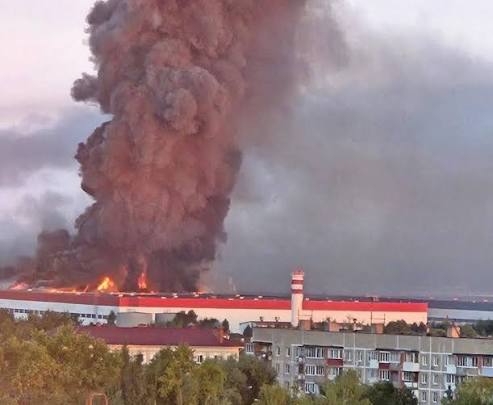
Ukrainian drone attacks Russia’s western industrial belt overnight, setting facilities alight in the city of Ryazan and forcing the country’s largest online retailer to clear out its local warehouses. It was another entry in a campaign that has steadily shifted from the front line toward the machinery that keeps Russia’s war economy running.
Ryazan Governor Pavel Malkov said air defences brought down 45 drones over the region during the night. Falling debris, he wrote on Telegram, ignited a fire in an industrial area and damaged a house and another building. Six people were taken to hospital with injuries.
The Retailer Caught in the Crosshairs
Among the sites affected was Wildberries, Russia’s dominant e-commerce platform, which confirmed it had evacuated staff from its Ryazan warehouses.
That company has become a recurring target. Kyiv accuses it of assisting supply operations for the Russian military, and drones have damaged at least seven of its storage facilities over the past several days.
The commercial fallout is substantial. According to the company and local officials, roughly 10 percent of Wildberries’ total warehouse capacity has been destroyed. Operations across the network have been disrupted, and the losses ripple outward to tens of thousands of small businesses that depend on the platform to reach customers.
That last detail explains part of the strategy. Striking a logistics company does not knock out a weapons plant, but it degrades the distribution backbone that both the military and the civilian economy rely on, and it makes the war visible to Russians who otherwise experience it only through television.
What Zelenskyy Said Was Hit
President Volodymyr Zelenskyy described the night’s targets more specifically than Russian officials did. He said Ukrainian forces struck an oil refinery and a logistics centre in Ryazan, along with a location in occupied Crimea where high-speed vessels belonging to Russia’s Black Sea Fleet are based.
His framing of the purpose was consistent with recent months. Russia must feel that every day of this war carries a higher price than the one before it, he wrote.
That sentence functions as the operating logic behind the entire long-range campaign. Ukraine cannot match Russian manpower or artillery volume. What it can do is make the war progressively more expensive to sustain — in fuel, in revenue, in shipping capacity and in domestic patience.
Casualties on Both Sides of the Border
The exchange produced deaths in both countries within the same period.
In the southern Russian city of Taganrog, on the Sea of Azov, missile debris struck an apartment building, killing a woman and injuring a man, according to regional governor Yury Slyusar. Taganrog hosts a range of industrial facilities and a grain terminal, which places it squarely within the category of targets Ukraine has been pursuing.
In Ukraine’s Kherson, a Russian drone attack killed one man and wounded three other people, local authorities said.
The Dnipropetrovsk region absorbed dozens of separate attacks involving drones, aerial bombs and artillery. Five people were injured, including a child, according to the head of the regional military administration.
Moscow’s Claims
Russia’s Defence Ministry announced Wednesday that its forces had captured two Ukrainian villages: Svtitle in the eastern Donetsk region and Nova Sich in the northeastern Sumy region.
It also claimed its drones hit two vessels carrying weapons and military equipment east of the Ukrainian port of Odesa. The local military administration chief there reported damage to infrastructure without confirming the rest of the account.
Neither side’s claims could be independently verified, which has been the standard condition of reporting on this war for more than four years.
The War Moves Onto the Water
The strikes near Odesa and in Crimea reflect a trend that has accelerated noticeably in recent weeks: both militaries are now going after ships.
Ukraine and Russia have increasingly targeted vessels operating in the Black Sea and the Sea of Azov, and the consequences reach well past the two countries involved. Oil and grain supplies moving through the region have fallen as a result.
That decline matters far beyond the immediate combatants. These waters carry a meaningful share of the world’s exported wheat and sunflower oil, and buyers across the Middle East, North Africa and South Asia feel disruptions there as price increases at home. A war fought over land is now steadily interfering with the food and fuel trade of countries that have no stake in the outcome.
Ukraine’s Stated Doctrine
Ukraine’s new acting defence minister, Yevhenii Khmara, offered an unusually candid summary of the country’s approach in an interview Wednesday.
Ukraine cannot fight punch for punch with Russia, he said. It has to use its resources carefully and operate asymmetrically.
That is a plain acknowledgment of a mismatch that has defined the conflict from the beginning. Russia has more people, more artillery and more industrial capacity. Ukraine has better drones, faster innovation cycles and a willingness to reach far behind the front rather than trading casualties along it.
The refineries, warehouses and naval bases hit overnight are exactly what that doctrine looks like in practice — targets chosen because damaging them costs Russia disproportionately more than the operation costs Ukraine.
The Washington Backdrop
The strikes came a day after Zelenskyy met President Donald Trump in Washington.
Their discussion covered two subjects that will shape the months ahead. The first was Ukrainian production of Patriot missile interceptors, which are central to defending cities against Russian aerial attacks and which Kyiv wants to build domestically rather than continue requesting shipment by shipment. The second was the possible revival of peace negotiations with Moscow.
The sequence of those events — a White House meeting followed immediately by deep strikes into Russian territory — reads as deliberate rather than coincidental. Ukraine appears to be demonstrating that diplomatic engagement and military pressure operate on parallel tracks, and that talks in Washington will not slow the tempo of the campaign.
For residents of Ryazan waking to smoke, and for those in Kherson counting casualties, the distinction between those tracks matters very little.
Author
-
Lucienne Albrecht is Luxe Chronicle’s wealth and lifestyle editor, celebrated for her elegant perspective on finance, legacy, and global luxury culture. With a flair for blending sophistication with insight, she brings a distinctly feminine voice to the world of high society and wealth.