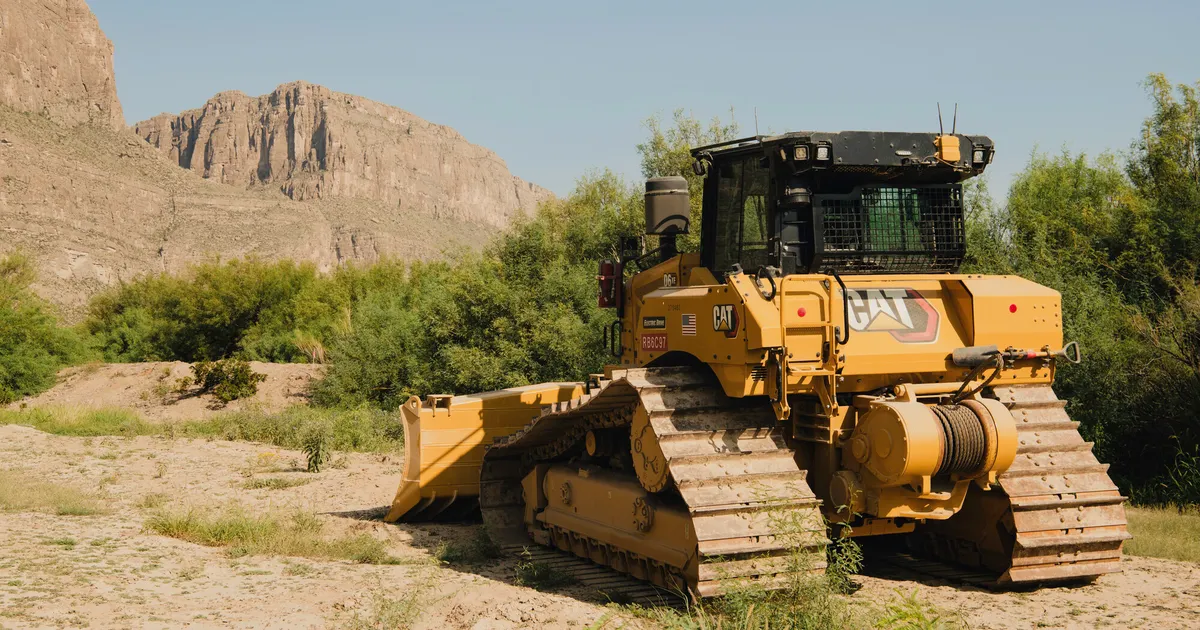
The Big Bend border wall project has ignited an unusual political fight in Texas, one that scrambles the normal partisan lines and has landed squarely in the middle of a Senate campaign. Federally contracted crews arrived in the national park last week to begin clearing land, and the reaction has come from Republicans and Democrats alike.
One prominent figure has notably declined to take a side.
Paxton Declines to Say Where He Stands
Attorney General Ken Paxton, the Republican nominee for Senate and a close Trump ally, has said nothing definitive about whether barriers and patrol roads should be built in Big Bend.
Asked directly, his campaign responded with language that avoided the question. Spokesperson Madison Cercy said Paxton is focused on listening to voters and exploring effective solutions for border communities, and that he supports strong security while taking into account the distinctive characteristics of different stretches of the border, including Big Bend.
The statement did not indicate whether he backs construction, nor whether he agrees with calls to pause work pending consultation with local officials.
That silence is conspicuous given how many Republicans have already spoken.
Cornyn Breaks Ranks
Senator John Cornyn became the highest-ranking Republican to push back, sending a letter to Homeland Security Secretary Markwayne Mullin urging consultation with local leaders before construction proceeds. He sent it Friday and released it publicly Tuesday.
Cornyn noted that fourteen border county judges had asked DHS in April to be included in planning discussions, and that the department appeared not to have responded. He described those requests for coordination as entirely reasonable.
He also relayed a point his constituents make repeatedly: the region’s thousand-foot riverbank cliffs and punishing terrain already function as a deterrent.
Cornyn is leaving office at the end of his term, having lost the Republican primary runoff to Paxton earlier this year, which arguably frees him to speak more bluntly.
Democrats Seize the Opening
Democratic Senate nominee James Talarico praised Cornyn’s letter and framed the project as wasteful. He called the wall a monument to corruption that no Texan requested.
Talarico said he and Cornyn agree on the principle of listening to local sheriffs and Border Patrol, and argued against damaging a national treasure by building an expensive barrier where a natural one already exists.
He also described a campaign stop in Sanderson where Republican, Democratic, and independent sheriffs, mayors, and small business owners all told him the same thing: the spending enriches contractors without improving safety.
Republicans have countered by attacking Talarico’s legislative record. Paxton has labeled his border positioning the fake Talarico, pointing to votes against a major state border funding package and against legislation requiring sheriffs to cooperate with federal immigration authorities. At a rally in Allen, Paxton said his opponent had opposed every bill that would have protected the state at the border.
The Numbers Behind the Argument
Opponents lean heavily on enforcement data.
The Big Bend Sector is the least trafficked of the nine Customs and Border Protection sectors along the southwest border. In fiscal year 2025 it accounted for roughly 1.3 percent of apprehensions while covering close to a quarter of the entire southwest boundary.
Critics refer to the limestone canyon walls as God’s walls, arguing that crossings are rare precisely because the geography makes them impractical.
The Scale of the Spending
The financial commitment is substantial.
In May the administration awarded a 1.7 billion dollar contract for construction in Big Bend. The agency’s public smart wall map describes that contract as covering vehicle barriers, technology, and a patrol road rather than a 30-foot wall.
It is one of five projects in the region. Others include a 2.6 billion dollar agreement for vehicle barriers and patrol roads across a stretch of nearly 166 miles east of the park near Alpine and Sanderson, and a 1.2 billion dollar contract for vertical barrier construction west of the park running from Presidio County to Big Bend Ranch State Park.
Environmental Laws Set Aside
To move quickly, DHS waived dozens of environmental laws in February under then-Secretary Kristi Noem, covering a stretch of border in the Big Bend region. In May, with Mullin leading the department, further waivers were issued for an area including the national park.
Those waivers are permitted under existing immigration statute but remain contentious, since they remove the review processes that would normally apply to construction in protected land.
Warnings From Those Who Know the Park
Seven former superintendents of Big Bend National Park wrote to Mullin in May cautioning that vehicle barriers would permanently alter the landscape, heighten flash flooding risk, and damage desert plant and animal life.
Their letter used stark historical framing, arguing that building such infrastructure inside the park would represent the most serious assault on the integrity of the National Park System since a dam was constructed in Yosemite’s Hetch Hetchy Valley more than a century ago.
Local Business and Law Enforcement Object
In early August, 140 local businesses and recreation organizations wrote to Cornyn, Senator Ted Cruz, and Governor Greg Abbott. They warned the current plan would end commercial and recreational river use in the park and along the Rio Grande Wild and Scenic River, damaging local businesses and the regional tourism economy without producing demonstrable security gains.
A bipartisan group of area sheriffs issued a statement in March arguing that a continuous physical barrier would be impractical and would not deliver the strategic value that wall segments provide in high-traffic urban sectors. Terrell County Sheriff Thaddeus Cleveland, a Republican signatory, described the planned vehicle barriers east of the park as a boondoggle.
Residents have additionally raised concerns about lighting systems and access roads. The region holds some of the darkest night skies in North America along with unusual biodiversity.
The Congressional Race
Big Bend sits in Texas’s 23rd Congressional District, vacant since moderate Republican Tony Gonzales resigned earlier this year.
Both candidates seeking the seat oppose the project. Republican nominee Brandon Herrera said he opposes any construction that disturbs the natural landscape and threatens tourism jobs where non-intrusive technology could accomplish the same goal.
Herrera said he has raised his concerns with Mullin directly and pledged to oppose any border-related spending bill that does not guarantee no disruptive construction in and around the park.
Democrat Katy Padilla Stout criticized Herrera’s Trump endorsement and characterized the effort as driven by greed rather than security, saying children will bear the cost.
Failed Legislative Attempts
House Democrats from Texas have written to DHS and tried legislative routes. Representatives Henry Cuellar of Laredo and Veronica Escobar of El Paso offered an amendment to the homeland security appropriations bill in June to bar construction in the national and state parks. It failed on a party-line vote.
At an April rally at the Capitol, Representative Lizzie Fletcher of Houston urged Republican colleagues to join, saying the issue is not partisan and that nobody asked for the project.
What Makes This Fight Unusual
Border security typically produces predictable partisan alignment. Big Bend has not.
The opposition spans a sitting Republican senator, Republican and Democratic sheriffs, county judges, business owners, former park officials, and both candidates in a contested House race. The supporters, so far, are primarily in Washington.
That configuration explains why Paxton’s non-answer stands out. Taking a position risks alienating either Trump or a coalition of Texas constituencies, and for now he appears to have chosen neither.
Author
-
Lucienne Albrecht is Luxe Chronicle’s wealth and lifestyle editor, celebrated for her elegant perspective on finance, legacy, and global luxury culture. With a flair for blending sophistication with insight, she brings a distinctly feminine voice to the world of high society and wealth.