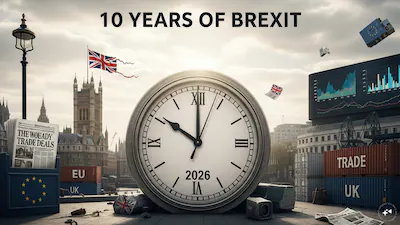
The Brexit economic impact is finally coming into sharper focus a decade after the referendum, as years of accumulated data allow economists to assess what leaving the European Union actually cost Britain. The picture that emerges is complex, but a clear consensus has formed: the UK economy is smaller than it would have been had it stayed.
One Company’s Story
The broader trend can be seen up close through a single Bristol-based firm. Not long after the UK left the EU in 2020, a company called Eskimo began selling a new kind of high-fashion, energy-efficient electric radiator built on technology developed by local academics. The plan was to ship them across Europe via the Channel Tunnel.
The timing seemed perfect given Europe’s green ambitions, and with orders flowing, the company’s Birmingham factory stayed busy. Its boss, Phil Ward, says the start-up has kept growing, but believes it could have achieved far more without what he calls “the Long Brexit effect.”
The numbers tell the story. In 2020, 40 percent of Eskimo’s exports went to the European Union. By 2025, that figure had collapsed to just 5 percent.
Zero Tariffs, But Plenty of Friction
The post-Brexit deal that then-Prime Minister Boris Johnson agreed with the EU in December 2020 guaranteed zero tariffs on exports. Yet Ward says that promise didn’t prevent the damage.
Red tape and paperwork unrelated to tariffs created delays, added costs, and bred an expectation of hassle among prospective customers. The consequences were tangible:
- Eskimo stopped selling directly to European consumers entirely
- A planned expansion into Germany floundered
- The company only managed to export some goods through agents in France
The firm also ran into a surprising obstacle when it tried to sell towel rails to Australia and New Zealand. Both countries follow international safety standards heavily shaped by the EU’s CE mark, undercutting one of the theoretical benefits of Brexit: the freedom for UK regulators to break from EU rules and pursue a more innovation-friendly approach.
A Sharp Drop in Trade Variety
Eskimo’s experience reflects a wider pattern visible in the export data. The UK Trade Policy Observatory at Sussex University calculated a rapid 26 percent reduction in the different types of UK exports by 2023. A more recent study from Aston University Business School, drawing on five years of detailed trade data, found an even steeper decline, a loss of 53.8 percent in the variety of exports and 31.5 percent for imports.
These “trade varieties” figures measure the number of distinct products sent to different EU countries, and the falls have been striking.
The Challenge of Measuring Brexit’s Effect
A decade ago, many economists warned that leaving the EU would cause long-term economic harm, and many now believe that damage has materialized. But proving it requires comparing what actually happened against what might have happened otherwise, a task that depends heavily on method and statistical judgment.
That judgment is complicated by the extraordinary turbulence of the post-Brexit years. Any honest analysis must account for:
- The pandemic that struck in spring 2020
- The war in Ukraine that began two years later
- The energy price shock more recently sparked by the conflict in Iran
- The question of whether a Brexit-free UK would have matched the recent Silicon Valley tech boom
Economists making these calculations say they have factored in the global turmoil, though others continue to question their methods and the true scale of Brexit’s impact.
The Worst Predictions Didn’t Come True, But Damage Did
Some of the gloomiest forecasts from 2016, including warnings of a Great Depression-style hit, proved overly pessimistic. Whatever damage occurred was not sharp enough to trigger an immediate recession.
Still, those who believe the UK suffered lasting harm argue the hit was no less profound for arriving slowly. Nick Bloom, a British Stanford University professor behind one of the most prominent recent studies using Bank of England data, put it bluntly: among economists there isn’t much debate, even if there still is among policy circles. In his view, the experts were right, and the damage was arguably worse than expected, just slower to fully appear.
What the Trade Figures Show
UK trade with Europe had been climbing before 2016, but the reversal since has been clear. Compared to 2019, UK exports to the EU in 2025 were down 14 percent and imports down 10 percent, and the trend has been worsening. Last year marked the worst year for UK goods export volumes to the EU this century, apart from a single year during the depths of the financial crisis.
Several think tanks have tried to quantify the gap against what might have been:
- Niesr calculates exports were 16.9 percent lower and imports 16.1 percent less than pre-2016 trends would have predicted.
- The Centre for European Reform, using a different method, estimates a goods trade hit of 16 percent to exports and 14 percent to imports.
These figures cluster in a similar range, and research from European countries points to comparable drops in their trade with the UK. That said, using raw figures that ignore inflation, UK goods exports to the EU actually rose 4 percent in cash terms since 2019, a statistic some analysts cite to argue the impact has been minimal.
A Bright Spot in Services
Not everything has suffered. Services, which make up over 80 percent of total UK economic output, have performed more strongly since 2016.
UK services exports to the EU are up 57 percent over the last decade, driven by accountancy, legal services, and consultancy. Non-EU services exports have risen 49 percent. Imports of services have also grown, up 35 percent from the EU and 60 percent from outside it.
There has, however, been a services boom across the advanced world, and some argue Britain might have done even better without Brexit. Either way, financial services held up far better than the bleakest referendum-era projections suggested.
The Investment Shortfall
Business investment paints a more troubling picture. Two studies found it significantly lower than what would likely have continued without Brexit.
Former Bank of England economist Jonathan Haskel calculates a £29 billion reduction in the economy, equivalent to 1.3 percent, from lower investment since 2016. His latest estimate puts the shortfall at 13 percent against the pre-referendum trend. Using different methods, both the National Institute of Economic and Social Research and the US-based NBER find UK business investment down 12 to 13 percent against where it would otherwise have been, compared to a basket of advanced economies.
Much of this damage predates the 2022 energy shock and is attributed to the uncertainty of Brexit’s early years. Notably, the latest analyses show the UK still trailing most of the G7, though it has overtaken Germany following the blow that country’s economy took from the 2022 energy crisis.
The Pound’s Decline
The most visible sign of economic shock was the fall in the value of the pound, both in the minutes and the years after the referendum. A weaker currency makes imports and travel more expensive and reduces the global value of UK assets.
Before the vote, the pound had reached new highs against major currencies. It then dropped sharply and traded lower afterward, falling further during bouts of Brexit uncertainty and again during Liz Truss’s mini-budget in 2022. Since then, sterling has broadly strengthened, benefiting from a weaker dollar, and now sits near the top of its post-Brexit range.
A weaker pound has cut both ways. It raised prices for imported goods, from fresh food to manufactured products, but also cushioned exporters by making their goods cheaper abroad.
New Trade Deals: A Mixed Verdict
One promised benefit of Brexit was the freedom to strike independent trade deals. The UK-India agreement stands out as a genuine breakthrough beyond what EU membership might have allowed, and Britain signed the first deal to soften the impact of President Trump’s tariffs.
Yet the government itself calculates these deals will boost economic growth only slightly, by fractions of a percentage point over decades. The competitive picture is mixed:
- The EU’s Mercosur deal with South America gives EU car exporters zero-tariff access to Brazil, versus 35 percent for the UK.
- On Trump’s tariffs, the UK’s 10 percent rate beats the EU’s 15 percent, but the EU faces no quota on car exports to the US, while the UK is capped at 100,000.
Even committed Remainer Tony Blair has acknowledged the UK gained some benefit from setting its own AI regulations, a factor with implications for any future attempt to rejoin the EU.
The Channel Tunnel Tells the Tale
Perhaps no place captures Brexit’s impact more vividly than the Channel Tunnel, once the embodiment of frictionless trade. In 2016, 1.64 million trucks passed through it. Last year, that number fell to 1.16 million, meaning nearly half a million lorry journeys a year have vanished, almost 30 percent of this high-value cross-Channel traffic.
An industry participant described the pattern as “pure Brexit,” with small exporters leaving because they couldn’t afford to invest in new systems. HMRC data analyzed by LSE found that 16,400 firms, 14 percent of EU exporters, stopped exporting to the EU entirely between 2019 and 2023, with the losses concentrated among smaller businesses.
The Bottom Line: A Smaller Economy
The academic consensus holds that the UK economy is now smaller than its 2016 trajectory suggested, with estimates ranging from about 3 to 8 percent.
Nick Bloom, lead author of the NBER research, attributes roughly half the hit to the increased difficulty of trading with the EU, in line with earlier forecasts. The other half, he argues, stems from the sheer uncertainty of the chaotic Brexit process itself, damage he says can never be recovered. The most recent NBER study, accounting for population growth, estimates the UK lost 6 to 8 percent of per capita output. A separate firm-level analysis using a Bank of England survey reached a strikingly similar conclusion: an economy about 6 percent smaller than it would have been, growing roughly two-thirds of a percentage point slower each year over the decade.
The Next Ten Years
The world Britain entered after 2016 has transformed almost beyond recognition. Brexiteers once touted a free-trade deal with the US, yet today’s America has raised trade barriers and weaponized tariffs. Predictions of the EU’s collapse never materialized; instead it has strengthened protections for its manufacturers. And China has grown more assertive.
These shifts pose entirely new strategic questions. An economically independent UK might be well placed to navigate this volatile world, or exporters might benefit from rejoining the EU single market. What’s clear is that many UK goods exporters, especially smaller ones, have not adjusted to Brexit, and in some sectors conditions are not improving.
Looking ahead, difficult choices loom. Does the UK align with the US and its lightly regulated approach to tech and AI, and can that be reconciled with a closer EU relationship? The EU’s “Made in Europe” legislation may require a certain share of parts to be made in Europe, with the UK’s status unclear. Early tests include steel next month and a deal to avoid UK-EU electric car tariffs at the end of the year.
UK officials have floated establishing a single market for goods trade with the EU as part of a Brexit reset, though the EU says this clashes with current red lines around freedom of movement. Recently, ministers have quietly suggested those red lines apply only to this Parliament and could be revisited. With a new prime minister set to succeed Sir Keir Starmer, the direction Britain takes remains uncertain, especially after next month’s UK-EU summit was postponed.
A decade on, the data finally offers clarity on what Brexit has cost. What it cannot yet reveal is whether the next ten years will vindicate the decision or deepen the regret.
Author