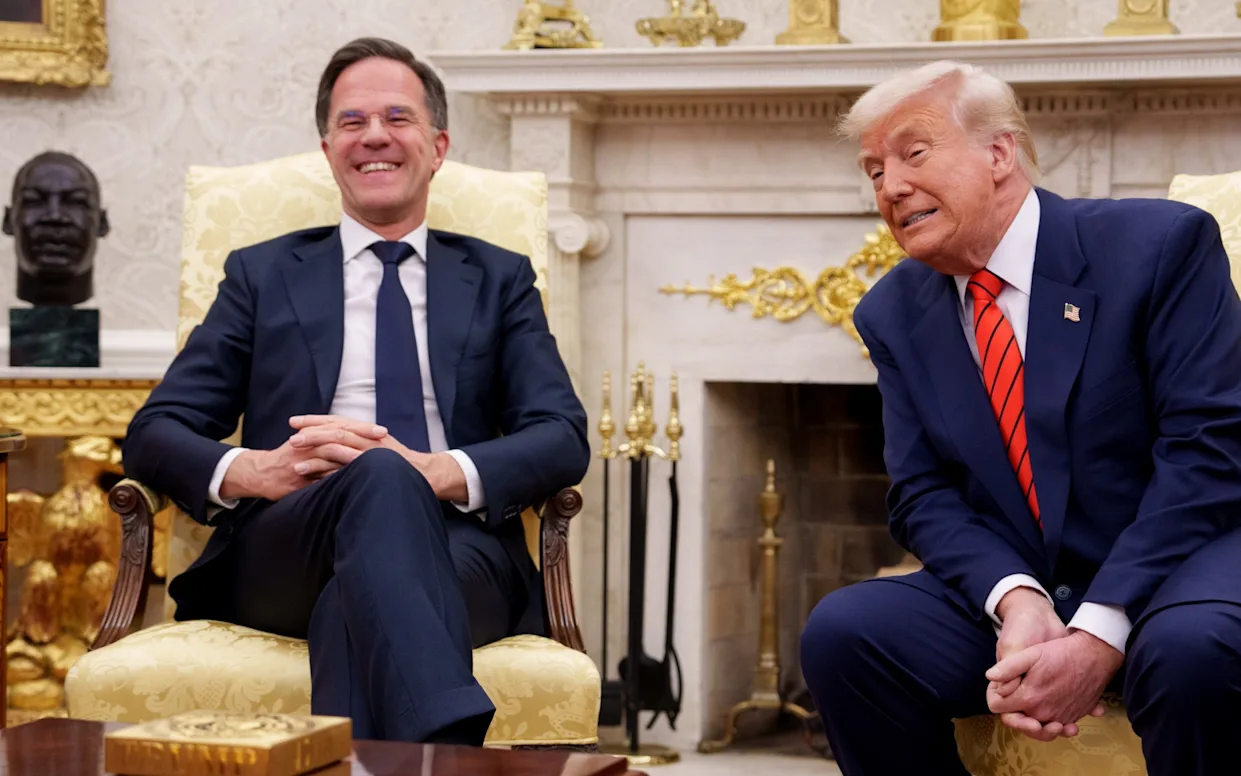
The debate over NATO defense spending played out in unusually theatrical fashion this week, as Secretary General Mark Rutte walked into the Oval Office armed with charts to calm a visibly frustrated President Trump. The performance offered a revealing glimpse into how Europe’s leaders are navigating the unpredictable relationship at the heart of the transatlantic alliance.
A Lesson in the Oval Office
Trump was in the middle of airing a string of grievances about NATO allies on Wednesday afternoon when Rutte interrupted to redirect the conversation. The former Dutch prime minister, who has earned a reputation as the European leader most adept at managing Trump’s moods, had come prepared with props.
Setting up posters to demonstrate what he framed as the president’s own achievements, Rutte moved around the room like a teacher leading a class, with Defense Secretary Pete Hegseth among those looking on. His charts highlighted a surge in current and projected European defense spending.
The “Trump Trillion”
Rutte’s central pitch revolved around a figure he dubbed the “Trump Trillion.” He traced spending back to 2017, when Trump first took office, to illustrate the extra money spent by European and Canadian members. He zeroed in on the last two years, when NATO spending topped $250 billion.
Crucially, Rutte gave Trump direct credit. While he acknowledged the spending surge stemmed largely from the threat posed by Russia, he insisted that Trump’s pressure had made a historic difference, achieving something no president since Eisenhower had managed: getting Europeans to bring their defense spending in line with that of the United States. He closed his presentation with a note about how much of that spending had created jobs in the U.S.
As Rutte made his case, the president’s initial anger appeared to ease.
A Diplomatic Balancing Act
There’s some historical irony in the Eisenhower comparison. Eisenhower didn’t threaten to weaken NATO; he helped build it, drawing on his experience as supreme allied commander. But Rutte understood both his audience and his objective: keeping the peace ahead of Trump’s planned arrival in Ankara, Turkey, for the NATO summit beginning July 7.
The bar for that summit is notably modest. As one European diplomat described it earlier in the week, the main goal is simply to avoid a public blowup by Trump over allies’ reluctance to support the military operation against Iran, a campaign many European nations regard as ill-advised and even illegal.
Not Entirely Deferential
Despite his accommodating approach, Rutte didn’t simply roll over. When Trump complained that European nations were too slow to invest in their own security and too hesitant to back operations against Iran, Rutte pushed back, saying he disagreed “slightly.” He conceded there had been isolated cases that disappointed the president but argued that, on the whole, European allies had shown up.
Trump’s own demand was blunt and simple. Asked what he wanted from America’s allies, he said he just wanted their loyalty. Earlier, he had singled out Italy, Britain, and Spain for specific criticism.
Critics and Calculations
Not everyone admires Rutte’s strategy. Among his critics are several NATO allies who view his handling of Trump as overly accommodating. But Rutte has made clear, both publicly and privately, that he measures his own success by his ability to keep the United States anchored at the center of the alliance.
He’s also working to restore a fading confidence among European leaders: the belief that if Russian forces pushed even a short distance into NATO territory, the United States would join a unified response.
That reassurance may be hard to come by. Trump appears unlikely to offer any explicit guarantees. During his first term, he pointedly declined to mention Article 5, the treaty’s collective-defense promise, in a speech at NATO headquarters.
Turkey, Erdogan, and the F-35 Question
Trump’s attendance at the upcoming summit hinges largely on personal relationships. He made clear he wouldn’t be going if Turkey’s president, Recep Tayyip Erdogan, weren’t hosting it. He explained that he was attending out of respect for Erdogan, who had personally urged him to come and stressed that the United States needed to be there.
Trump also hinted at a significant policy shift, suggesting the U.S. would likely allow Turkey to purchase F-35 fighter jets, something Washington has long blocked. Turkey was removed from the F-35 program in 2019, during Trump’s first term, after Erdogan bought Russian S-400 air defense systems. U.S. officials had feared Russia could gather intelligence on the F-35 through Turkey’s involvement. Notably, Trump made no mention of that standoff when he indicated he would likely lift the ban in the coming weeks.
Keeping the Alliance Intact
The Oval Office exchange captured the delicate dance now defining the transatlantic relationship. With charts, flattery, and just enough pushback, Rutte managed to steer Trump away from confrontation, at least for the moment. Whether that approach can hold through the Ankara summit, and whether it can ultimately secure the American commitment European leaders crave, remains the central question hanging over NATO’s future.
Author