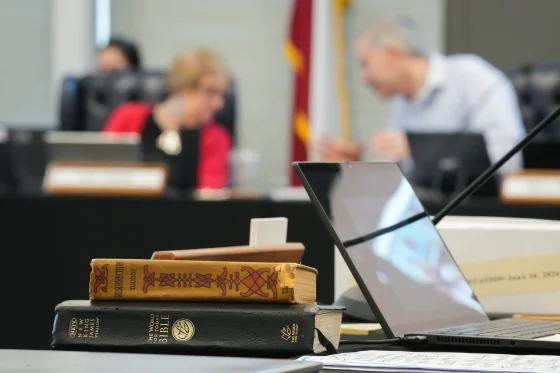
Texas Bible school curriculum cleared its final hurdle Friday, making the state the first in the nation to require students to read scripture as part of mandatory instruction. After months of heated debate, the State Board of Education approved standards that weave Christianity into classroom learning for all 5.5 million children attending Texas public schools.
A Landmark Vote
The Republican-led board locked in a new required reading list spanning every grade level with a 9-5 vote, then approved a sweeping rewrite of the state’s social studies requirements for kindergarten through eighth grade. Both plans embed biblical figures and concepts directly into coursework, ranking among the most far-reaching efforts in the country to mandate the teaching of Christianity.
These standards will serve as the foundation for textbooks and yearly exams. They are set to roll out in phases, starting with elementary grades in the 2030-2031 school year.
Supporters Hail a Return of Faith to Classrooms
Republicans celebrated the decision as a win for Judeo-Christian values and classical ideals. Advocates argue that the Bible-centered provisions, including required lessons on Jesus, Abraham, and Moses, aren’t meant to convert students but to help them build moral character and appreciate what they describe as American exceptionalism.
One board member framed the moment dramatically during a prayer gathering outside the hearing, declaring that the Bible was returning to schools for the first time in six decades.
Not every Republican was on board. Evelyn Brooks of Frisco broke ranks and voted against the reading list, arguing it would strip teachers of their autonomy.
Critics Warn of Favoritism and Legal Trouble
Opponents contend that the board has filtered history and literature through a narrow Christian lens, sidelining racial and religious diversity. Among their concerns:
- A world cultures course was eliminated.
- Lessons covering the experiences of Black, Hispanic, and other minority communities were scaled back.
- Several critics believe the standards breach the constitutional separation of church and state, predicting lawsuits ahead.
The president of the Freedom From Religion Foundation argued that Texas is signaling to millions of children that one faith carries the government’s endorsement while all others are treated as secondary. She characterized this as state-sponsored religious favoritism, which she said the First Amendment plainly prohibits.
Concerns Over How Other Faiths Are Portrayed
Advocates say the rare moments the standards address non-Christian religions often cast them unfavorably. Rabbis and Jewish community organizations testified that awkward pairings of certain texts with Holocaust lessons could fuel antisemitism in classrooms.
References to Islam, meanwhile, tend to center on violence. Students would be required to study the so-called “Muslim invasion” of Christian territories during the Crusades and the role of jihad in modern terrorism. A representative from the Fort Bend Coalition for Justice criticized the board for linking Muslim history to warfare and radicalism while deliberately removing the algebra and astronomy contributions made by Muslim scholars, saying the choices determined which children inherit pride and which inherit suspicion.
Part of a Broader Push
These standards represent the latest in a series of moves by Texas lawmakers to bring religion into public education. Recent years have seen a law requiring the Ten Commandments be posted in every classroom, as well as the adoption of state-developed, Bible-infused textbooks known as Bluebonnet.
There’s a key difference, though. The Bluebonnet textbooks remain optional and have so far been adopted by only about a third of districts. The standards approved Friday, by contrast, will be mandatory for every student across all public schools, including charter schools.
Texas now stands alone as the only state to require students to read direct religious texts. Children will analyze roughly a dozen Bible passages and stories, progressing from David and Goliath in second grade to the Book of Job in tenth grade.
Teachers Voice Practical Concerns
While educators can still add their own supplementary books, many testified before the vote that the mandated list was already too lengthy to fit into a single academic year. A representative from the Texas Council of Teachers of English Language Arts warned that the requirements would consume weeks of valuable instructional time, calling it a step too far.
A Dramatic Overhaul of Social Studies
The social studies changes approved Friday evening signal a major shift in teaching philosophy. The board favored a history-heavy approach, sharply increasing the number of names and terms students must memorize while largely abandoning skills-based instruction like building timelines or learning cardinal directions.
The scope is striking. Kindergarteners, for instance, would be expected to learn about explorers such as Cabeza de Vaca and Coronado, Native American figures like Squanto and Massasoit, flagmaker Betsy Ross, a priest, former Governor Sam Houston, Benjamin Franklin, and a Texas rancher.
Difficult subjects would also appear much earlier than they currently do:
- Slavery and the Civil War would move from fifth grade down to first grade.
- Second graders would study the American Revolution and the War of 1812.
- Third graders would cover ancient Israel, Greece, and Rome, along with the Ten Commandments.
Questions About the Process
The social studies drafts followed an unusual path over the past year. An appointed panel of nine content advisors took on an elevated role, directly writing outlines and submitting amendments to the board. Several advisors faced accusations of having improper connections to conservative groups and right-wing think tanks, and Democrats alleged that one received improper outside payment tied to his influence.
Traditionally, this drafting work fell to groups made up largely of classroom teachers. But educators played a reduced role this year, following a failed 2022 attempt to revise social studies that Republicans had dismissed as too progressive.
Shaping the Narrative
Across months of debate, the board’s members generally favored American “heroes,” expanding coverage of figures like George Washington and Harriet Tubman while reducing references to historical villains such as the Ku Klux Klan. The standards also stress the dangers of communism, in line with a state law passed last year.
In a flurry of last-minute revisions this week, during hearings that ran past midnight, members added even more faith-based content, including the evangelist Billy Graham and a provision asking students to examine the harms of divorce.
Race remained a persistent point of conflict. Members clashed over which civil rights figures deserved inclusion and removed mentions of slave revolts and racial segregation. Republicans also voted to delete language stating that Africans were enslaved in the United States because of the color of their skin, though several joined Democrats in preserving a provision recognizing slavery as a central cause of the Civil War.
Author