Beijing skyscraper plane crash sent shockwaves through China’s heavily guarded capital on Friday, only for nearly every trace of the incident to vanish within hours. A small plane appeared to slip past some of the world’s strictest aviation controls and slam into the tallest building in the city, killing the pilot and injuring 13 others, yet the government’s response made it seem almost as though nothing had occurred.
A Sudden and Shocking Collision
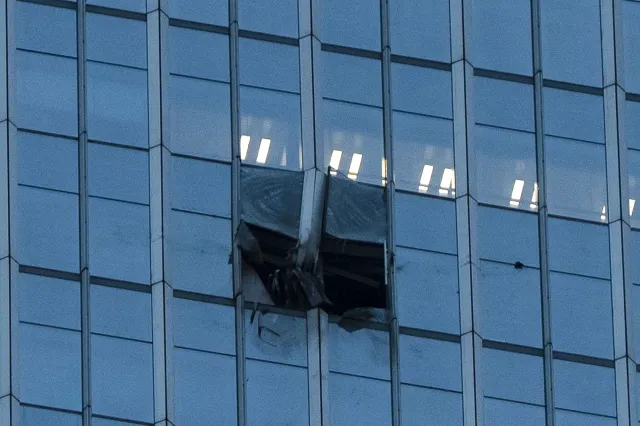
On Friday afternoon, the aircraft struck the 109-story CITIC Tower, the towering structure that dominates Beijing’s skyline. The impact rained shards of glass and aircraft debris hundreds of feet down onto the streets below, just as office workers were heading home for the weekend. The scene triggered panic in the heart of one of the most protected cities on earth.
Then, in a striking turn, the evidence began to disappear.
The Censorship Machine Springs Into Action
Within a short time, all mention of the crash, along with the dramatic footage capturing it, had been wiped from Chinese social media. The government initially declined to publicly acknowledge that anything had happened. Even state media stayed silent, including the national broadcaster CCTV, whose headquarters sit directly across the road from the crash site.
This rapid erasure reflects the work of China’s vast network of censors and the Communist authorities’ obsessive control over information, particularly regarding events they fear could attract negative attention or consequences.
An Information Vacuum
The blackout left witnesses and observers grappling with unanswered questions. For nearly a full day, even the number of people injured remained unknown.
It was not until Saturday afternoon, local time, that media affiliated with the Beijing government finally reported the event. According to that account, a single-engine, two-seat light sports aircraft collided with a high-rise building while in flight. The pilot, the only person aboard, was killed, and 13 people were injured at the scene. Officials said the matter was under investigation.
Several critical questions remain unresolved:
- Whether the crash was accidental or intentional
- How the pilot managed to fly over Beijing’s fortified airspace
- Why aviation controls failed to prevent the collision
That final point is especially troubling for authorities, given that most of the Communist Party elite live in the capital, where even flying drones is effectively prohibited.
About the CITIC Tower
The CITIC Tower, which stands 528 meters tall, or roughly 1,732 feet, has been Beijing’s tallest building since 2018 and is a defining feature of the skyline. Also known as China Zun, it houses the state-owned conglomerate CITIC Group and tech giant Alibaba.
The surrounding neighborhood is among the most prominent in Beijing, frequently visited by foreigners and diplomats. Embassies from countries ranging from the UK to Vietnam sit just steps away, as do major names in global finance, including the China offices of the World Bank and the IFC.
What the Footage Revealed
The crash occurred during Friday’s late-afternoon rush hour. In the brief window before censors intervened, footage circulating online showed the small plane striking the upper portion of the building, sending debris and a tail section showering down onto the city.
Images displaying the plane’s registration code appeared to identify it as a domestically manufactured light sport aircraft, a Sunward SA 60L Aurora, owned by a local general aviation company that offers services such as pilot training, recreational flights, and aerial photography. Reporters on the scene observed crowds evacuating the skyscraper and gathering on nearby streets, joined by firetrucks, police cars, and an ambulance.
Chasing a Vanishing Story
One Beijing resident, who gave only her first name, Anna, described rushing to the site after seeing a post about the crash online, only to watch it get deleted soon after. She happened to be just two stops away and decided to see for herself.
While the footage went viral on social media outside mainland China, the situation inside the country was very different. A search for “plane crash in Beijing” on Weibo, China’s equivalent of X, returned no relevant results.
Such information blackouts are routine. Chinese authorities commonly move quickly to censor or suppress coverage and deploy a heavy police presence at any incident viewed as a potential threat to social stability.
A Locked-Down Scene
By Saturday, roads near the CITIC Tower were closed and police surrounded the area. Only those who could prove they worked nearby were permitted to enter. Delivery drivers were left stranded outside, waiting for employees to come collect their orders.
A press official with the Beijing municipal government said by phone Saturday that the incident was under investigation and that an official statement would follow, without specifying when. Meanwhile, unverified flight data from Flightradar24 posted online appeared to show the aircraft following a severely deviated path after taking off from Beijing’s Shifosi airport.
Strict Rules and Past Silences
Flying any light aircraft in Beijing requires approval from both the Civil Aviation Administration of China and the People’s Liberation Army Air Force. Just last month, the city enacted sweeping regulations that effectively banned casual recreational flying and consumer drones, making the breach all the more puzzling.
History suggests answers may be slow to come. Deadly and highly public incidents in China are sometimes followed by official silences that stretch on for years. More than four years after a China Eastern Boeing 737-800 crashed in the Guangxi region and killed 132 people, in the country’s deadliest air disaster in decades, Beijing has still offered no official explanation.
That track record leaves little certainty about when, or whether, the full story behind the CITIC Tower crash will ever come to light.
Author