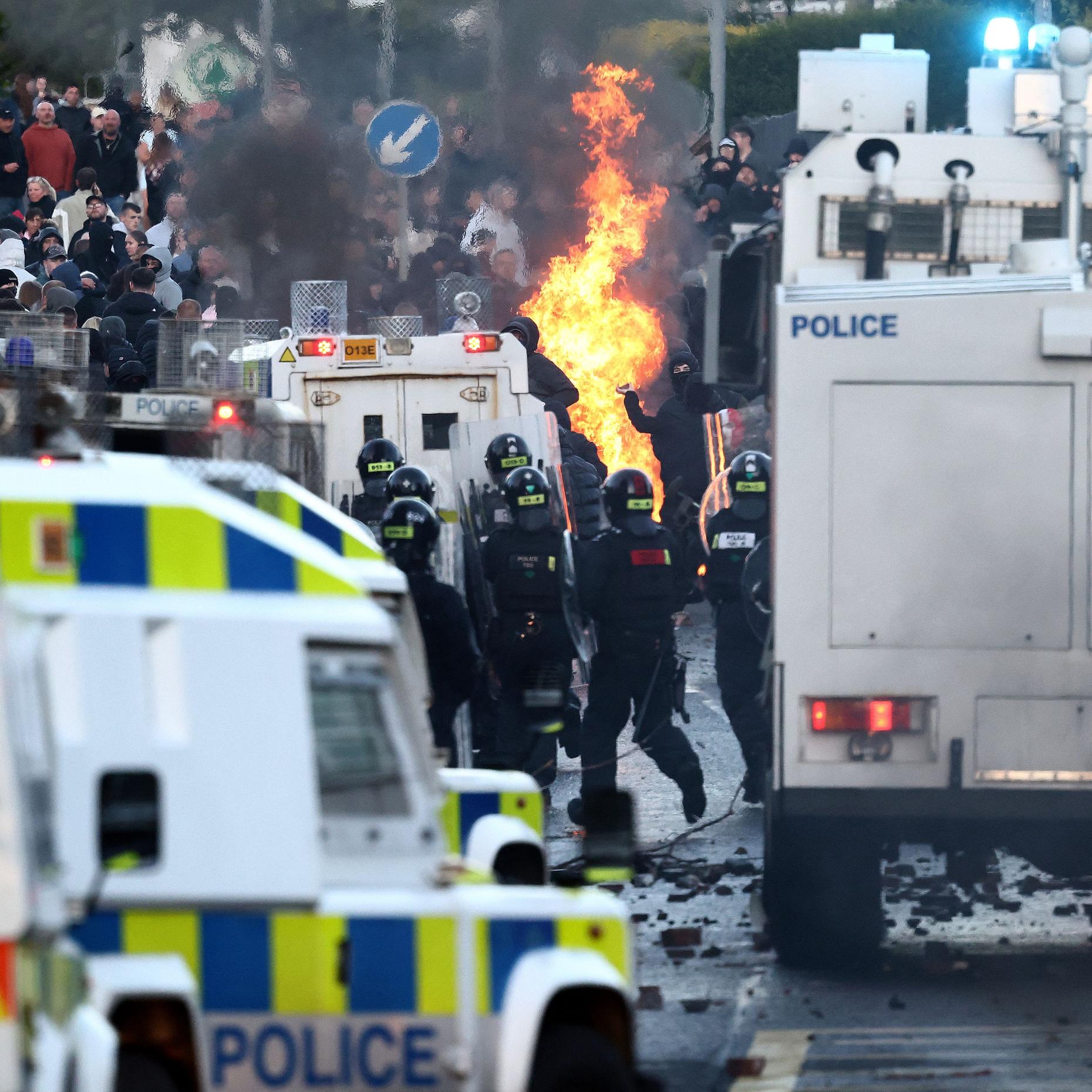
Questions surrounding the Belfast riots active clubs connection have drawn the attention of extremism researchers, after violence drove scores of ethnic minorities from their homes in Northern Ireland earlier this month. At the center of the inquiry is whether a network of neo-Nazi youth groups helped organize or instigate the unrest, and what the episode reveals about a region already on edge.
The Trigger for the Violence
The disorder followed a brutal incident on June 8, when 44-year-old Stephen Ogilvie was stabbed in an attack caught on video and widely shared on social media. The alleged perpetrator was a 30-year-old Sudanese man seeking asylum in the United Kingdom.
Ogilvie survived but was seriously injured, and the accused has been charged with attempted murder. The stabbing ignited unruly protests in which masked, anti-immigrant mobs set fire to vehicles and homes in predominantly ethnic minority neighborhoods, raising urgent questions about how the participants organized so quickly.
What Are “Active Clubs”?
Much of the speculation centers on a phenomenon known as “active clubs,” a network of neo-Nazi youth groups that researchers have tracked with growing concern. These groups have been on the rise in recent years across both Western Europe and the United States.
What sets them apart is their structure and purpose. Organized locally but linked transnationally through digital platforms and conferences, they build their activities around a shared interest in mixed martial arts training. According to Michael Colborne, a journalist and researcher with the investigative group Bellingcat, their interest in combat sports is fundamentally different from the average person’s.
He explained that for these groups, training isn’t about getting fit, learning self-defense, or personal improvement. Instead, their engagement with combat sports is explicitly about preparing for political violence.
Claims of Orchestration
A burst of social media activity on active club accounts both before and after the Belfast unrest prompted reporting suggesting the groups may have helped orchestrate or instigate the attacks. If accurate, that would mark a significant escalation in their public activities.
Yet the claims have met with skepticism from observers familiar with Northern Ireland’s specific circumstances. Sid Venkataramakrishnan, an analyst at the Institute for Strategic Dialogue, cautioned that the broader environment was already primed for violence. He described the U.K. as something of a tinderbox at the moment, suggesting that even without active club promotion, Belfast would likely have seen the kind of violence that has erupted in numerous other U.K. cities.
Disturbing Online Activity
Despite the uncertainty over direct involvement, the online footprint surrounding the riots has fueled suspicion. The Telegram account of a neo-fascist group called the Ulster Youth Club drew particular attention.
The account shared content that pointed toward coordinated incitement and operational planning. Some of the most alarming examples included:
- A reposted message urging white men to take action against non-white people and to “make them terrified they are trapped on an island with you”
- Advice posted the morning after the stabbing, hours before the riots, telling protesters not to bring smartphones or smartwatches, to wear hats and gloves, and to cover tattoos
- A declaration that “citizen journalists” were explicitly not welcome at street actions
Following the unrest, which some in Belfast described as a pogrom, a Substack account tied to the active club movement published a detailed analysis of the rioters’ operational security tactics. It notably praised participants who conducted phone searches of opportunistic videographers who might have captured identifying footage. Colborne described this as an explicit way of framing, for a far-right audience, how one should go about committing this kind of violence.
A Lack of Confirmed Links
For all the suggestive online chatter, hard evidence connecting active club members to the streets remains elusive. It is still unclear whether people affiliated with the network were actually among those rioting on June 9, the day after the stabbing.
So far, no individuals known to be tied to the neo-Nazi groups have been identified among the participants. Experts caution that the rapid mobilization may instead reflect conditions that developed over a much longer period. Venkataramakrishnan pointed to Northern Ireland’s long history of sectarian violence and the involvement of Loyalist groups, the largely Protestant, working-class formations that fought to keep Northern Ireland within the U.K., in previous violent attacks. Given that backdrop, he argued, it’s difficult to attribute the unrest specifically to active clubs.
A Recurring Summer Pattern
The Belfast violence fits into a troubling trend that has emerged in recent years. Violent anti-immigrant mobilizations have become almost an annual summer occurrence in Northern Ireland.
The recent history illustrates the pattern clearly:
- In August 2024, Belfast was among many U.K. sites where the killing of three young girls at a dance class in Southampton triggered widespread disorder, even though the convicted man was U.K.-born to Rwandan immigrant parents
- In 2025, an alleged sexual assault of a girl in Ballymena led groups to target ethnically Roma residents, ultimately driving hundreds from the town
In each case, influential far-right figures in the U.K., and even some in the U.S. such as Elon Musk, who has railed against demographic changes in both countries, seized on crimes against white residents to amplify a broader message about the mass expulsion of non-whites. Anti-immigrant networks, particularly on Facebook, have also used these cases to organize street action.
The Shadow of “The Troubles”
Beyond the modern far-right infrastructure, experts say the legacy of Northern Ireland’s paramilitary past deserves closer examination. The decades of religious strife known as “The Troubles” left a lasting mark on the region’s social fabric.
A representative of a volunteer group called The Accountability Project, which monitors anti-immigrant networks on Facebook, noted that some members of the identified network in Northern Ireland self-identify as former Loyalist prisoners. The group formed in the wake of the 2025 Ballymena violence with the aim of spotting early signs of planned violence, and its members asked to remain anonymous in reporting.
She observed an important distinction, however. The age of paramilitary veterans tends to be older than many of the young masked men seen on the front lines of the recent arson attacks. While her group witnessed open planning on Facebook, she suspects the younger participants coordinated through closed applications like Signal, WhatsApp, or Telegram, raising the question of where the link lies between the public Facebook networks and the closed systems used to mobilize youth.
An Open Investigation
As police in Northern Ireland continue to investigate the unrest, significant questions remain unresolved. Chief among them is whether any concrete connection exists between the active club network, established paramilitary figures, and the young men who carried out the violence.
The episode highlights the difficulty of pinning down responsibility in an environment shaped by multiple overlapping forces: a rising international neo-Nazi movement, a well-developed domestic far-right infrastructure geared toward rapid mobilization, and a region still living with the legacy of sectarian conflict. Whether investigators can untangle these threads and determine what role, if any, the active clubs played may shape how authorities and researchers understand the next wave of anti-immigrant violence, should it come.
Author