Trump crypto diplomacy has quietly reshaped the relationship between Washington and Islamabad, and a recent financial disclosure helps explain why. When US President Donald Trump’s 2025 earnings became public this week, one number jumped off the page: his family’s digital currency venture, World Liberty Financial, delivered him upward of $500 million from token sales alone. That figure sits inside an even larger crypto fortune worth hundreds of millions more.
Pakistan, as it turns out, was one of the earliest governments to align itself with the firm.
A Deal Signed With Fanfare
In January, Pakistan’s Ministry of Finance entered into a memorandum of understanding with SC Financial Technologies, a company connected to World Liberty Financial. The stated goal was to examine whether the firm’s dollar-linked USD1 stablecoin could be used for payments moving across borders.
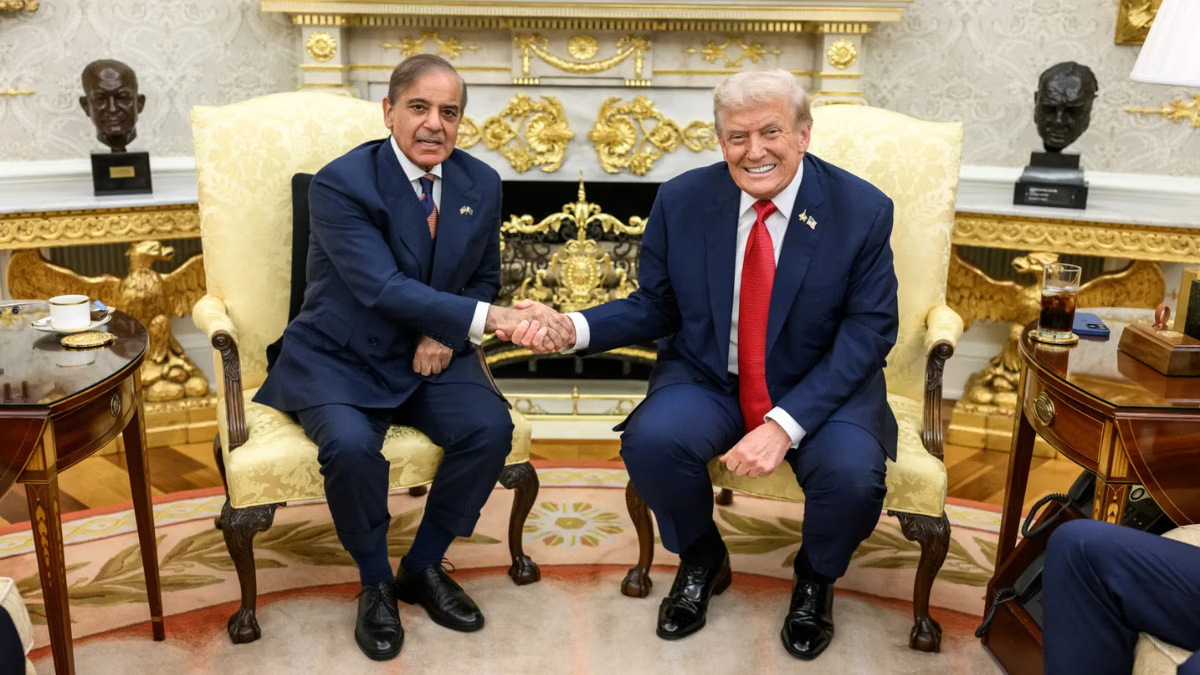
The signing was hardly a low-key affair. Prime Minister Shehbaz Sharif and army chief Field Marshal Asim Munir both attended as company executives arrived in Islamabad. Among them was Zach Witkoff, son of Trump adviser Steve Witkoff, who put his signature on the agreement alongside Pakistan’s Finance Minister Muhammad Aurangzeb.
Yet nearly half a year later, the practical results are strikingly thin. Pakistani officials have confirmed there has been:
- No pilot program testing USD1
- No licenses granted for its use
- No known transactions involving the stablecoin
Even so, analysts argue Pakistan walked away with something arguably worth as much as Trump’s windfall: a rare and direct line into his administration.
What Exactly Is USD1?
To understand the arrangement, it helps to know what a stablecoin actually does. A stablecoin is a form of digital money tied to a fixed value, almost always the US dollar, built to send funds across the internet without relying on traditional banks. USD1 is World Liberty Financial’s entry in that space.
Here’s the catch that makes it lucrative: the company collects interest on the reserves that back each coin. The more USD1 circulates, the more income flows to its owners, the Trump family included.
Pakistan already ranks among the biggest crypto markets on the planet. According to the Chainalysis adoption index, it placed third worldwide last year, trailing only India and the United States. Much of that informal activity is believed to run through Tether’s USDT, currently the largest stablecoin in existence.
Does the Deal Even Make Sense?
There’s little evidence that USD1 appeared in any actual Pakistani transactions, and the broader picture of how much money flows through such channels stays murky.
A senior banking figure in Pakistan, speaking anonymously, admitted that no dependable estimate exists. The numbers floating around, he said, are guessed at from formal inflows rather than genuinely measured. Informal routes are thought to make up roughly ten percent of remittances, with stablecoins representing some unmeasured slice of that.
All of this unfolds while formal money transfers are hitting historic highs. Pakistan pulled in $38.3 billion in remittances over the last financial year, its largest total ever and a 27 percent jump from the year before, per the State Bank of Pakistan. In May, inflows touched a record $4.25 billion, and the central bank anticipates the annual figure will surpass $42 billion.
That success naturally invites a question: why bother with the deal at all?
Ibrahim Khalil, a banking and finance professional based in Canada, put it bluntly. He wondered aloud why anyone leans on USDT when Pakistan is already receiving record remittances through banks, often with transfers landing instantly. Whatever drives people away from banking channels, he argued, USD1 won’t fix it if banks are still part of the equation.
Khalil raised a logistical hurdle too. With Pakistan’s central bank holding $16.5 billion in reserves in late June, barely enough to cover two months of imports, the country would still have to convert USD1 back into actual dollars unless trading partners accepted the token directly. That, he noted, could add friction rather than remove it.
Building Rules Before a Rollout
Despite the doubts, Pakistan has moved fast on regulation. The Virtual Assets Act, passed in March, established a permanent watchdog, the Pakistan Virtual Assets Regulatory Authority, or PVARA. The body can license firms and hand down prison terms of up to five years for anyone operating without approval. By April, the State Bank had authorized banks to open accounts for licensed crypto companies.
Still, the framework remains a work in progress. PVARA is only taking preliminary applications, and complete licensing rules haven’t been released. Major exchanges Binance and HTX have received no-objection certificates and are registered, but neither is cleared to operate yet.
The anonymous banking executive was measured about the World Liberty Financial pact, describing it as exploratory and technical, focused on dialogue and knowledge-sharing without any promise to deploy a specific stablecoin. In his view, any firm that meets PVARA’s standards could fill the same role. The structure, he suggested, matters more than the partner. On timing, he was direct: licensing, onboarding, a pilot, and scaling would realistically stretch across many months.
Access Was the Real Prize
If the financial rationale looks shaky, the diplomatic payoff is far harder to wave away.
The World Liberty Financial delegation first landed in Islamabad in April of last year, just days after a deadly attack in Indian-administered Kashmir’s Pahalgam region sent tensions between India and Pakistan climbing. In June, Pakistan nominated Trump for the Nobel Peace Prize, praising what it called his statesmanship in cooling the May standoff with India.
The goodwill kept flowing. Trump hosted Munir for lunch at the White House in June 2025, the first time a US president had welcomed a Pakistani army chief who wasn’t also the head of state. The January agreement arrived just ahead of the US-Israeli conflict with Iran, during which Pakistan cast itself as a go-between for Washington and Tehran. In Switzerland last month, US Vice President JD Vance praised Munir for helping shape a peace framework, calling him a great statesman.
There’s a revealing personal thread too. Bilal Bin Saqib, who now chairs PVARA, was named an adviser to World Liberty Financial in April last year before stepping away to join the government. He later told Bloomberg that the crypto initiative had opened doors and restored trust with Washington. The White House has insisted there were no conflicts of interest, and Bin Saqib, PVARA, and the Finance Ministry did not respond to requests for comment.
In the end, whether the deal ever helps ordinary Pakistani workers may matter less than what it has already secured for the state. As Karachi-based economist Khurram Husain framed it, the memorandum was essentially a tool for access with no genuine policy foundation, and that bet paid off handsomely by opening the doors of the Trump White House. Khalil reached the same conclusion, summing up the entire episode as a straightforward exchange of pay for access.
Author