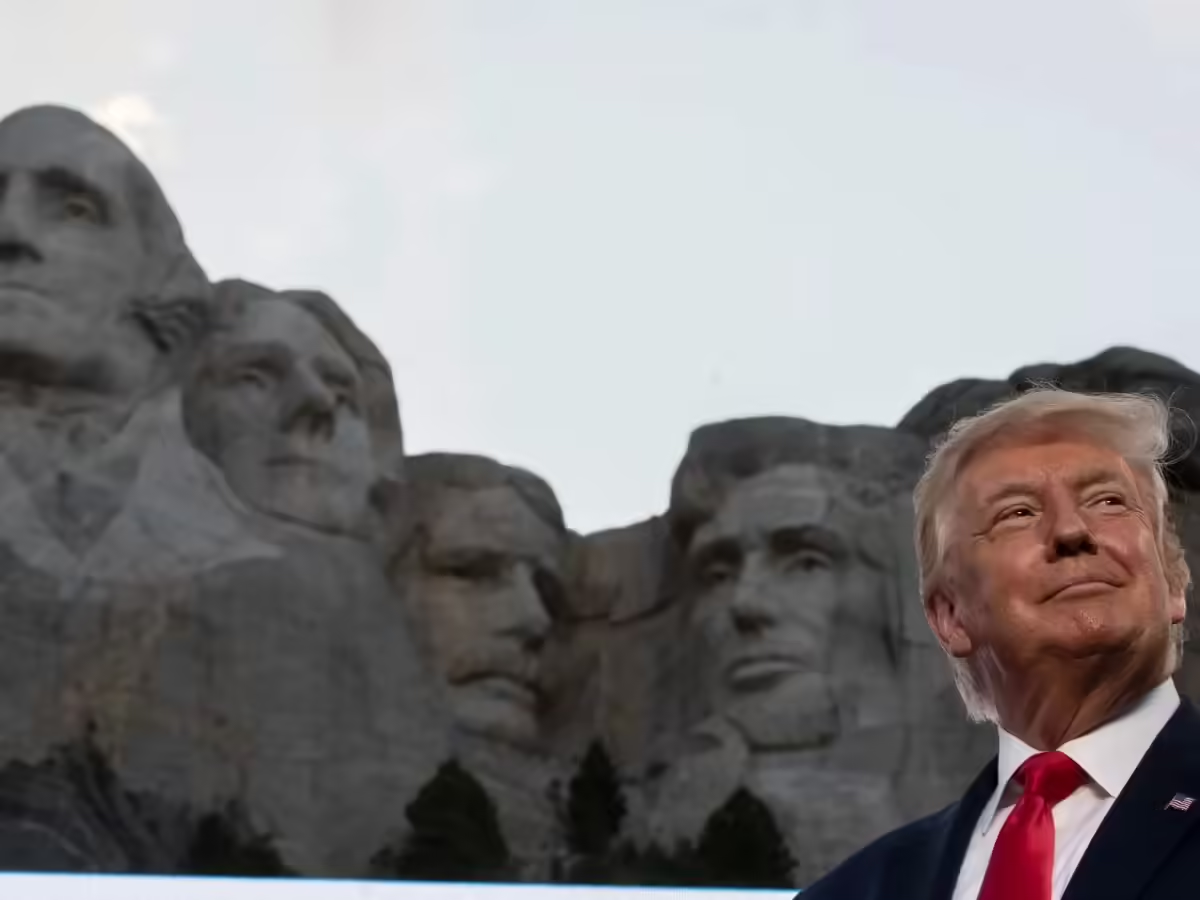
Trump’s 250th anniversary speech turned what many expected to be a unifying national moment into one of the most politically charged addresses of his presidency. Standing before the granite faces of Mount Rushmore on Friday evening, the president opened America’s semiquincentennial weekend not with a call for unity, but with a sharp warning about what he described as a rising “communist menace” threatening the nation.
A Milestone Celebration Turns Combative
The event in South Dakota marked the newest stop on Trump’s tour honoring 250 years since the United States declared independence from Britain. For roughly thirty minutes, he addressed an enthusiastic crowd that greeted him with chants of “USA! USA!” The evening even featured a dramatic flyover of F-16 fighter jets that briefly paused his remarks.
Trump devoted part of his speech to praising the four leaders memorialized on the mountain: George Washington, Thomas Jefferson, Theodore Roosevelt, and Abraham Lincoln. He described them as bold, ambitious, and destined for greatness, calling them among history’s finest figures. Notably, Trump has never dismissed the possibility of one day seeing his own likeness added to the monument.
Reclaiming “American Identity”
A central theme of the address was the idea that American greatness stems not only from its founding documents but from a unique national culture and character. Trump criticized what he viewed as deliberate efforts to erase the country’s heritage and distance citizens from their past.
Speaking to a largely white audience, he promised to restore the nation’s sense of self, pledging to “give our country its identity back.” From there, however, the tone shifted sharply away from the traditional role of a head of state seeking to bridge divides.
Targeting Progressives Ahead of the Midterms
With congressional midterm elections just four months away, Trump leaned into a message he has increasingly emphasized: portraying progressive Democrats as communists who endanger the country’s survival. The timing was significant. Hours earlier, New York Mayor Zohran Mamdani, a self-described democratic socialist, had delivered a pro-immigrant speech widely interpreted as a direct challenge to Trump and his “Make America Great Again” movement.
The political landscape gave his remarks added weight. In recent contests, several progressive candidates, including multiple democratic socialists, secured primary victories across the country:
- New York and Colorado saw progressive wins in the past week
- Additional victories emerged in Kentucky, New Jersey, Ohio, Pennsylvania, and Texas
Trump wove these developments into a broader narrative connecting anti-communist sentiment with his long-standing hardline stance on immigration.
Framing Communism as an Existential Threat
Trump argued that America now faces a renewed ideological danger. He claimed that a generation after winning the Cold War, communism was resurfacing, partly through newcomers whose values he said clashed with the American way of life.
In striking language, he ranked this alleged threat above both world wars and the September 11 attacks, calling it an enemy of the Constitution and of the ideals behind July 4, 1776. He contrasted the principles of “life, liberty, and the pursuit of happiness” with what he described as “death, tyranny and the pursuit of evil.”
The president went further, insisting that loyalty to Marxist ideology and loyalty to America were fundamentally incompatible. In his words, a person could be a communist or a patriot, but never both.
Rewriting History and Contested Ground
Critics have accused Trump of using the anniversary to reshape the national story, spotlighting figures like Washington and Jefferson while omitting uncomfortable truths, including that both men enslaved people. During his speech, he pushed back against what he called Marxist distortions of American history, dismissing claims that the nation was built on stolen land or that its heroes were oppressors.
That argument carried a notable irony given the setting. Mount Rushmore sits within the Black Hills, territory that the federal government took from the Sioux Nation in 1877, breaking a treaty that had guaranteed the land to the tribe.
Immigration, Exile, and Election Warnings
Trump then linked his warnings about communism directly to immigration, suggesting that those he labeled as threats could be removed from the country. He vowed to “vanquish communism quickly” and send offenders into exile, promising the crowd that America would never become a communist nation.
He also called on Congress to eliminate the filibuster and approve the Save America Act, legislation that opponents have condemned as an effort to suppress voting. Trump claimed passing it would secure long-term electoral dominance, while describing the “communist party” as composed of undocumented immigrants, criminals, and people unwilling to work.
Pageantry and Spectacle
The evening blended politics with performance. Before Trump spoke, actors dressed as Washington, Jefferson, Roosevelt, and Lincoln recited famous historical quotations from a blue-carpeted stage. Country musician Chancey Williams performed a set, and among the audience, a young boy held up a handmade sign reading “Trump the GOAT.”
What Comes Next
Trump, whose approval numbers remain near record lows, is scheduled to speak again on Saturday at the National Mall. The appearance will precede a large fireworks display, though an intense heatwave has disrupted Independence Day festivities in many parts of the country.
As the nation marks a quarter-millennium of independence, Trump’s Mount Rushmore address signals that this historic celebration will be shaped as much by political battle lines as by national pride.
Author