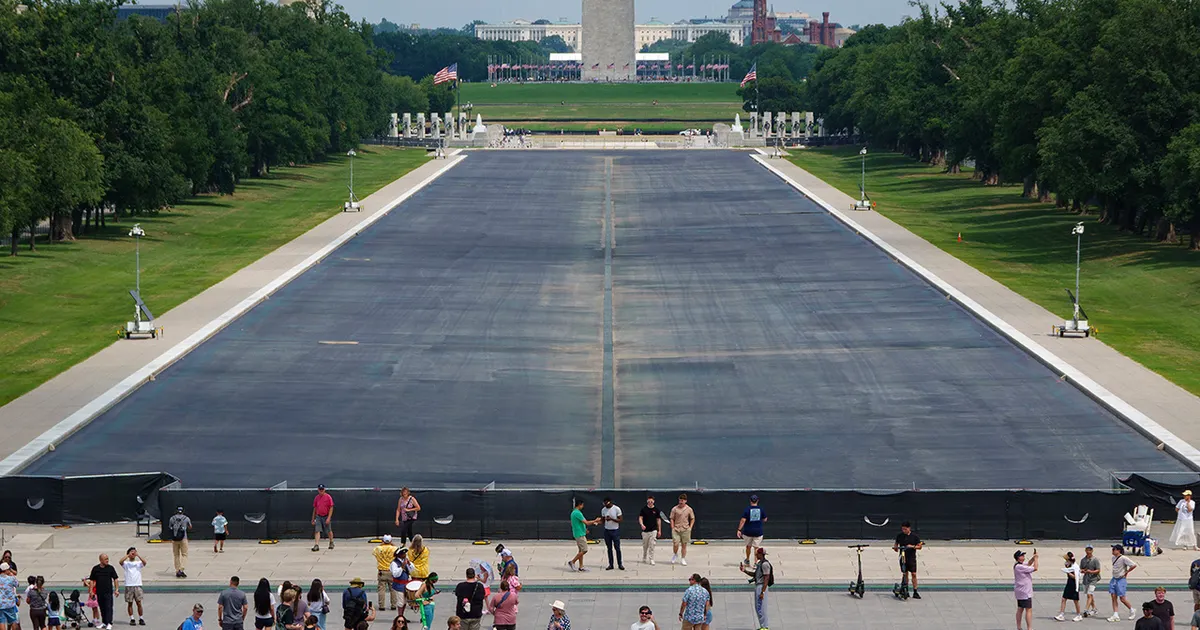
The Lincoln Reflecting Pool vandalism charges that dominated headlines this summer have collapsed entirely. Every one of the four people accused of damaging the iconic Washington landmark is now free of criminal liability, after federal prosecutors quietly walked away from the cases they had pursued with considerable public fanfare only weeks earlier.
What Actually Happened in Court
On Monday, prosecutors working under U.S. Attorney Jeanine Pirro filed a notice of nolle prosequi covering the final two defendants, Cameron Theirs and Sophie Dennison-Gibby. In plain English, the filing signals that the government has decided it will not carry the prosecution forward.
That decision followed an earlier one. Court records show the cases against former Olympian David Hearn and Justin Carreno were abandoned on Friday, and the remaining two files were folded into the same disposition shortly afterward. Paperwork requesting the dismissals was submitted Friday but did not clear the docket until the start of the week.
There is an important asterisk here. A nolle prosequi is not the same thing as an acquittal. No jury weighed the evidence and no judge declared anyone innocent. The government retains the ability to bring identical charges again should it choose to. For now, though, the prosecution has stopped.
From Presidential Accusation to Federal Case
The chain of events began on June 20, when President Donald Trump publicly asserted that vandals had carved a 350-foot gash into the reflecting pool. The claim landed with enormous force. Within a day, Pirro announced her office would pursue the people responsible.
Arrests followed. Theirs and Dennison-Gibby were charged with a combination of misdemeanor and felony offenses, based on allegations that they had peeled away a section of the pool’s surface.
For the accused, the experience was compressed and public. Their names circulated nationally before any evidentiary hearing took place.
The Defense Response
Jamison Koehler, the attorney representing Dennison-Gibby, offered a blunt assessment in a statement provided to WUSA9. He said his client had been arrested for conduct that no reasonable observer would believe she committed.
According to Koehler, the defense repeatedly attempted to hand over evidence favorable to Dennison-Gibby, and investigators showed little appetite for examining it. His explanation was direct: the material contradicted the story the administration had already committed to publicly.
He also described the personal toll. Being identified by the sitting president, characterized in harsh terms and warned of significant prison time, left his client badly shaken. Koehler closed by saying the ordeal had finally ended.
An attorney representing Theirs was contacted for comment but had not responded at the time of publication.
Why the Government Backed Down
The dismissal filing itself contains the most revealing material in the entire episode.
Prosecutors wrote that had the Department of the Interior shared information it already possessed, the government would never have gone to a grand jury seeking an indictment in the first place. That is an unusually candid admission from a prosecuting office.
The filing describes a frustrating pattern of communication. Attorneys said they contacted the Interior Department dozens upon dozens of times. Rather than a straightforward handover, information arrived slowly and in fragments over an extended period.
When the relevant records finally surfaced, they pointed away from criminal conduct and toward something more mundane.
The Contractor at the Center of It
Court documents allege that Atlantic Industrial Coatings, the firm hired for the reflecting pool renovation, rushed the job and executed it poorly. In other words, the damage that triggered the criminal investigation appears to have been a construction problem, not a crime scene.
A few details make this harder to dismiss:
- The renovation was awarded through a no-bid contract worth close to fifteen million dollars.
- In July, the administration announced it would not solicit new bids to fix the outstanding problems.
- Secretary Burgum publicly praised the original workmanship, describing it as extremely well done.
That combination, a large no-bid award, botched execution alleged in federal filings, and no competitive process to correct it, raises questions that extend well past the four people who were charged.
Trump Holds His Position
The president has not accepted the outcome. Writing on Truth Social over the weekend, he expressed open confusion about Pirro’s decision, saying he did not understand what she was thinking.
His revised position concedes ground without surrendering the core claim. Trump acknowledged the contractor encountered problems but insisted the more significant damage to the pool was inflicted deliberately.
That leaves a striking gap between the White House and the prosecutors who were supposed to make the case. The office that would have argued it in court has effectively conceded that the evidence was not there.
What This Episode Reveals
Strip away the politics and a few structural lessons remain.
Speed cuts both ways. The case moved from presidential statement to criminal charges in roughly twenty-four hours. That pace generated headlines but left little room for basic verification.
Agencies control the facts. Prosecutors said plainly that a single federal department’s reluctance to share records drove the entire misfire. Charging decisions are only as sound as the information underneath them.
Reputational harm outlasts dismissal. Four people were publicly named, one of them an Olympic athlete. The charges vanished in a filing that most people will never read. The coverage that preceded it reached a far larger audience.
And the underlying problem persists. The reflecting pool still needs repair. The contract that produced the damage was never rebid. The people accused of causing it are no longer charged. The question of who ultimately answers for a fifteen million dollar renovation gone wrong remains open, and the criminal case that briefly seemed to supply an answer has now been withdrawn without one.
Author
-
Lucienne Albrecht is Luxe Chronicle’s wealth and lifestyle editor, celebrated for her elegant perspective on finance, legacy, and global luxury culture. With a flair for blending sophistication with insight, she brings a distinctly feminine voice to the world of high society and wealth.