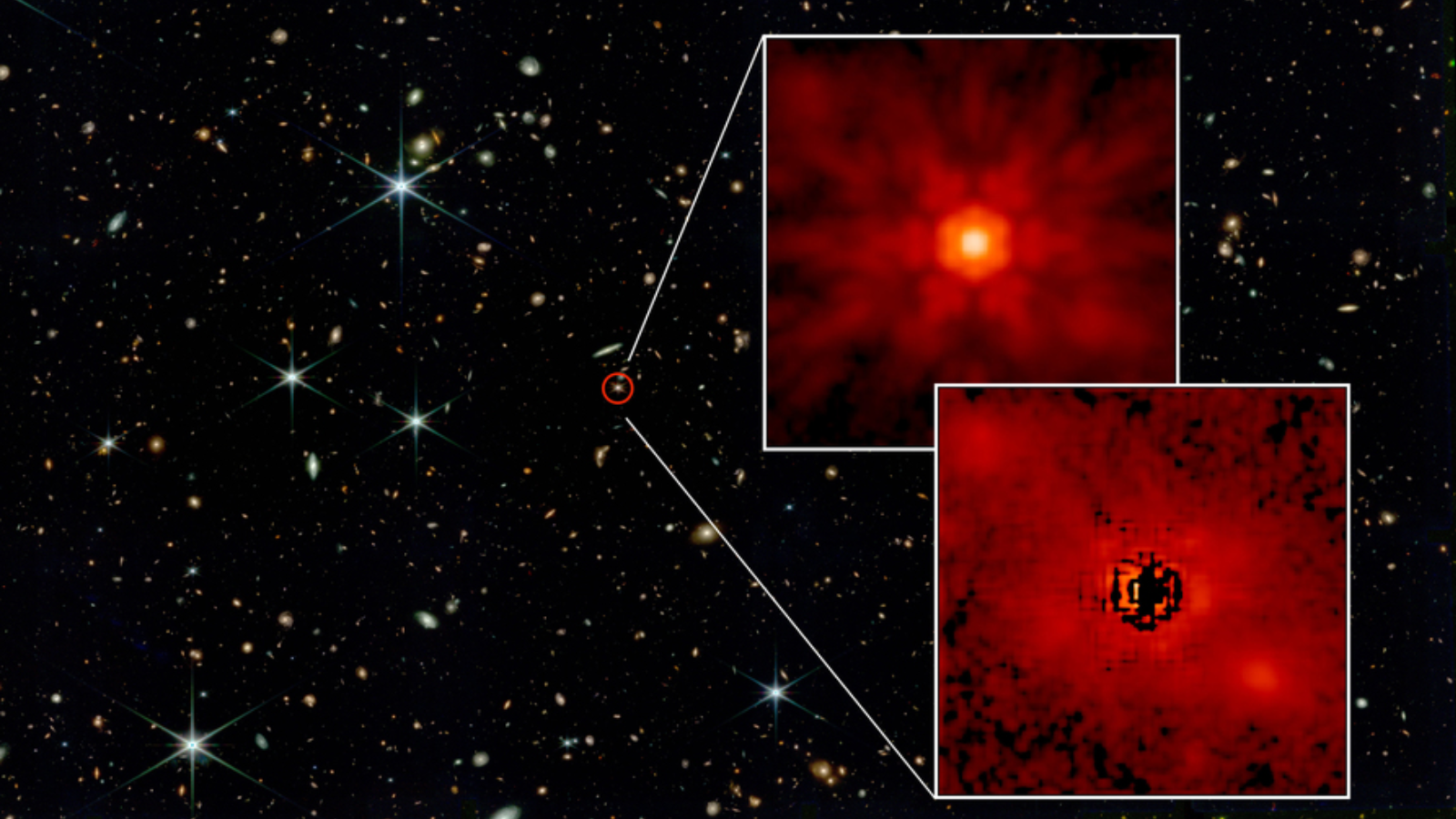
Black hole star discovery has given astronomers a compelling explanation for one of the most persistent puzzles the James Webb Space Telescope has produced: a scattering of small red objects in the early universe that refuse to fit any established category.
New research published in Nature makes the case for an object roughly the size of our solar system, glowing intensely red, that appears to be a black hole wrapped in a shroud of extraordinarily dense gas.
Light From 660 Million Years After the Beginning
The signal at the centre of the study originates from a period when the universe was just 660 million years old. For context, it is now approaching 14 billion years old.
In Webb’s images, the object appears as one among many bright reddish points scattered through the early cosmos. Designated MoM-BH*-1, it initially resembles an enormous star when viewed across billions of light-years.
That resemblance breaks down under closer examination.
The Energy Problem
The first anomaly is output. According to the research team, the object emits roughly 100 billion times more energy than any star could generate through nuclear fusion.
That is not a matter of degree. Fusion has physical limits, and this exceeds them by a margin that eliminates conventional stellar explanations entirely. Even accounting for the extreme conditions of the early universe, when stars were larger and more luminous than those forming today, the object is exceptionally bright.
The Missing Light
The second anomaly involves absorption. Part of the object’s light simply vanishes at certain wavelengths.
Stars can produce a comparable effect when their outer atmospheres absorb specific frequencies, so the signature itself is not unusual. What is unusual is the intensity. The effect in MoM-BH*-1 is far too pronounced to result from ordinary stellar behaviour.
Researchers concluded that an enormous quantity of extremely dense gas must be responsible for swallowing that light.
Assembling the Hypothesis
Together, those observations point toward a specific structure.
At the centre sits a black hole actively consuming matter and releasing tremendous energy in the process. Surrounding it is a massive envelope of gas.
Energy generated by the black hole must pass through that envelope before escaping into space. In transit, it acquires properties that resemble starlight, which is why the object masquerades as a star when observed from a distance.
The result is neither one thing nor the other. It is a black hole wearing a star’s appearance.
Solving a Broader Mystery
The finding matters beyond this single object because Webb has been finding these small red spots with surprising regularity.
They do not fit comfortably into existing classifications, and several competing explanations have been proposed:
- Compact galaxies densely packed with stars
- Black holes concealed behind thick dust
- Systems fundamentally unlike anything observed in the present-day universe
- Black hole stars
MoM-BH*-1 is particularly valuable because of how cleanly it presents. Unlike other red dots, its black hole appears to almost entirely overwhelm the light from whatever galaxy surrounds it.
Rohan Naidu, the study’s lead author, who conducted the work while at MIT, described the significance in a press release. Every little red dot, he noted, is consistent with being a black hole star embedded within an ordinary early galaxy. What distinguishes MoM-BH*-1 is that the black hole star essentially outshines its host completely, meaning observers are seeing black hole star light in isolation.
Why This Could Matter
If the interpretation holds, the implications reach into one of cosmology’s harder problems: how supermassive black holes grew so large so quickly after the Big Bang.
Standard models struggle to explain black holes of enormous mass existing when the universe was only a few hundred million years old. There simply does not appear to have been enough time for them to accumulate that mass through conventional accretion.
Objects that grow rapidly inside dense gas envelopes offer a possible mechanism. A black hole feeding within an effectively unlimited local fuel supply can gain mass at rates that isolated black holes cannot match.
The Appropriate Caution
This remains a hypothesis rather than a confirmed object class. One well-observed example, however striking, does not establish a category.
Alternative explanations have not been eliminated, and the extreme distances involved mean every measurement carries substantial uncertainty. Confirmation will require finding additional examples and demonstrating that the model predicts their properties accurately.
What the discovery does provide is a testable framework. Astronomers now have specific signatures to search for across the growing catalogue of Webb observations.
The Broader Point
Webb was built to look further back in time than any previous instrument, and it has done so successfully. The consequence is that it keeps finding things nobody expected.
Each unexplained red dot represents a gap between what theory predicted and what the early universe actually contained. Black hole stars may fill some of that gap. If they do, the picture of how the first galaxies and their central black holes formed will need substantial revision.
Author
-
Lucienne Albrecht is Luxe Chronicle’s wealth and lifestyle editor, celebrated for her elegant perspective on finance, legacy, and global luxury culture. With a flair for blending sophistication with insight, she brings a distinctly feminine voice to the world of high society and wealth.