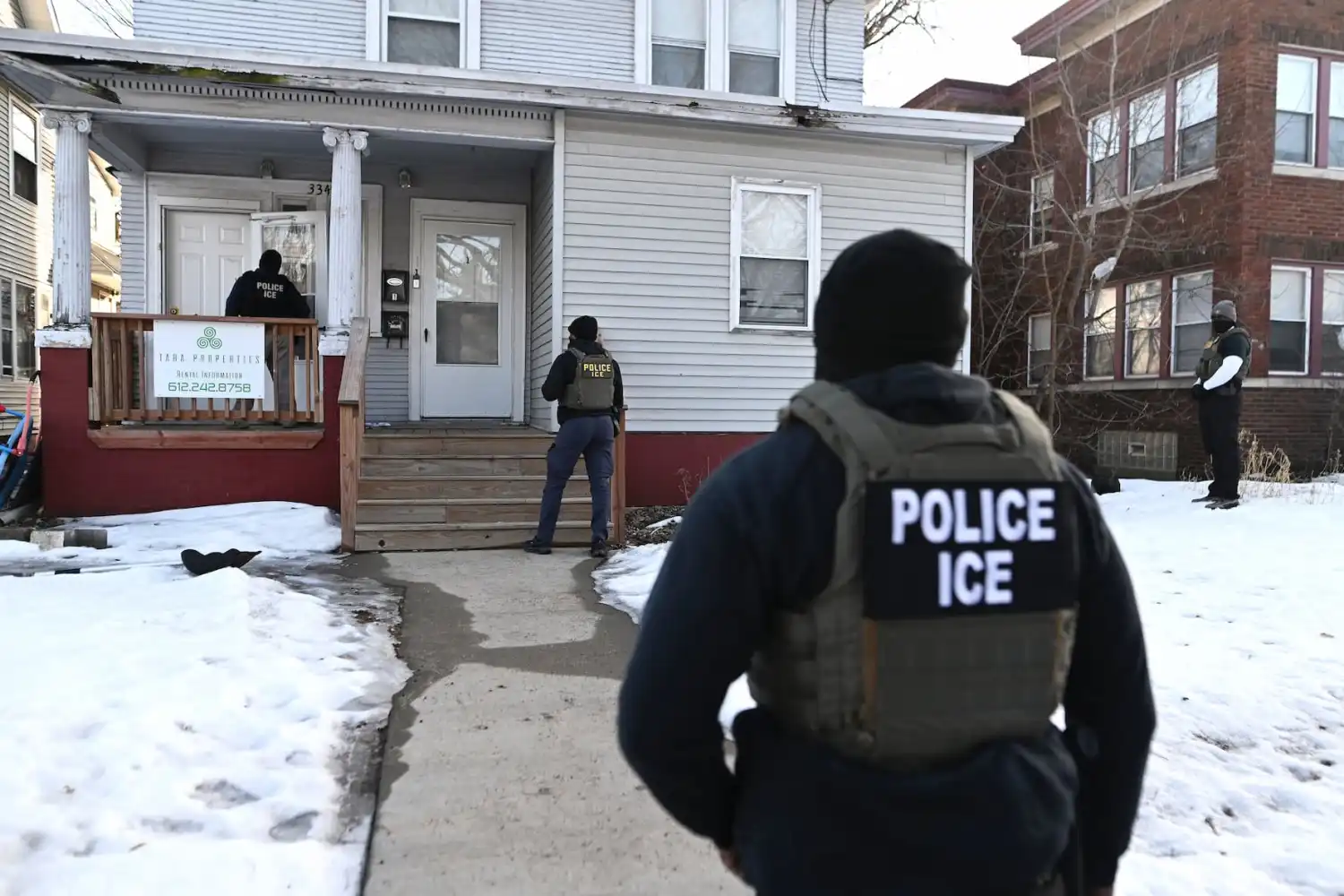
An ICE email investigation has thrust a Rochester man into a troubling standoff over free speech, after federal agents showed up at his home and later tracked him to a hotel over a strongly worded message he sent months earlier. The case of David Streever has alarmed civil liberties advocates, who see it as part of a broader pattern of intimidation aimed at silencing critics of federal immigration authorities.
What began as one citizen’s angry email has spiraled into a saga involving doorbell footage, warning forms, and questions about government surveillance.
An Unsettling Discovery From Abroad
David Streever, 45, was vacationing in Finland with his 7-year-old daughter last week when his doorbell camera back home caught something strange. In footage recorded hours earlier, he spotted two people who appeared to be law enforcement officers in blue jackets standing on his front porch in Rochester, New York.
He did not think much of it at first. The concern set in only after he heard the details from his wife, the Rev. Hilary Streever, 43, an Episcopal priest. She had come face to face with the pair on the afternoon of June 23 while arriving home with the couple’s 2-year-old son, still wearing her clergy collar.
Agents on the Porch
The two visitors were agents from Homeland Security Investigations, a branch of the U.S. Department of Homeland Security, and they were searching for David Streever. According to Hilary Streever, the agents said their visit concerned an email her husband may or may not have sent threatening Todd Lyons, the former acting director of U.S. Immigration and Customs Enforcement.
She immediately doubted the premise, telling the agents her husband would never have sent such a thing. She explained he was out of the country and would return that Friday.
Before leaving, the agents asked her to have David call them back and left behind a form for him to sign. The document was stamped with bold warnings, declaring “WARNING NOTICE” and “YOU MAY BE IN VIOLATION OF FEDERAL LAW,” and it outlined federal laws criminalizing threats against federal officials.
A Familiar Pattern of Forms
The Streevers later discovered they were not alone. The same agents had presented an identical form that very day to a Syracuse poll worker, accusing her of threatening an ICE officer through her Instagram account.
Civil liberties advocates have sharply criticized the agency’s growing reliance on these forms, describing them as a tactic meant to intimidate and silence critics rather than address any genuine threat.
The Email That Started It All
When Hilary relayed the agents’ message, David was baffled. He insisted he had never threatened anyone and did not consider himself a violent person. Then he remembered a pointed message he had sent to Lyons’ government email in January, shortly after federal immigration officers fatally shot two people in Minneapolis.
A former journalist now working in tech, Streever had written the note on January 26. In it, he warned Lyons that his own conscience would one day torment him and drew a comparison between Lyons and a Nazi official. It was, Streever said, the only email he ever sent to Lyons.
He summed up the surreal turn of events plainly: one powerless citizen had shouted into the void with a stern email six months ago, and now federal agents were at his door.
Yelling Into the Void
Streever traced his outrage back to January, when videos of federal officers fatally shooting two observers, Renée Macklin Good and Alex Pretti, in Minneapolis left him fearing the country was sliding toward fascism. He was especially disturbed by administration officials labeling both victims as domestic terrorists.
Feeling compelled to register his moral objection, he wrote to Lyons under the subject line “What’s next.” In the message, he called Lyons a monstrous human being and predicted he would be remembered as a historical villain, invoking a notorious architect of the Holocaust. The email went on to say that Lyons’ defense of what Streever called an obvious execution would lead to his downfall, and that he would never know peace, tormenting himself until his final day.
Streever doubted Lyons would ever read the note himself but hoped whoever did would seriously weigh questions of right and wrong.
Advocates Say It Was No Threat
Free speech experts who reviewed the email argue it plainly falls short of any legal definition of a threat. Adam Steinbaugh, an attorney with the Foundation for Individual Rights and Expression, or FIRE, called the investigation clearly out of line.
He explained that a true threat requires a serious expression of intent to commit unlawful violence, something entirely absent from Streever’s message. Instead, Steinbaugh said, the email amounted to criticism of the ICE director and an appeal to his conscience. The First Amendment, he emphasized, protects Americans who voice concerns to their government. Officials are free to ignore those concerns, but they cannot dispatch agents to someone’s door and trail them across the state.
Tracked to His Hotel
The story took an even more unnerving turn once Streever returned to the United States. Just hours after he landed at John F. Kennedy International Airport on Thursday evening, a third Homeland Security Investigations agent tracked him down at the airport hotel where he was staying that night.
The agent left a business card with the front desk, raising pointed questions about whether Streever was under active surveillance. He had checked in around 8 p.m., swiping his credit card before he and his daughter went to sleep, apparently unaware he had already been located.
Earlier, while still abroad, Streever had tried not to dwell on the situation, enjoying a visit to a Finnish theme park with his daughter. On the flight home, though, he began to wonder whether federal officers would stop him at passport control. He and his daughter passed through without incident, only for the hotel visit to follow.
A Broader Crackdown on Critics
The pursuit of Streever fits into a wider series of DHS actions against protesters and critics over the past year. For months, the department and ICE have pursued what they describe as threats against their personnel and doxxing attempts, going so far as to send administrative subpoenas to email and social media platforms to unmask people who posted about ICE anonymously.
DHS has defended these efforts as necessary. The department did not respond to specific questions about Streever’s case but provided a statement saying ICE investigates all credible threats against its employees and officers, including threats to the ICE director, while declining to comment on ongoing investigations. In a separate statement, DHS insisted the danger to its officers is real, citing what it called coordinated campaigns of violence against them.
Yet the tactics have raised red flags well beyond this single case. Last year, Homeland Security agents visited a Philadelphia man’s home to question him about a critical email he had sent to a DHS attorney regarding the deportation of an Afghan man who feared Taliban reprisal.
Nathan Freed Wessler, deputy director of the ACLU’s Speech, Privacy and Technology Project, said the situation increasingly resembles a pattern of knocking on doors to question people about constitutionally protected speech, which he found deeply troubling.
An Escalation That Worries Experts
Civil liberties experts say Streever and the Syracuse poll worker represent the first cases they know of involving agents leaving a form to sign, an approach Wessler characterized as an escalation and a clear attempt at intimidation.
The form left for Streever stated that ICE’s Office of Professional Responsibility had identified an email sent to Lyons that it believed might violate a section of federal law, and it requested that Streever promptly stop the behavior in question. Streever was left puzzled by the language, especially since five months had already passed since he sent the message. The bottom of the form added an ominous note, warning that its receipt would be taken into account should he continue any of the criminal activities it described.
Steinbaugh found the whole approach chilling, objecting to a government that crafts a form telling citizens their protected speech might be criminal and instructing them to knock it off. He has since asked others who received similar forms to come forward.
For Streever, what started as a single act of moral protest has become a personal ordeal that civil liberties advocates warn could foreshadow how the government treats dissent going forward. The core question now hanging over the case is whether Americans can criticize their government without agents appearing at their door.
Author