Drone Attack Sparks Fire at UAE Nuclear Power Plant
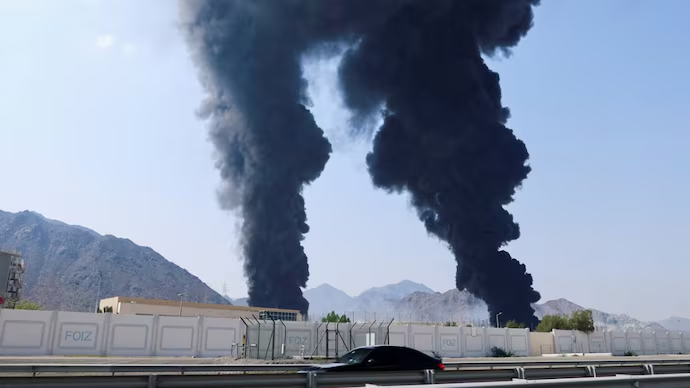
A UAE nuclear power plant drone attack rattled the Middle East on Sunday, after an aerial strike targeted the United Arab Emirates’ only nuclear facility and ignited a fire along its perimeter. While officials reported no injuries and no radiological leak, the incident sent a clear and unsettling signal: the fragile ceasefire with Iran could unravel at any moment.
The strike on the Barakah nuclear power plant marks a dangerous new chapter in a regional conflict that has already drawn in several major powers — and it has revived fears that nuclear sites are increasingly being treated as fair targets in modern warfare.
What Happened at the Barakah Plant
According to the UAE Defense Ministry, three drones crossed into the country from its western border with Saudi Arabia. Air defenses intercepted two of them, while the third reached the plant and caused the fire.
Authorities described the incident as an “unprovoked terrorist attack” but stopped short of directly blaming any nation. Notably, no group claimed responsibility.
Reassuringly, the damage appeared contained:
- The UAE’s nuclear regulator confirmed the fire did not affect plant safety
- All reactor units remained operating as normal
- The International Atomic Energy Agency said the fire struck an electrical generator, with one reactor temporarily running on emergency diesel power
IAEA director-general Rafael Mariano Grossi expressed “grave concern” over the strike and later spoke directly with the UAE’s foreign minister.
Why the Barakah Plant Matters
The Barakah facility is no ordinary power station. Built at a cost of around $20 billion with assistance from South Korea, it went online in 2020 and stands as the only nuclear power plant in the entire Arab world.
Its importance to the UAE is substantial. The four-reactor plant can supply roughly a quarter of the country’s total energy needs — a critical resource for a federation of seven sheikhdoms that includes Dubai. An attack on this site, therefore, is not just symbolic; it strikes at the heart of national infrastructure.
This is the first time the plant has been targeted during the current war, though it is not the first threat it has faced. Yemen’s Iran-backed Houthi rebels claimed to have targeted the facility back in 2017, while it was still under construction — a claim Abu Dhabi denied at the time.
A Ceasefire Hanging by a Thread
The timing of the attack could hardly be more tense. The UAE has recently accused Iran of launching drone and missile strikes as friction grows over the Strait of Hormuz, a vital energy waterway currently under a US naval blockade.
The broader conflict traces back to February 28, when Israel, with US support, launched an attack on Iran. The UAE has since hosted Israeli air defenses and personnel, placing it firmly within the conflict’s blast radius.
On Sunday, signs pointed toward escalation rather than calm:
- US President Donald Trump spoke by phone with Israeli Prime Minister Benjamin Netanyahu
- Shortly after, Trump posted a stark warning that “the clock is ticking” for Iran
- Two sources said Israel is coordinating with the US over a possible resumption of attacks
Speaking to his Cabinet, Netanyahu said Israel’s “eyes are also open” regarding Iran and that the country was “prepared for any scenario.”
Iran Prepares Its Public for War
Inside Iran, the messaging has grown openly militant. Iranian state television aired unusual segments designed to brace citizens for conflict, including news anchors appearing on air while holding rifles.
In one striking moment, presenter Hossein Hosseini received basic firearms training from a masked member of the Revolutionary Guard and mimed firing a shot at the UAE flag. On another channel, anchor Mobina Nasiri said a weapon had been delivered to her and declared she was ready to sacrifice her life for the country.
Such broadcasts suggest that diplomatic off-ramps are narrowing, and that Tehran is preparing its population for the possibility of renewed fighting.
How the UAE’s Nuclear Program Differs
It is worth noting that the UAE’s nuclear ambitions are very different from those at the center of the Iran-Israel standoff.
The UAE signed a strict “123 agreement” with the United States, under which it agreed to forgo domestic uranium enrichment and the reprocessing of spent fuel. Its uranium is sourced entirely from abroad, a deliberate choice meant to ease any concerns about weapons proliferation.
Iran’s program stands in sharp contrast. Tehran insists its work is peaceful, yet it has enriched uranium close to weapons-grade levels and is widely suspected of having pursued a military dimension at least until 2003. It has also repeatedly restricted UN inspectors.
Israel, meanwhile, is broadly believed to be the only nuclear-armed state in the region, though it has never confirmed nor denied possessing atomic weapons.
A Worrying Global Pattern
The Barakah strike fits into a troubling trend. Nuclear facilities have increasingly come under threat during recent conflicts, most notably during Russia’s full-scale invasion of Ukraine, which began in 2022. During the Iran war, Tehran also repeatedly claimed its Bushehr plant had been attacked, though no direct reactor damage or radiological release was confirmed.
Targeting nuclear infrastructure — even when the immediate damage is limited — carries enormous risk, raising the specter of a catastrophe that could extend far beyond any single battlefield.
The Bottom Line
The UAE nuclear power plant drone attack ended without casualties or a radiation leak, but its significance lies in what it represents rather than what it destroyed. With the Iran ceasefire visibly fraying, leaders trading warnings, and state media preparing populations for combat, the region appears to be edging closer to renewed war.
For now, the world watches the Barakah plant — and the diplomatic efforts around it — hoping that this fire remains an isolated incident rather than the spark for something far larger.
Author