Nearly six months into the war with Iran and with stockpiles of key weapons thinning, the administration has announced a shift toward economic pressure on Iran that officials are describing in maximalist terms. Trump promised what he called an economic D-Day, an unprecedented campaign of financial warfare and isolation.
The target is a country that has spent close to five decades under American sanctions and is still standing.
What Was Announced
Details remain sparse. Trump said this week that the United States would impose an extraordinary level of economic pressure aimed at forcing Iran’s leadership to abandon its nuclear program and fully reopen the Strait of Hormuz to oil and gas tankers.
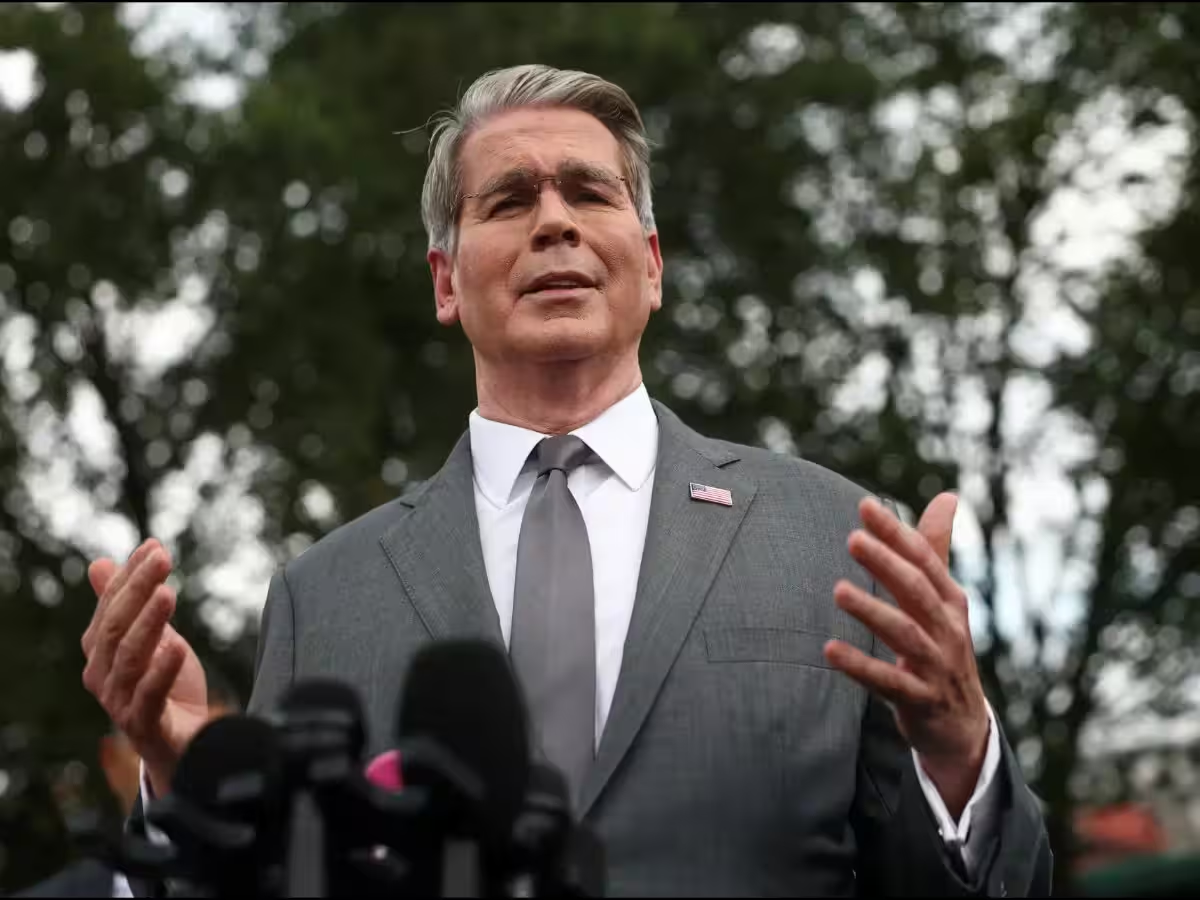
Treasury Secretary Scott Bessent offered a partial glimpse in a CNBC interview Thursday, threatening secondary sanctions against nations and companies that continue doing business with Iran.
He declined to identify specific targets under what the administration calls Operation Economic Fury, which to this point has focused on entities and individuals purchasing Iranian oil or banking with Iranian institutions. China and India remain the largest buyers of Iranian crude.
His warning was blunt: anyone insisting on doing business with Iran will face the full force of the Treasury and the government. He said it is time for allies and the rest of the world to choose.
The Political Backdrop
The timing is not incidental. Trump faces an increasingly unpopular war he has been unable to conclude, with midterm elections approaching that will determine whether Republicans retain control of Congress.
Whether the pivot reflects strategy or difficulty finding better options, it redirects attention toward an economic instrument that can be deployed without additional military commitment.
The Hawkish Case for Optimism
Supporters argue circumstances have changed enough to make this attempt different from previous ones.
Richard Goldberg, who coordinated diplomatic pressure on Iran during Trump’s first term and now works at the Foundation for Defense of Democracies, believes strikes on Iranian nuclear sites last year, the current war and the naval blockade of Iranian ports have combined into conditions that did not previously exist.
He described what is unfolding as a strategy aimed at fundamentally changing the world by bringing an end to the current Iranian government, whether that takes a short time or a long one.
He also urged humility, cautioning everyone including himself, despite his own background in sanctions and financial warfare, that this represents uncharted territory.
Goldberg pointed to the United Arab Emirates suspending trade with Iran over an alleged missile attack as a significant development. Beyond direct commerce, the Emirates had served as a re-export hub that helped Iran absorb sanctions pressure for years.
The Enforcement Problem
Nearly all of Iran’s energy, financial and transportation sectors already fall under American sanctions. The remaining lever is secondary sanctions targeting third countries, including allies and partners that have maintained some connection to Iran.
This approach has been tried before, and its difficulties are well documented.
During the first-term maximum pressure campaign, enforcement repeatedly collided with American interests. The administration granted numerous waivers, particularly to countries dependent on Iranian oil for their energy needs. Penalizing allies carries costs, including the possibility of reciprocal measures.
Behnam Ben Taleblu, senior director of the FDD’s Iran program, framed the current strategy as targeting Tehran’s remaining access points to the formal financial system and international economy. Doing so, he acknowledged, will require elevating the Iran question in bilateral relationships across Europe and Asia.
That is a substantial diplomatic ask, and it competes with every other priority in those relationships.
Tehran’s Response
Iranian officials have characterized the shift as inconsistency, noting that Trump has previously criticized predecessors who relied on sanctions to constrain Iran’s military and nuclear programs.
Foreign Ministry spokesman Esmail Baghaei wrote on X that Washington’s habit of retreating to sanctions whenever it declines to pursue diplomacy has repeatedly proven ineffective.
Iran has demonstrated across decades that it will not be strangled by such tired approaches, he said, arguing the real danger is that American politicians clinging to the habit will instead eliminate their own chances of a less humiliating exit from a crisis of their making.
The Analytical Skepticism
Ali Vaez, Iran director at the International Crisis Group, offered an assessment that cuts against the administration’s core assumption.
He argued that escalating maximum pressure with military action disregards years of accumulated lessons showing Iran does not respond to pressure the way its architects expect. If anything, he said, the current campaign has hardened Tehran’s position.
His formulation of the central problem was precise: the Iranian government views surrendering to American terms as more dangerous than enduring American sanctions.
Vaez also pointed to a trust deficit built through a year of intermittent diplomacy. Iranian officials, he said, believe that even if they capitulated under economic duress, the terms would simply shift and further demands would follow.
Pressure without an open door, in his summary, is an exercise in futility.
The Underlying Question
Both sides of this debate are making a prediction rather than an argument about facts.
Supporters believe an economy already battered by war, blockade and the loss of a major trading partner has finally reached a point where additional pressure produces collapse rather than endurance.
Skeptics believe that a government which has organized itself around resisting exactly this form of pressure for decades has both the institutional capacity and the ideological motivation to keep absorbing it.
Nothing about the coming months will resolve that disagreement quickly. Sanctions operate slowly, their effects are difficult to measure in real time, and both camps will find evidence for their position in whatever happens next.
For now, the escalation of economic pressure on Iran proceeds without published targets, without a stated timeline, and without any indication that Tehran intends to respond the way Washington hopes.
Author