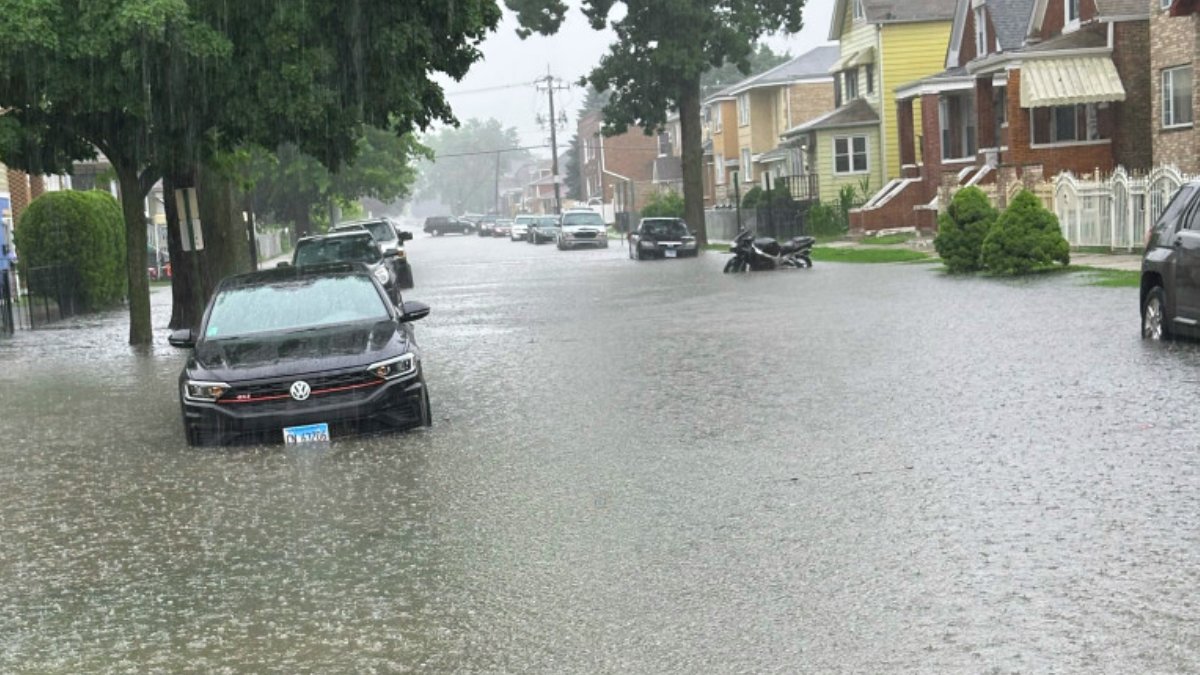
A Chicago area flood advisory covering multiple counties went into effect Sunday afternoon as the first of two expected rounds of strong to severe thunderstorms pushed across the region, delivering rain faster than drainage systems could handle.
The National Weather Service placed portions of McHenry, Lake, DuPage and Cook counties under advisories, with rainfall rates approaching an inch and a half per hour reported in the hardest-hit areas.
That figure is what matters most. Total accumulation is only half the story; the speed at which water arrives determines whether streets flood. Storm sewers in most suburban systems are designed for steady rain, not for that intensity concentrated into a short window.
Where Flooding Was Already Happening
The advisories were not precautionary. Water was on the roads before the warnings expired.
The weather service reported roadway flooding in Itasca, where multiple vehicles became stranded after drivers encountered water deeper than it appeared.
Addison, also in DuPage County, saw significant street flooding.
In Chicago itself, Total Traffic reported flooding in a lane of the inbound Eisenhower Expressway near Cicero, the kind of localized pooling that turns a normal commute into a bottleneck within minutes.
Most of the advisories were set to run through the 4 p.m. hour, with the weather service noting that flooding was imminent in a number of low-lying locations.
The Line That Moved Through
The system that produced the flooding was a line of showers and storms tracking across the northern portions of the Chicago area, generally dropping one to two inches of rain along its path.
Rainfall totals were still being collected as the storms passed, and reported figures typically continue climbing for several hours after a line clears as observers submit their measurements.
With a second wave of storms in the forecast, the concern is cumulative. Ground already saturated from the first round absorbs far less of the second, meaning the same amount of rain produces noticeably worse flooding the second time through.
Why Stranded Vehicles Keep Happening
The situation in Itasca illustrates a problem that repeats in every flood event.
Standing water on a road is almost impossible to judge by sight. A flooded viaduct or dip that looks like a few inches can be a foot or more, and moving water adds force that a stationary puddle does not. Roughly a foot of water is enough to float many passenger cars, and considerably less can stall an engine or reach the intake.
Once a vehicle stalls in rising water, the driver’s options narrow quickly and a routine drive becomes a rescue.
The standard advice exists for a reason: turn around rather than attempting to gauge depth. Detouring costs ten minutes. Guessing wrong costs the car, and occasionally more.
What to Do During the Next Round
A few practical steps for anyone in the affected counties.
Avoid underpasses and viaducts entirely during heavy rain, since they collect water first and drain last. In Chicago and the near suburbs, these are consistently the first spots to close.
If you park on a low-lying street or in a basement-level garage, move the vehicle to higher ground before the next line arrives rather than after.
Clear storm drains near your property if you can do so safely from the curb. Leaf and debris blockage is a common cause of localized street flooding that would otherwise drain normally.
For homes with basements, check that sump pumps are functioning and consider whether a backup power source is available, since heavy storms often bring outages at exactly the wrong moment.
Do not walk through moving water on flooded streets. Curbs, open drains and dropoffs are invisible below the surface.
Tracking It as It Develops
Rainfall totals will keep updating as reports come in from spotter networks and automated gauges across the region, and advisory boundaries shift as storms reorganize.
For current conditions in your specific area, National Weather Service alerts and local traffic reporting will be more reliable than any snapshot, particularly with a second round of storms still to come.
Author