The France social media ban for children under 15 has been struck down by the country’s highest constitutional authority, just weeks before it was due to begin taking effect.
The Constitutional Council ruled on Friday that the measure infringed on freedom of expression, halting what would have made France the first European nation to bar young people from social platforms outright.
What the Law Would Have Done
Lawmakers approved the legislation in July, driven by mounting concern about the effects of social media on children’s mental health.
The rollout was designed in stages:
- From September, no one under 15 could open a new account, and age verification would be required for all new registrations
- From January, the same requirement would extend to existing accounts
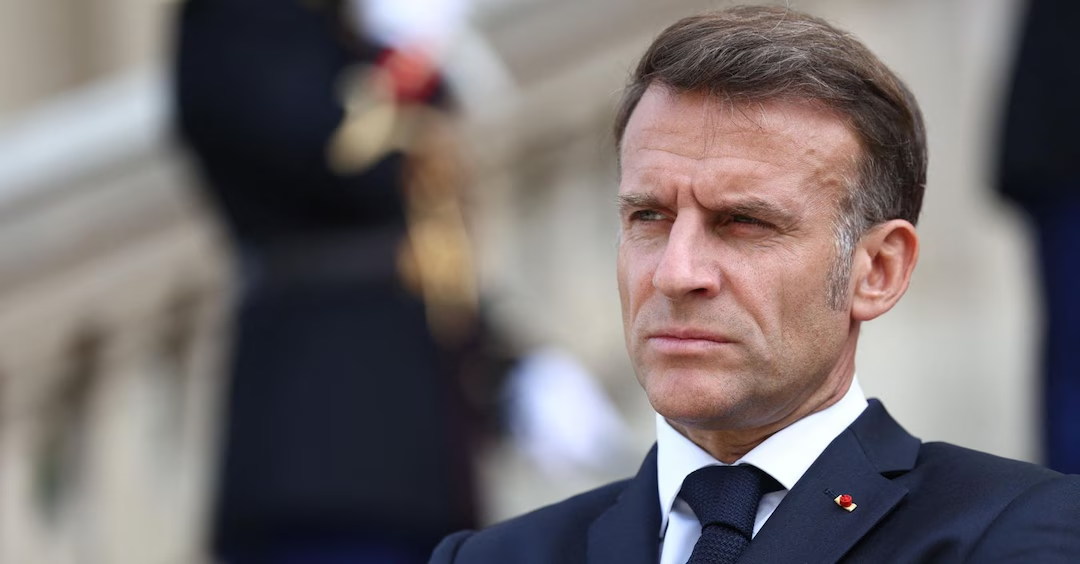
President Emmanuel Macron had championed the timeline publicly.
Why the Council Blocked It
After the vote, Prime Minister Sébastien Lecornu referred portions of the law to the Constitutional Council — a nine-member body that assesses whether legislation conforms to the constitution.
The council concluded that Article 1 of the law amounted to an infringement that was neither appropriate, necessary nor proportionate to the freedom of expression and communication belonging to under-15s.
Its objections did not stop there. The ruling also flagged problems with the requirement that users provide proof of age to access online services, finding that the law failed to establish the legal safeguards such a system would demand.
That second point is significant. It suggests the difficulty is not only the ban itself but the verification machinery any similar law would need.
Macron’s Immediate Response
The president did not accept the ruling as an ending.
His office said the government would move as quickly as possible to produce a new draft, and Macron directly instructed Lecornu to prepare legislation addressing every point the council raised.
Macron remains committed to seeing the reform in place by early 2027, according to his office.
The Objections That Predated the Ruling
Critics had been raising concerns well before the council intervened.
Their arguments centred on:
- Privacy risks created by requiring identity or age documentation to use ordinary websites
- The unreliability of existing age-verification technology
- The ease with which young people bypass such systems using VPNs, borrowed credentials or false details
- The speed at which the legislation was drafted and pushed through
The council’s finding on legal safeguards effectively validated part of that critique from a constitutional direction rather than a practical one.
What Australia’s Experience Suggests
France is not operating in a vacuum. Australia became the first country to implement a restriction of this kind, banning social media for under-16s last December.
The results have been mixed at best. It is widely acknowledged that substantial numbers of young Australians continue using the platforms despite the prohibition.
That outcome informs the central policy question facing every government pursuing this route: whether a ban that is widely circumvented achieves anything beyond signalling, and whether the verification infrastructure required to enforce it properly is worth the privacy cost to everyone else.
Europe Is Moving in the Same Direction
Restrictions on young people’s access have accelerated across the continent in recent months.
In May, European Commission President Ursula von der Leyen proposed a social media delay for children across the EU, indicating that formal legislation could follow within months.
In the United Kingdom, then Prime Minister Sir Keir Starmer announced in June that under-16s would be barred from social media beginning in January 2027. That announcement also included an optional midnight curfew for teenagers aged 16 and 17.
France’s setback therefore lands amid a broader wave rather than in isolation — and other governments will be reading the French ruling closely as they draft their own measures.
The Underlying Tension
The case exposes a conflict that does not resolve neatly.
On one side sits genuine evidence of harm: research linking heavy adolescent social media use to anxiety, disrupted sleep, body image problems and exposure to material children are not equipped to process. Parents and clinicians have pressed governments to act.
On the other sits the fact that minors also hold expression rights, that social platforms are now core infrastructure for communication and information, and that verifying everyone’s age means building systems capable of identifying everyone.
The Constitutional Council did not dispute that protecting children matters. It ruled that this particular instrument went further than the goal justified and lacked adequate protections around the data it would collect.
What Happens Next
The government now has to write a version that survives constitutional review — likely meaning narrower scope, clearer safeguards around verification data, and a stronger demonstration that less restrictive alternatives were considered.
Whether that can be achieved in time for the early 2027 target is uncertain. What is clear is that France intends to try again rather than abandon the policy.
Author
-
Lucienne Albrecht is Luxe Chronicle’s wealth and lifestyle editor, celebrated for her elegant perspective on finance, legacy, and global luxury culture. With a flair for blending sophistication with insight, she brings a distinctly feminine voice to the world of high society and wealth.