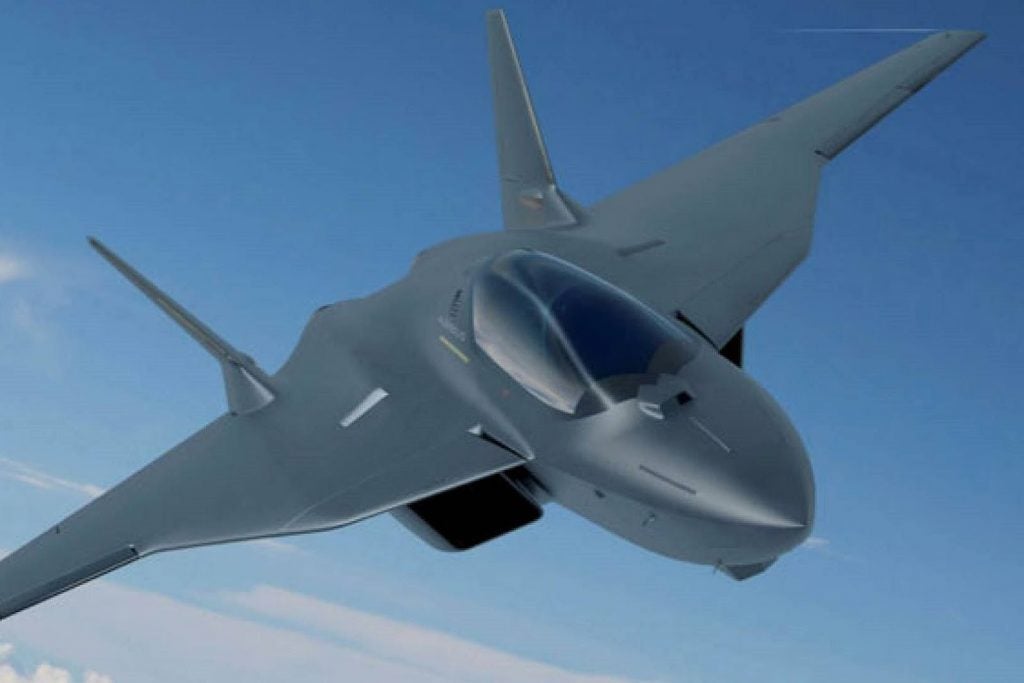
The FCAS fighter jet, the centerpiece of an ambitious $115 billion European defense effort, appears to have collapsed before it ever left the drawing board. Yet Germany and France are signaling they won’t walk away from each other entirely, instead pledging to salvage the technology side of the program and pursue what German officials describe as “realistic” projects going forward.
A Project Declared Dead
In a statement provided late Monday, German government officials confirmed earlier media reporting that leaders in Berlin and Paris have accepted the difficult reality that the long-troubled sixth-generation fighter must be scrapped. The reason, in short, was that the industrial partners simply could not align.
According to the officials, French President Emmanuel Macron and German Chancellor Friedrich Merz reached a shared conclusion that the companies tasked with building a joint fighter could not come to an agreement. (Note: the original source named Angela Merkel as chancellor; she left office in 2021, and Friedrich Merz has held the post since May 2025.) On that basis, the German side advised Macron not to pursue construction of a joint jet any further.
Salvaging the “Nervous System”
Even with the aircraft itself off the table, the two European powers intend to preserve what they called the “core” of the broader effort: the next-generation data-sharing “system of systems.”
German officials described this component as a kind of nervous system, the connective tissue that links aircraft, drones, and other elements into a single integrated whole. Whether other parts of the original vision, such as the envisioned drone wingmen or engine projects, can also be rescued remains unclear. Leaders are expected to hold discussions next month to sort that out.
The path forward will take shape at the Franco-German Ministerial Council meeting in Germany this July, where both defense ministries plan to draft an updated joint work plan for industrial cooperation, focused on a handful of realistic and relevant projects.
For now, some key players have stayed silent. The French Ministry of Defense referred questions to the president’s office, which has not commented publicly, and Spain, also a party to the FCAS project, has not addressed the program’s dissolution.
A History of Setbacks
The collapse caps years of difficulty for a program that launched with high hopes. Since its 2017 start, the roughly €100 billion ($115 billion) FCAS effort has run into repeated obstacles. Without naming names, the German statement appeared to point to long-standing friction between French firm Dassault and Airbus, centered on:
- Project leadership
- Distribution of workshare
- Conflicting visions for the future jet’s design
Reporting earlier this year described a last-ditch attempt by the manufacturers to converge on a common approach for the aircraft, formally known as the New Generation Fighter. Complicating matters, Airbus had backed an alternative two-fighter approach that would have left France to build its own jet separately, reflecting France’s need for an aircraft capable of carrying nuclear weapons.
A Wake-Up Call for Europe
The breakdown has reignited criticism over Europe’s fragmented approach to next-generation airpower. Belgium, which holds “observer” status on the FCAS program, had previously faulted European leaders for running two parallel future-fighter efforts at once: FCAS on one side, and the rival UK-Italy-Japan Global Combat Air Programme, known as GCAP, on the other. To critics, that duplication exposed a lack of European coordination.
After news of FCAS’s demise broke, Belgian defense minister Theo Francken said on social media that it should serve as a painful wake-up call, urging European capitals to collaborate and integrate more closely while setting aside narrow national interests.
For all the disappointment, the willingness of Berlin and Paris to keep working together on more modest, achievable goals suggests the partnership isn’t dead, even if this particular fighter is. The July meeting should offer the first real test of whether “realistic” cooperation can succeed where the grand ambition of FCAS did not.
Author