The Philippine senator ICC arrest standoff erupted into chaos this week when gunshots rang out inside the Senate building in Manila. The trigger: Senator Ronald dela Rosa, wanted by the International Criminal Court, publicly urged Filipinos to stop authorities from detaining him. What followed was a lockdown, troops in flak jackets surrounding the premises, and a country’s already strained politics pushed to a breaking point. Here’s a clear breakdown of what’s known so far.
Who Is Ronald dela Rosa?
Dela Rosa was the chief enforcer of former President Rodrigo Duterte’s war on drugs, serving as head of the Philippine National Police from 2016 to 2018.
That campaign left thousands of suspected drug dealers and small-time pushers dead and ultimately led to charges before the ICC. Rights groups argued that many of those killed were summarily executed.
A few key facts help explain his position:
- He is one of Duterte’s most loyal lieutenants. After retiring from the police, he was appointed head of the prisons bureau, then ran for senator and won.
- He was re-elected last year, placing third in the race for 12 Senate seats — a result that came just two months after Duterte was jailed at The Hague.
- He’s a colourful public figure, widely known by his nickname “Bato” (Tagalog for “rock”), and has even spawned a few internet memes.
The ICC warrant for his arrest was unsealed on Monday — the same day Dela Rosa returned to Senate sessions after months of unexplained absence. He has since sought protective custody from the Senate and asked the Supreme Court to block local authorities from enforcing the warrant.
Why the ICC Is Pursuing Him
The ICC case has a complicated jurisdictional backstory. Duterte withdrew the Philippines from the court while he was president, but the tribunal continued pursuing its crimes against humanity case anyway, arguing it had jurisdiction over deaths that occurred before the 2019 withdrawal.
The case also reaches further back, covering drug war deaths during Duterte’s years as mayor of Davao, the southern city where he first built his reputation as a tough-talking, populist crime-buster. Duterte himself was arrested and brought to The Hague in March 2025.
On Wednesday, the Supreme Court declined to issue a temporary restraining order against Dela Rosa’s arrest. Instead, it gave President Ferdinand Marcos’s government 72 hours to respond to the senator’s petition.
What Actually Happened Inside the Senate
The dramatic events unfolded on Wednesday evening, during a break in the Senate session.
Dela Rosa went live on Facebook, saying he had received information that authorities were coming to arrest him. He appealed directly to the public, urging Filipinos not to let another citizen be taken to The Hague like Duterte.
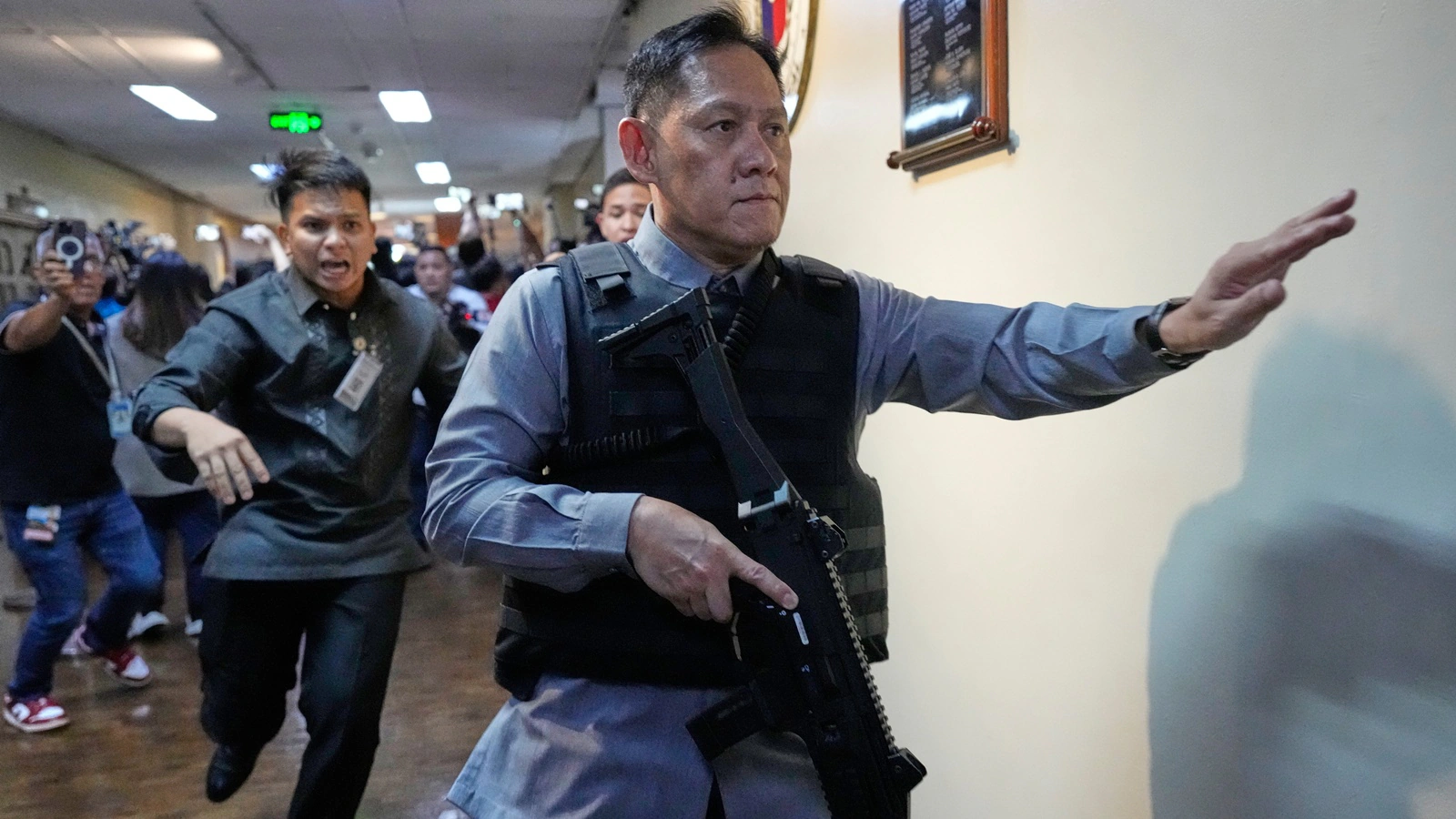
About an hour later, several gunshots rang out. Television reports said the sounds came from the building’s second floor.
The accounts of what triggered the gunfire conflict sharply:
- Senate Secretary Mark Llandro Mendoza told local media that the National Bureau of Investigation tried to enter the Senate and fired shots as they retreated.
- The head of the NBI — the Philippine equivalent of the FBI — said no agents had been deployed to the Senate at all.
The chaos played out live on television. Journalists and Senate staff ran for cover, phones pressed to their ears. Police and military personnel patrolled the grounds with rifles pointed at the ground, and the building’s steel doors were rolled down as it went into lockdown. Cameras caught Dela Rosa hurrying toward the lifts, while colleagues elsewhere in the building went live on Facebook to confirm they were safe.
Interior Secretary Jonvic Remulla then entered to meet with senators, stating he was not there to arrest Dela Rosa. He later emerged alongside Senate President Alan Peter Cayetano to confirm no one had been hurt — though they declined to say who fired the shots, citing the ongoing investigation.
President Marcos appealed for calm in a YouTube video, saying the government would get to the bottom of what happened and openly questioning whether the incident was part of a destabilisation effort. By the next morning, police said they had detained at least one man in connection with the shooting.
The Bigger Political Picture
The gunfire didn’t happen in a vacuum. It landed in the middle of a political atmosphere in Manila that has been steadily heating up.
On Monday, Vice-President Sara Duterte — President Marcos’s chief political rival — was impeached by the House of Representatives over alleged corruption and allegedly making threats against Marcos’s life. The articles of impeachment were sent to the Senate on the very day of the shooting.
That timing matters enormously, because the Senate will now act as an impeachment court with the power to convict or acquit her. A guilty verdict would effectively bar Sara Duterte from running for president in 2028.
How Dela Rosa Tipped the Balance
Dela Rosa’s reappearance in the Senate this week, after months out of public view, did more than dodge an arrest warrant — it shifted the chamber’s power balance.
His presence helped install Alan Peter Cayetano as Senate president. Cayetano is a longtime Duterte ally, having served as the elder Duterte’s foreign minister and vice-presidential running mate. With Dela Rosa and other Duterte-family allies now forming the majority in the 24-member Senate, senators aligned with Marcos have been pushed into the minority.
A Feud Between Two Dynasties
All of this feeds into the larger and increasingly bitter rivalry between the Duterte and Marcos families.
Bongbong Marcos and Sara Duterte won the 2022 elections together in a landslide, but their alliance collapsed publicly and dramatically as the two pursued sharply divergent agendas. The impeachment battle and the Senate power struggle are now the latest fronts in that feud.
The Bottom Line
The Philippine senator ICC arrest standoff has become a flashpoint where international justice, domestic power struggles, and a dynastic political war all collide. With an ICC warrant hanging over Dela Rosa, an impeachment trial looming for Sara Duterte, and conflicting accounts of who fired shots inside the Senate itself, the situation remains volatile. For now, the country waits — on the Supreme Court’s next move, on the shooting investigation, and on what the Marcos government does when its 72-hour window closes.
Author