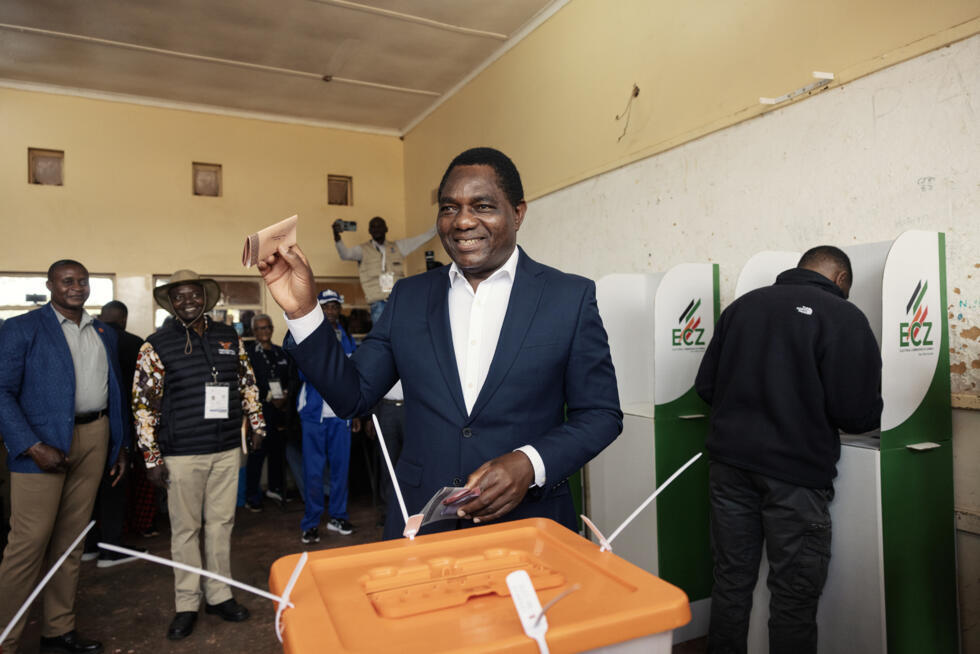
Zambia election Hichilema results were declared in the early hours of Tuesday, handing the incumbent a second five-year term and closing out a contest shadowed by fraud allegations, an armed raid and a temporary halt to vote counting.
The electoral commission reported that President Hakainde Hichilema took roughly 61.4 percent of valid ballots. His principal challenger, Brian Mundubile, finished with 38 percent.
Commission chairperson Mwangala Zaloumis formally declared Hichilema president-elect of the Republic of Zambia on Aug. 18.
A Long Road to a Second Term
The victory marked Hichilema’s seventh presidential campaign — a persistence rare in any political system. Having finally won power, he entered this race with the substantial advantages incumbency provides, and few analysts expected a different outcome.
For Mundubile, it was a first attempt at the presidency.
Once the result was announced, hundreds of supporters filled the streets of Lusaka in the red colours of the United Party for National Development, singing, dancing and setting off firecrackers.
Hichilema, 64, released a statement saying he felt truly humbled by the trust placed in his hands. He also addressed voters who had backed his opponents, telling them he hears them and will keep working on their behalf.
Mundubile offered no immediate response.
The Raid on Election Night
The campaign period had been comparatively calm, but the final days were not.
On the night of the vote, authorities arrested 11 people, including prominent opposition figures, during an operation that involved an exchange of gunfire. Mundubile was present when it took place.
The government described the raid as targeting militia activity, alleging those detained possessed military-grade weapons intended for an armed insurrection.
Mundubile’s National Reconciliation Party for Unity and Prosperity rejected that characterisation entirely. According to the party, the raid occurred at their leader’s residence, and a sitting member of parliament was wounded by gunfire during the operation.
Two accounts of the same event, with no independent adjudication between them, left a serious question hanging over the process before a single result was announced.
Counting Suspended
Complications continued the following day. The electoral commission halted vote counting for several hours, citing reports of violence directed at polling staff and the theft of ballot papers.
Mundubile said he had received information suggesting result forms from polling stations may have been altered, and called for an urgent independent investigation.
Hichilema’s camp dismissed the claim, accusing the opposition leader of lying.
What Observers Concluded
International monitors delivered a mixed verdict. The European Union mission found the election itself largely peaceful, while raising concerns about the conditions surrounding it.
Michael McNamara, who led the EU observation effort, said the wider electoral process unfolded in an environment that constrained fundamental freedoms. He pointed specifically to late changes in the law, resulting legal uncertainty, and campaign conditions that were not equal across competitors — factors he said distorted the playing field.
That assessment is a familiar one in contested African elections: voting day proceeds acceptably, but the months preceding it tilt the ground.
Approximately 5 million ballots were cast.
Zambia’s Democratic Track Record
The turbulence surrounding this vote sits against a genuinely notable national history. Zambia, home to 22 million people and Africa’s second-largest copper producer, has managed every change of president through the ballot box since multiparty politics returned in 1991.
That record includes transfers of power to opposition figures — Hichilema’s own 2021 victory among them. Few countries in the region can claim an equivalent run.
Preserving that reputation is part of what makes the current allegations consequential. A disputed count and an armed raid on opposition figures are the kinds of events that, if left unexamined, erode institutional trust built over decades.
What Comes Next
Several matters remain unresolved as Hichilema begins his second term:
- The fate of the 11 people arrested during the election-night raid
- Whether any independent inquiry examines the competing accounts of that operation
- Whether Mundubile mounts a formal legal challenge to the result
- How the government responds to the EU’s findings on campaign conditions
The copper sector will also demand attention. Zambia’s economy remains heavily dependent on the metal, and global price movements exert outsized influence on public finances and employment.
For now, the commission’s declaration stands and the celebrations in Lusaka have already happened. Whether the questions raised in the past week receive serious answers will shape how this election is remembered — as a rough patch in a stable democracy, or as the point where the pattern began to change.
Author
-
Lucienne Albrecht is Luxe Chronicle’s wealth and lifestyle editor, celebrated for her elegant perspective on finance, legacy, and global luxury culture. With a flair for blending sophistication with insight, she brings a distinctly feminine voice to the world of high society and wealth.