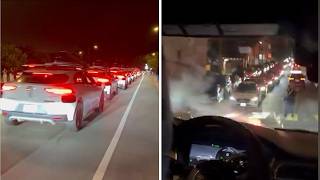
A breakdown in communication involving Waymo San Francisco traffic management turned what should have been a celebratory Fourth of July into a frustrating night of gridlock, as a miscommunication over road closures left one of the city’s most iconic parks choked with cars and stranded autonomous vehicles.
A Celebration Overshadowed by Chaos
In the hour before the highly anticipated fireworks display off the Golden Gate Bridge on Saturday, the foggy sky glowed a soft violet. Tens of thousands of spectators streamed through the Presidio, but the mood soured quickly as tangled roadways transformed the beloved park into something resembling a giant parking lot.
The trouble concentrated on Girard Road, a short connector linking a Highway 101 off-ramp to a roundabout within the Presidio. Traffic there ground to a complete halt around 8:30 p.m. Cars illegally lined the bicycle lane, and what began as a slow crawl soon froze entirely, with the backup spilling dangerously onto the highway itself.
The Roundabout That Broke Down
At the heart of the mess was the Lincoln Boulevard roundabout, which became hopelessly clogged with Waymo vehicles. Several of the self-driving cars found themselves trapped in the circle, unable to navigate through the constant flood of pedestrians heading toward the waterfront.
A park police officer was forced to step in, directing traffic away from the roundabout as the holiday crowd threw much of the Presidio into disarray. The situation only worsened as the night wore on. Once congestion finally eased in the early hours of Sunday, some of the Waymo vehicles had to be towed after their batteries drained completely.
When the Streets Stole the Show
For a large portion of the estimated 100,000 people who flocked to the northwestern corner of the city to mark America’s 250th anniversary, the real spectacle wasn’t overhead but underfoot. With the fireworks largely hidden behind a thick blanket of fog, the chaotic streets became the story instead.
The San Francisco Municipal Transportation Agency captured the scene bluntly, describing the situation on social media as unprecedented crowds and traffic in San Francisco in an early Sunday morning post. For many attendees, navigating the gridlock proved far more memorable than the muted light show.
How the Planning Fell Apart
The event itself had been in the works for weeks. Mayor Daniel Lurie announced the fireworks show on June 15, and over the following 20 days, residents learned of extensive road closures affecting multiple neighborhoods.
Among these was Halleck Street in the Presidio, a road connecting Crissy Field with the Main Post area, situated near the troublesome roundabout. In theory, coordination was in place. Waymo had worked with both the city and the Presidio Trust ahead of the holiday and even stationed an employee at the San Francisco Department of Emergency Management during the event.
Yet somewhere along the way, a critical piece of information slipped through the cracks.
The Missing Message
According to a Waymo spokesperson, the company was never informed about the Presidio road closures. This gap in communication directly hampered the company’s ability to respond to the mounting congestion, leaving its vehicles ill-prepared to handle the altered street layout.
The problem extended beyond Waymo, too. The public also struggled to find accurate information about the closures. Consider the following discrepancies:
- Neither the mayor’s office nor the SFMTA mentioned that Halleck Street would close in their official event notices.
- The Presidio Trust did announce the closure in a blog post updated on July 2, but this notice wasn’t widely echoed elsewhere.
This patchy dissemination of information meant that both a major technology partner and everyday attendees were left in the dark about key details.
Officials Respond to the Fallout
The mayor’s office had taken the lead in organizing the event, and in the aftermath, spokesperson Charles Lutvak addressed the disruptions. Rather than directly answering questions about the city’s preparedness or its coordination with Waymo, he emphasized that public safety remained the top priority.
Lutvak thanked first responders, transit operators, and others involved in staging the celebration. He acknowledged the difficulties, noting that with more than 100,000 people in the area, some individuals faced delays getting home. He added that the city would hold conversations with public and private partners to ensure a smoother experience in the future.
Lessons From the Presidio Trust
The Presidio Trust offered its own perspective on the night’s challenges. Spokesperson Lisa Petrie explained that the park had set up designated drop-off zones for Waymo and other ride-hailing services in an effort to manage the surge of traffic.
Looking ahead, Petrie signaled a commitment to improvement. She stated that the Trust would continue evaluating the best operational practices for autonomous vehicle companies during large-scale events, with the goal of keeping traffic flow as safe and efficient as possible.
Moving Forward Together
In response to the widespread disruptions, multiple parties have pledged to reassess their approach. The mayor’s office, the Presidio Trust, and Waymo have all begun evaluating how to better prepare for the next major event in San Francisco.
This collaborative reflection suggests that while the July 4 celebration exposed real weaknesses in coordination, there is a shared willingness to learn from the experience and prevent a repeat.
A Silver Lining for Local Business
Despite the traffic woes, the massive turnout did bring some benefits to the city. On Sunday, Mayor Lurie visited the Marina District to highlight small businesses that had profited from the previous day’s crowds.
In a video, he spoke with a representative from Lobalita, a newly opened establishment on Chestnut Street occupying the former Tipsy Pig location. Reflecting on the energy of the weekend, Lurie remarked that he’d been told things had been wild in the area, a nod to the intensity of the crowds that, for all the chaos, delivered a welcome boost to local shops and eateries.
Final Thoughts
The Fourth of July gridlock in San Francisco serves as a revealing case study in the complexities of hosting large-scale events in the age of autonomous vehicles. A single lapse in communication, the failure to inform Waymo about road closures, rippled outward into hours of congestion, stranded cars, and frustrated attendees.
While the fog may have stolen the fireworks from view, the streets below told a story of their own. As the city, the Presidio Trust, and Waymo regroup to refine their planning, the hope is that future celebrations will run more smoothly, ensuring that the spectacle remains in the sky rather than snarled on the ground.
Author